
Expect roughly $35,000 to $39,400 on average for a full backyard basketball court, with most homeowners landing between $12,400 and $60,000. The concrete slab alone is typically the largest line item, taking about 40% to 50% of the project budget.
That range sounds broad because basketball court cost depends less on the hoop and paint than on what happens below the playing surface. In Atlanta, red clay, slopes, drainage, access for excavation equipment, and the quality of the base can move a quote sharply. A contractor who skips those details may offer a cheap number, but the court can pay you back with cracks, standing water, and premature resurfacing.
What a Basketball Court Really Costs in 2026
An Atlanta homeowner can collect three quotes for the same backyard court and see differences of tens of thousands of dollars. That doesn't automatically mean one contractor is overcharging. One bid may include excavation, drainage, a reinforced slab, acrylic surfacing, lighting, fencing, and professional striping, while another may cover only a basic pad and hoop footing.
For a full-size backyard basketball court, recent estimates put the average installation near $35,000, while another estimate gives an average of $39,400 and a homeowner range of $12,400 to $60,000. National estimates commonly fall between $30,000 and $60,000, with a typical regulation court around $46,650 and high-end projects reaching $150,000, depending on grading, surfacing, hoops, lighting, and other site conditions. These figures come from HomeAdvisor's basketball court cost guide.
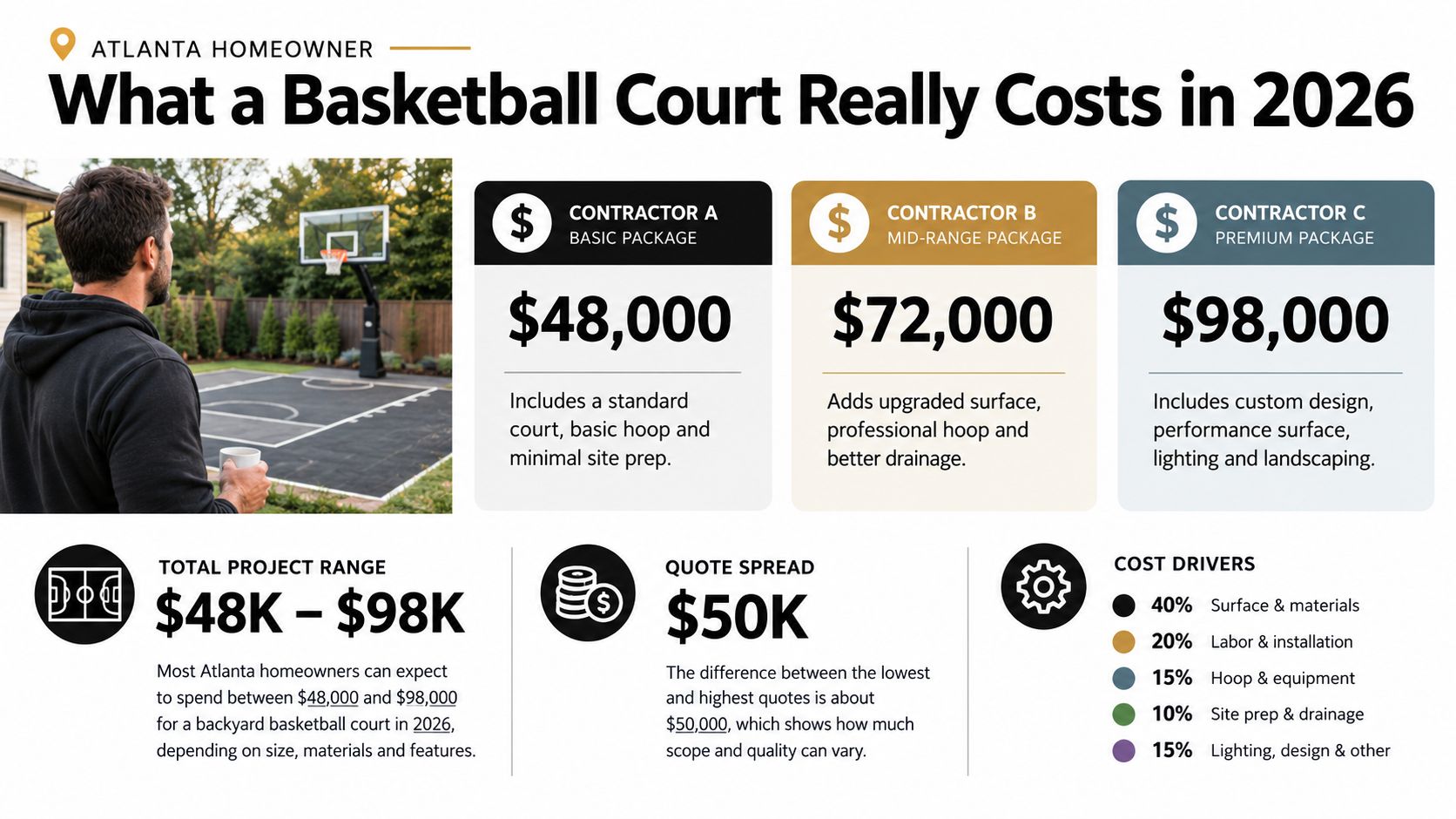
The headline number matters, but it doesn't tell you whether the contractor allowed enough money for the ground beneath the court. Two projects can have the same final price and completely different specifications. One might have proper compaction, reinforcement, drainage, and a durable sport surface. The other might spend more on decorative upgrades while underbuilding the foundation.
What a quote should reveal
Before comparing totals, look for separate allowances for:
- Site work: Clearing, excavation, grading, hauling, and drainage.
- Base preparation: Compacted aggregate or other approved support beneath the slab.
- Concrete work: Forms, reinforcement, concrete strength, finishing, and joints.
- Playing surface: Bare concrete, acrylic coating, asphalt, or modular tile.
- Extras: Hoops, lighting, fencing, striping, and electrical work.
A quote that hides all of those items under “court installation” makes comparison difficult. I'd rather see a higher, itemized number than a bargain proposal that leaves out drainage or base preparation. The rest of the budget becomes much easier to judge once you know which line items are carrying the project.
How Court Size and Square Footage Drive the Price
Court size is the first calculation I make because contractors buy and install materials by area. A compact shooting pad uses far less concrete, surface coating, labor, and edge work than a full-size layout. The correct way to sanity-check a proposal is to multiply the court footprint by an installed cost-per-square-foot range, then add site conditions and extras separately.
Outdoor courts are commonly estimated at $4 to $16 per square foot installed. Indoor courts are often estimated at $3.50 to $19 per square foot, because indoor construction brings different flooring, moisture, access, and building requirements. Those benchmarks are summarized in Angi's basketball court cost breakdown.
Rule of thumb: Start with the court's square footage multiplied by the applicable installed range. Then ask what the quote includes for earthwork, drainage, hoops, lighting, fencing, and surfacing.
A 30-foot by 30-foot half-court is commonly estimated at $3,600 to $14,400. That footprint works for shooting, free throws, and casual family play, but it won't feel like a full game court. A regulation NBA half-court can run about $9,400 to $37,600, showing how the footprint and finish level change the total.
| Court Size | Approximate Dimensions | Typical Installed Cost |
|---|---|---|
| Compact half-court | 30 feet by 30 feet | $3,600 to $14,400 |
| Regulation NBA half-court | Regulation half-court footprint | $9,400 to $37,600 |
| Full-size backyard court | Full-size layout | About $35,000 to $60,000 for many projects |
The table is a planning tool, not a promise. A 30-by-30 pad on a level, accessible yard can price very differently from the same pad on a slope that needs substantial excavation and drainage. Surface selection matters too. Bare concrete may produce a lower initial quote, while acrylic coatings and modular tiles add finish cost but can improve appearance, traction, and play comfort.
Choose the footprint before the features
My recommendation is simple. Mark the proposed court on the property before selecting colors, logos, or premium accessories. Include room around the painted lines for safe movement, and check how the court affects fences, trees, retaining walls, driveways, and drainage paths.
If the budget is tight, reduce the footprint before cutting the slab specification. A smaller, properly built court is a better investment than a larger court with weak subgrade work or insufficient reinforcement.
Site Prep and the Concrete Slab Where the Money Goes
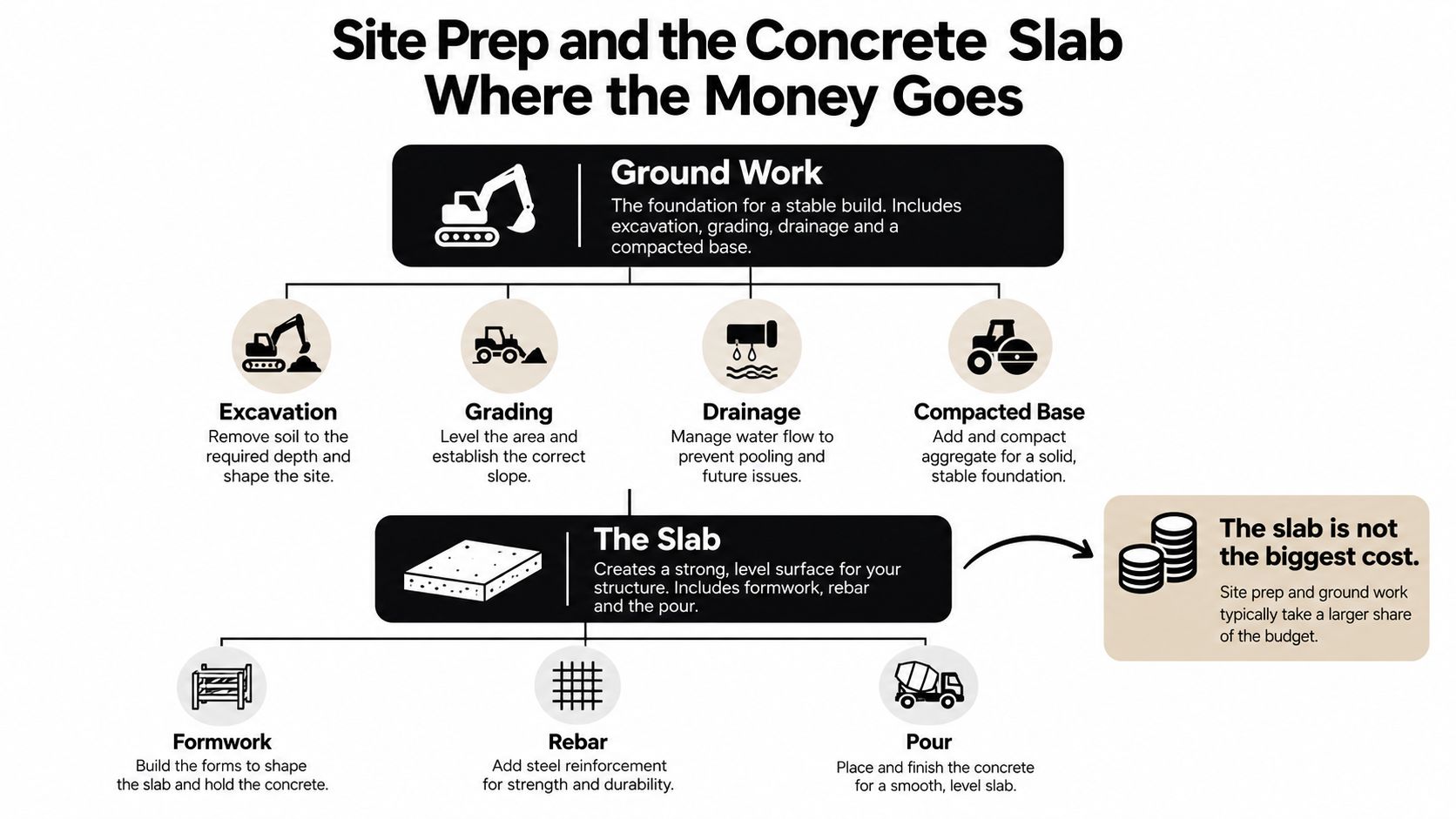
The ground usually causes more pricing surprises than the playing surface. A contractor has to create a stable, drainable platform before pouring concrete, and Atlanta's red clay can require more correction than a level yard with clean, workable soil.
The work sequence matters
First comes clearing and excavation. The crew removes vegetation, unsuitable soil, debris, and any material that won't support the court consistently. Grading then establishes the elevations and directs water away from the playing area. Compaction gives the soil enough stability to support the base rather than allowing settlement beneath the slab.
Base preparation follows. The crew places and compacts the supporting aggregate or specified subbase, correcting soft areas and preparing the platform for forms and reinforcement. Only after those steps are complete should the slab be poured.
Independent pricing guidance places excavation and grading at $3,000 to $15,000, base preparation at $2,000 to $8,000, and the slab and surface package at $5,000 to $25,000. The same guidance says excavation, grading, compaction, and base work can represent roughly 15% to 25% of the total, while concrete and asphalt often represent about 40% to 50%. See the sports court cost breakdown from Builds and Buys.
Where Atlanta sites get expensive
A sloped lot may need additional cut and fill, a retaining solution, or more extensive drainage. Poor access can force smaller equipment, longer hauling routes, or manual work. Wet areas and weak soil can require deeper or more carefully compacted base material.
Don't accept a quote that only says “prepare site” without describing the work. Ask how much soil will be removed, what material will support the slab, how water will leave the court, and what happens if the crew finds unsuitable soil. For an overview of residential poured concrete work, review Atlanta Concrete Solutions' residential poured concrete services.
This construction video gives homeowners a useful visual reference for how preparation and concrete work fit together.
The cheapest visible surface can't rescue a court built on unstable ground. If the quote has a small site-preparation allowance and a large decorative-surface allowance, I'd question the priorities before signing.
Choosing a Slab Spec and Surface That Lasts
The slab specification is where homeowners should resist false savings. A modular sports-court baseline commonly uses a 4-inch concrete slab, 3,000 PSI concrete, and #4 rebar. National residential slab pricing for similar concrete work is commonly cited at $4 to $10 per square foot for the slab alone, according to VersaCourt's backyard basketball court cost guide.
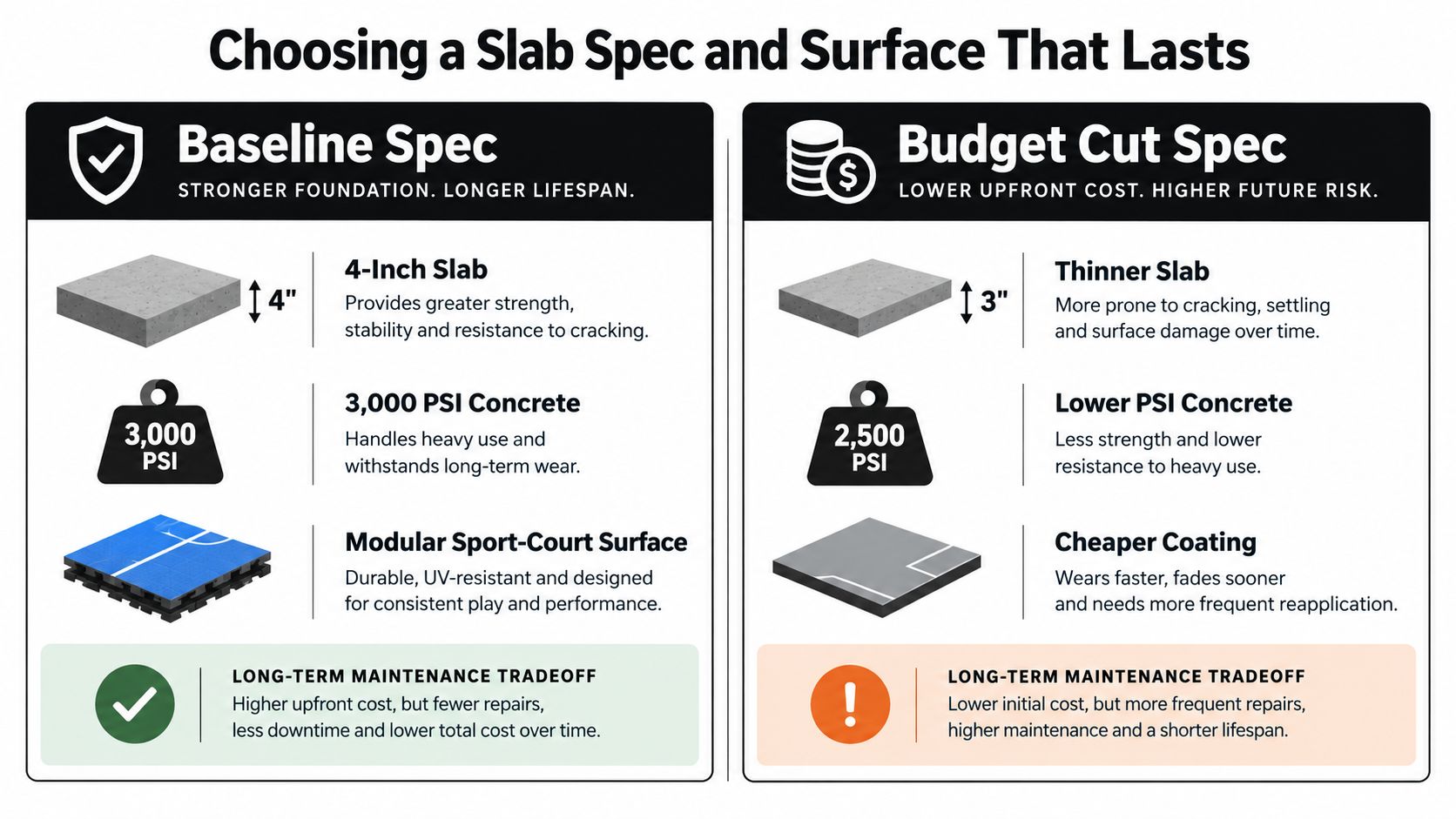
A thicker or more heavily reinforced slab may make sense for difficult soil, heavier use, or unusual loading, but the contractor should explain the reason. The important point is that thickness, reinforcement, slope, joints, and moisture control work together. Cutting one of those elements can raise cracking risk and create expensive repair or resurfacing work later.
Compare the surface choices honestly
Bare concrete is durable and straightforward, but it can feel hard underfoot and offers limited visual customization. It also makes every finishing flaw visible.
Acrylic coatings add color, game lines, and a more finished playing surface. They need a sound, properly prepared slab. Coating over cracks or moisture problems only hides trouble temporarily. For broader guidance on preparing concrete before an epoxy-style finish, these epoxy floor tips from Concrete Resurfacing Products provide useful background, although a basketball court coating still needs a system designed for its exposure and use.
Modular tiles can add drainage, visual customization, and a replaceable surface layer. They still need a hard, stable, level base. Tiles aren't a substitute for proper concrete construction.
Asphalt can serve a practical budget, but it has different maintenance and heat behavior than concrete. I'd choose it only after comparing the complete life-cycle scope, not just the initial paving number.
Hand every bidder the same checklist
Ask each contractor to identify the slab thickness, concrete strength, reinforcement, joint layout, base preparation, drainage plan, surface system, and warranty terms. Use Atlanta Concrete Solutions' residential decorative concrete information as one reference point when comparing finish options and concrete applications.
My recommendation is firm: build the slab correctly first. If you need to phase the project, delay decorative color or premium tile before you reduce the structural specification.
Hoops, Lighting, Fencing, and Striping Add-On Costs
A slab becomes a usable court through its accessories. These extras can improve play dramatically, but they should be ranked instead of added impulsively.
Spend first on the hoop and striping
The hoop affects every possession. A fixed in-ground system with a stable pole and quality backboard gives a better experience than a portable unit that shifts during play. If serious practice matters, buy the hoop you want during construction, because the footing and anchor layout should be coordinated before the pour.
Professional striping is also a day-one item. Lines should be measured, straight, durable, and compatible with the chosen surface. Adding pickleball or other sport markings later is possible, but decide early if conduit, edge clearances, or surface colors will affect the layout.
Add lighting only when the site is ready
Lighting earns its place when the family will play after dark. It requires more than fixtures. The quote should address poles, foundations, wiring, controls, glare, and the effect on neighbors. Plan conduit before the slab and coordinate electrical work with the court layout, even if the fixtures come later.
Fencing pays off when the court sits near a road, slope, neighbor's property, or vulnerable landscaping. It keeps balls contained and can make the space safer, but the perimeter, gate placement, height, and wind exposure drive the design. Homeowners comparing containment options can use this guide to affordable chain link fencing from Connecticut Fence Works as a general material reference.
My priority order is structural hoop footing, accurate striping, planned electrical access, then fencing and lights based on how the court will be used. Premium logos and decorative upgrades can wait without forcing you to rebuild the slab.
Atlanta Pricing Factors and Regional Cost Modifiers
Atlanta homeowners should use local concrete pricing as a reality check, but they shouldn't mistake driveway pricing for a complete court quote. A standard concrete driveway in Atlanta is commonly priced at $8 to $14 per square foot in 2026, with many ordinary residential projects falling between $3,000 and $8,000 before unusual excavation, drainage, demolition, or decorative work. That benchmark comes from R&W Lawn's Atlanta concrete driveway cost guide.
A narrower local benchmark puts basic concrete driveways at $4 to $8 per square foot, with a typical two-car driveway of roughly 600 to 800 square feet totaling about $3,000 to $7,000. Johns Creek Concrete's Atlanta driveway guide explains that size directly affects replacement cost.
Those numbers help homeowners understand the local concrete market, but a court is more demanding than a driveway. Contractors must manage a large, visibly flat play area, precise slope, reinforcement, surface finish, line layout, and often more extensive earthwork. A driveway can also use existing grades and access more easily than a backyard court.
Conditions that move an Atlanta quote
- Clay soil: Georgia red clay may need excavation, replacement, and careful compaction when it holds water or shifts.
- Rain drainage: The court needs a controlled slope and discharge path, not just a level-looking surface.
- Restricted access: Fences, houses, retaining walls, and narrow side yards can increase equipment and hauling labor.
- Permitting: Impervious-surface rules and permit expectations vary by city and county, so the proposal should state who handles approvals.
- Concrete scope: A high-quality slab, reinforcement, joints, finishing, and curing protection cost more than a basic flat pour.
For a local overview of concrete installation and applications, see Atlanta Concrete Solutions' Atlanta concrete services. Ask bidders to separate local site conditions from optional upgrades. That distinction tells you whether a higher price reflects necessary construction or a nicer finish.
Budgeting Smart and Protecting Your Court Investment
I'd build a court in phases, but I wouldn't phase the foundation. Spend the initial budget on clearing, grading, drainage, compaction, base preparation, the specified slab, reinforcement, and properly planned hoop footings. Add premium coatings, modular tile, fencing, extra markings, or lighting after the structure is sound.
A concrete driveway is often expected to last 30 to 40 years when properly installed, although base preparation, reinforcement, climate, installation quality, and maintenance affect longevity. Standard residential slabs are commonly 4 inches thick for passenger vehicles and light SUVs, while 5 to 6 inches is recommended when heavier vehicles such as delivery trucks, RVs, or boats may use the driveway, according to SlabCalc's Atlanta driveway guidance. A basketball court has different loading, but the same principle applies: the slab's performance starts with its specification and support.
Questions to put in the contract
- What is included in site preparation? Require excavation, grading, hauling, compaction, and drainage language.
- What is the slab specification? Confirm thickness, concrete strength, reinforcement, joints, and finish.
- What does the surface price include? Separate bare concrete, acrylic, tile, striping, and future maintenance.
- Who handles approvals? State responsibility for permits and inspections where they apply.
- What happens after unexpected soil conditions? Require written change orders before extra work starts.
- What is excluded? Check electrical service, lighting, fencing, landscaping repair, and debris removal.
Get multiple itemized quotes, not just multiple totals. Atlanta Concrete Solutions offers free quotes, which makes comparison shopping cost nothing, but the value comes from comparing scopes line by line rather than choosing the lowest number.
A well-built court should give your household years of use, and the slab deserves the same care you'd give any major concrete improvement. Measure the available footprint, identify drainage and access constraints, choose your structural specification, then request proposals that show every major line item before you commit.
Atlanta Concrete Solutions can evaluate the Atlanta site conditions, prepare the concrete base, install poured slabs, and discuss resurfacing or decorative finish options for a basketball court project. Visit Atlanta Concrete Solutions to request a quote and compare your court scope with a contractor who works on Atlanta-area concrete projects.