
You pull into the driveway after a hard Atlanta rain and notice three different problems at once: a crack widening near the garage, water sitting beside the walkway, and not enough room for a second vehicle. It may look like one cosmetic project, but those symptoms point to very different remedies. A sealed surface won't stabilize a moving slab, and a beautiful overlay won't solve water flowing toward the house.
The right driveway repair ideas start with diagnosis. Minor cracks may need cleaning and sealing. A sound but stained surface may suit an overlay, while settlement, rocking slabs, or hidden base failure can justify replacement. Functional upgrades, including drainage work, a new apron, widening, and better transitions, often make more sense when completed alongside concrete work.
Atlanta homeowners also need to plan around intense rain, runoff, municipal apron requirements, curing access, and ongoing maintenance. The following options move from structural triage and surface renewal to drainage, access, appearance, and long-term protection, with practical checks for Atlanta, Marietta, Alpharetta, Johns Creek, and Duluth properties.
1. Concrete Driveway Replacement Atlanta
Replacement is the clearest answer when concrete has widespread movement, deep breaks, repeated patch failures, or a base that no longer supports the slab. The work should include removal, excavation where needed, base preparation, reinforcement decisions, form setting, drainage review, and a new pour. Patching a visibly failing surface without correcting the support beneath it only postpones the same decision.
Concrete repair commonly costs about $3 to $25 per square foot, while replacement can range from roughly $6 to $20 per square foot, depending on severity and scope, according to published driveway repair and replacement guidance. Atlanta estimates vary substantially. One 2026 Atlanta concrete cost guide places standard concrete at about $8 to $14 per square foot, before unusual excavation, drainage, demolition, or decorative work.
Practical rule: Don't approve replacement based on surface appearance alone. Ask whether the slab is moving, whether water is undermining the base, and whether the proposed scope includes those causes.
A new driveway also creates an opportunity to improve the finish. An Atlanta home moving from cracked asphalt might choose a polished concrete look, a Marietta owner could select stamped concrete, and a Johns Creek commercial property may need a load-rated installation. Plan during favorable curing weather, confirm the required slope, and request itemized quotes that separate demolition, base work, drainage, finishes, and access limitations. Ask Atlanta Concrete Solutions about free quotes and available financing before comparing bids.
2. Concrete Driveway Crack Repair and Sealing
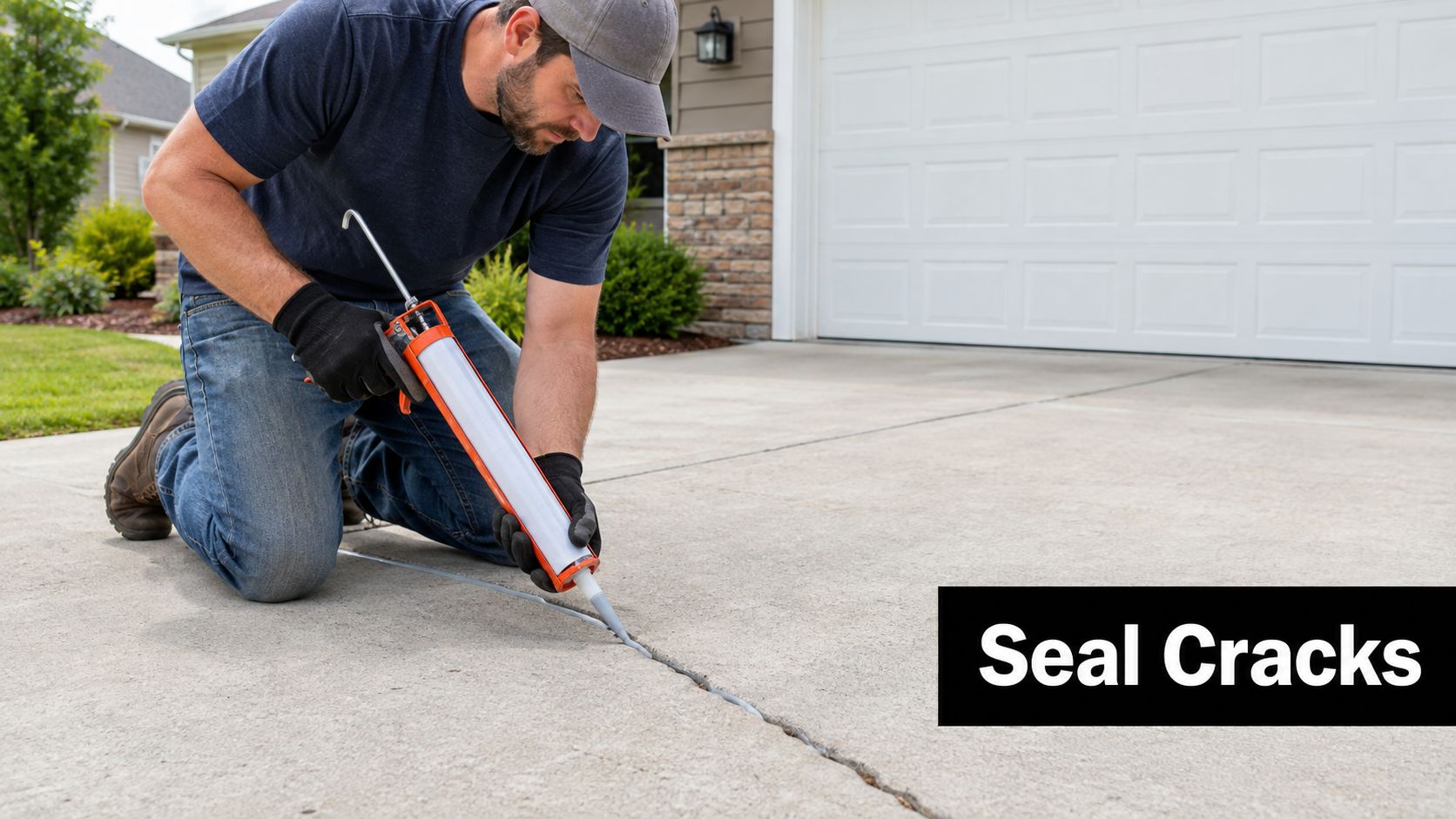
Small, stable cracks are repair candidates, especially when the surrounding concrete remains solid and level. The process starts with removing dirt, plant growth, loose concrete, and old filler. A compatible crack filler or sealant can then close the opening and reduce water entry.
The repair fails when the contractor treats a moving crack as a surface defect. Cracks that continue across a slab, rise at one side, or accompany rocking, settlement, or drainage problems need a broader inspection. Photographing and marking each crack gives you a simple record of whether the pattern is changing.
For an Alpharetta homeowner, fall sealing may be a sensible preventive step before the wet season. A Duluth property owner might combine crack work with a broader maintenance review, while an Atlanta commercial parking area may schedule recurring inspections instead of waiting for visible deterioration. Cleaning matters more than rushing the application. Sealant won't bond reliably to a dusty, damp opening.
Use residential concrete and masonry repair services when you need help distinguishing cosmetic cracking from structural movement. A contractor should explain whether the repair is intended to preserve the slab, prepare it for resurfacing, or serve as a temporary measure before replacement.
3. Concrete Driveway Resurfacing and Overlay
An overlay can refresh a driveway when the existing concrete has a stable base, limited movement, and enough remaining strength to support a bonded surface. Preparation determines the result. Contractors may clean, profile, repair defects, address weak edges, and verify drainage before placing the new layer.
The attraction is straightforward. You avoid full demolition, gain a new appearance, and may reduce disruption compared with rebuilding the entire driveway. A Johns Creek homeowner with sound concrete but staining and shallow surface wear could use a decorative overlay, while a Marietta property might add a texture that improves the entry without changing the entire base.
Check the transitions first
An overlay changes finished height. That affects garage thresholds, sidewalks, steps, gates, drainage paths, and the street connection. If the existing slab has settlement or active cracking, the new layer may reflect those defects. Water problems also remain water problems unless the contractor corrects slope or drainage before applying the overlay.
A practical assessment should answer three questions:
- Is the base stable? A slab that rocks or has separated sections is a poor overlay candidate.
- Can the new height work? Confirm garage and walkway transitions before approving the finish.
- Will water move correctly? Review low areas, edges, and downspout discharge before surface renewal.
For a before-and-after comparison, visualize the same driveway from the street, garage, and side edge. The finished color may look excellent from the curb, but a raised garage lip or trapped runoff can make the project perform poorly.
4. Stamped Concrete Driveway Installation
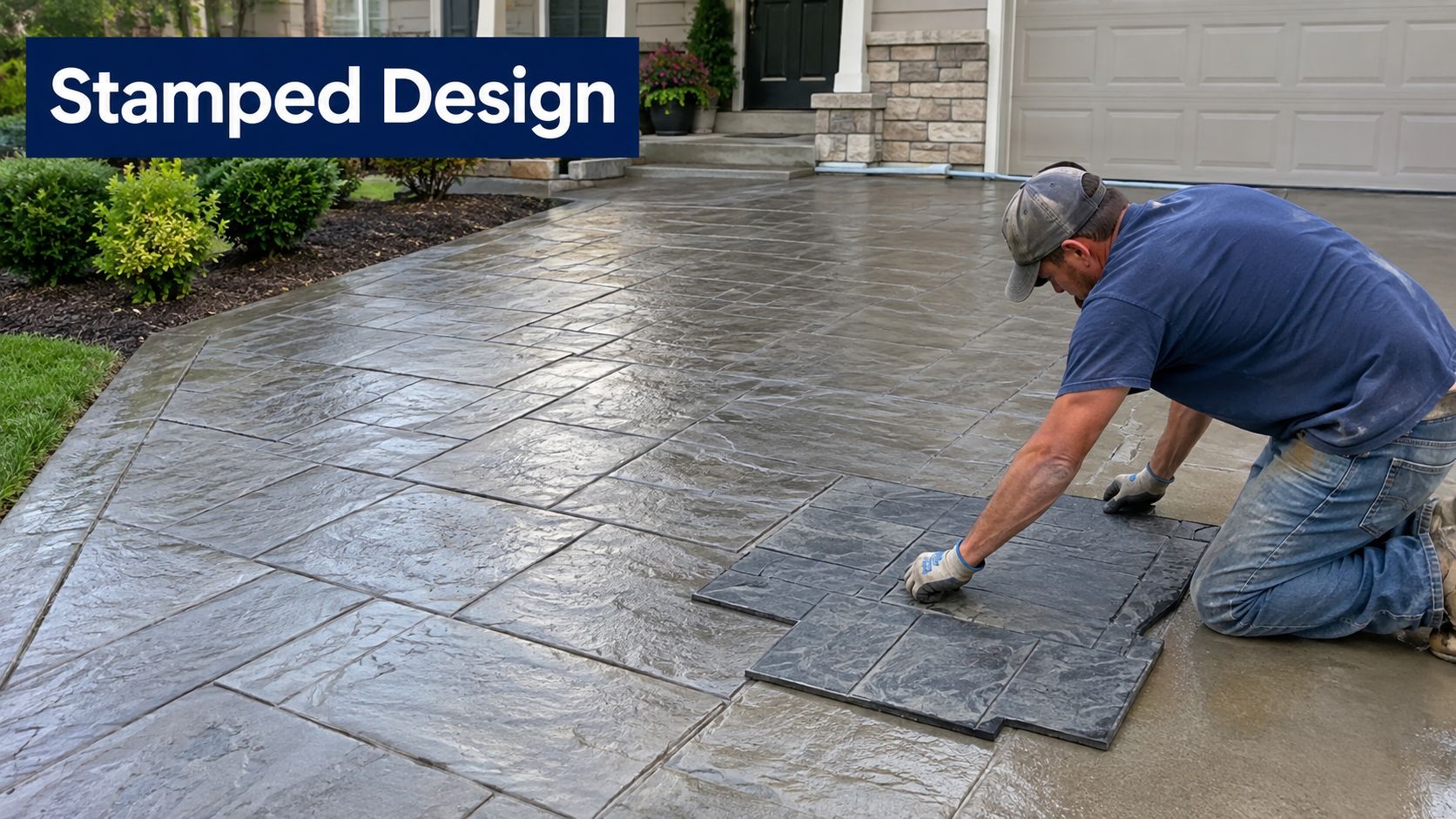
Stamped concrete adds pattern, texture, and color during the finishing process. It can resemble slate, brick, stone, or wood while keeping a continuous concrete surface. That makes it useful when curb appeal matters but individual pavers, shifting joints, or extensive weed growth aren't desirable.
Pattern selection should follow the architecture rather than compete with it. A slate pattern may suit an Atlanta contemporary home, a brick-look entry can work at a Duluth residence, and an ashlar field with a herringbone border may fit a higher-end Marietta property. Color samples should be reviewed outdoors because Atlanta sunlight and wet conditions can change how the finish reads.
Stamped concrete isn't maintenance-free. Texture can collect dirt, and a poorly selected sealer may become slick when wet or show uneven wear. Ask how the contractor will manage control joints, edges, color variation, and future repairs. A small test area can reveal whether the pattern scale and color work with the house.
Design decision: Choose the border and field pattern together. A restrained border often gives a driveway a finished appearance without making the entire surface visually busy.
Sealing protects the look and helps preserve the finish, but the maintenance plan should be agreed on before installation. Review stamped concrete driveway services for design consultation and installation planning.
5. Polished Concrete Driveway Finishes
Polished concrete creates a smooth, refined surface through staged grinding and polishing. It suits contemporary Atlanta homes where the driveway is part of the exterior design rather than a purely utilitarian strip. Colored stains, exposed aggregate, and contrasting textured borders can make the result feel custom without using separate paving units.
The finish needs a careful wet-weather strategy. A highly smooth surface can shed water quickly, but rapid runoff still needs somewhere to go. A non-slip sealer, textured perimeter, or carefully designed transition can improve confidence near the garage and walkways. The contractor should review slope, drainage, tire paths, and pedestrian routes before choosing the final sheen.
A polished center with textured borders can balance appearance and grip. That combination works well for a Johns Creek property with a contemporary façade, while a Marietta homeowner may prefer a quieter aggregate exposure that hides everyday dust. Maintenance is easier when the surface is cleaned with suitable products and protected with a compatible sealer.
See the finish in context
Don't judge a sample only under showroom lighting. Compare it beside the home's siding, roof, masonry, landscaping, and garage door. A before-and-after visualization should show both a dry sunny view and the wet appearance after rain, because gloss, color depth, and texture change with moisture.
Use polished concrete driveway services to discuss grinding, aggregate exposure, staining, borders, and protective treatment. A polished finish can look exceptional, but it won't compensate for a failed slab or unresolved runoff.
6. Concrete Driveway Sealing and Protective Coating
Sealing is one of the simplest ways to protect a serviceable driveway from moisture, staining, weather exposure, and chemical contamination. It works best after proper cleaning and after cracks, spalls, and damaged edges receive suitable repairs. A coating can't stabilize a settling slab or hide an active drainage defect for long.
Atlanta's rain makes water management central to the decision. Before sealing, inspect where runoff travels, whether the surface dries evenly, and whether soil or mulch remains against the edges. A Duluth homeowner might prioritize stain protection near a garage, while an Alpharetta commercial property may need a scheduled appearance and maintenance program.
Concrete is often resealed every 4 to 5 years, while asphalt is commonly resealed every 2 to 3 years, according to driveway cost and maintenance guidance. Those are planning intervals, not guarantees. Traffic, exposure, product quality, surface preparation, and standing water all affect performance.
Avoid coating the wrong surface
The contractor should identify the existing sealer, remove contamination, and select a compatible product. Epoxy-style protection may help in areas exposed to staining, but appearance and slip resistance need equal attention. Ask how long the surface must remain unused, how the product behaves in wet weather, and what future reapplication involves.
The best before-and-after comparison shows not only darker color or stronger gloss, but also cleaner edges, reduced staining, and a surface that remains usable without creating a slippery walking route.
7. Driveway Widening and Extension
Widening solves a parking and circulation problem rather than a crack problem. It can add space for another vehicle, improve the approach to a garage addition, or create a safer turning path for a growing household. In Marietta, a garage expansion may require a wider approach. In Johns Creek, a family may need multi-car parking, while an Atlanta property may benefit from a side extension rather than a full redesign.
The new section must connect visually and structurally with the old one. Matching color exactly can be difficult because existing concrete weathers, so a deliberate border, contrasting band, or larger planned finish may look better than an attempted invisible patch. Matching slope, joint placement, thickness, and drainage remains more important than chasing identical color.
Before design work begins, review property lines, setbacks, HOA rules, landscaping, utility access, and municipal requirements. An extension that pushes water toward a neighbor or blocks a swale creates a new problem. The contractor should also explain how the joint between old and new concrete will be managed and maintained.
A published Atlanta estimate places a typical two-car driveway of 600 to 800 square feet around $3,000 to $7,000, while another local guide gives a broader standard range of $4 to $8 per square foot. Compare Atlanta driveway cost guidance with your actual site conditions, since demolition, drainage, access, and reinforcement can change the scope.
8. Driveway Drainage Improvement and Repair
Standing water is a diagnosis, not a finish problem. Watch the driveway during or immediately after rain. Note whether water pools beside the garage, crosses the walking route, collects at the street apron, or runs along an edge and erodes the supporting soil.
Solutions may include correcting slope, installing a French drain, adding a catch basin, improving downspout discharge, rebuilding a low section, or replacing concrete with a water-managed layout. A driveway can look level and still move water poorly, especially where paving meets a garage, retaining wall, sidewalk, or public road.
For Atlanta properties, drainage review should happen before resurfacing or decorative work. An overlay over a wet, poorly supported surface preserves the cause of failure. A new driveway with better collection and discharge can cost more at the start, but the alternative may be repeated repairs, stained surfaces, undermined edges, and water near the structure.
Drainage test: Follow the water path, not just the stain. The correct fix often begins beyond the visible puddle.
A Duluth property may need slope re-establishment, an Alpharetta replacement may incorporate drainage into the new layout, and an Atlanta home with recurring pooling may need a French drain or catch basin. Review AI front yard design ideas for visual planning, then have a qualified contractor verify grades, discharge, and local requirements in the field.
9. Concrete Driveway Apron Installation and Repair
The apron is the transition where a private driveway meets the street or another public area. It carries vehicles across a high-use edge and must connect the driveway's slope, sidewalk, curb, and roadway without creating a lip or drainage conflict. A damaged apron can also undermine an otherwise sound driveway project.
Atlanta-area municipalities may apply specific requirements for location, dimensions, slope, thickness, finish, and approvals. Confirm current rules with the responsible municipality before demolition. Requirements can differ between Atlanta, Marietta, Johns Creek, Duluth, and surrounding jurisdictions, so a contractor's local familiarity matters.
A proper apron assessment considers more than the visible crack. Check whether the section has settled, whether water flows toward the street as intended, whether the curb connection is intact, and whether reinforcement is appropriate for the expected loads. During replacement, coordinate the apron with the driveway grade rather than treating it as a separate cosmetic patch.
Protect the transition
Allow adequate curing before opening the area to traffic. The Federal Highway Administration's guidance for full-depth concrete repairs calls for opening traffic after patches reach at least 13.8 MPa, or 2,000 psi, compressive strength, and 2.1 MPa flexural strength, with opening windows ranging from 4 to 6 hours to 24 to 72 hours depending on the mix and curing method. See the Federal Highway Administration concrete repair guidance when discussing early traffic access with your contractor.
10. Concrete Driveway Maintenance Program and Preventive Care
A maintenance program combines ordinary actions that homeowners often handle separately: cleaning, crack observation, joint review, sealing, edge care, and drainage checks. The goal isn't to make a failing driveway last indefinitely. It's to find manageable defects before water, traffic, and movement turn them into structural work.
Start after installation with the contractor's curing and care instructions. Record the concrete type, finish, sealer, joint layout, repairs, and drainage features. For an Atlanta homeowner, spring and fall are useful review points because rain exposes pooling, edge erosion, staining, and changing crack patterns.
Concrete pavement has an average life expectancy of 27.5 years before repairs are needed, compared with 15.5 years for asphalt, based on Michigan Department of Transportation figures cited in industry driveway repair reporting. Properly maintained concrete can commonly last 30 to 40 years or more, but service life depends on construction quality, base stability, drainage, loads, and care.
Use a simple rhythm:
- Clean surfaces: Remove leaves, soil, oil, and organic buildup before they obscure defects.
- Inspect movement: Look for widening cracks, settlement, rocking slabs, and damaged edges.
- Protect the finish: Reseal when the existing protection has worn, using a compatible product.
- Track repairs: Keep photos and invoices so recurring defects are easy to identify.
A maintenance plan cannot correct a failed base. It can, however, help an owner choose a measured repair instead of discovering the problem after a larger section has deteriorated. For broader maintenance guidance, see these concrete driveway maintenance tips.
10-Point Driveway Repair Comparison
| Service | Implementation Complexity 🔄 | Resource & Cost Requirements ⚡ | Expected Outcomes 📊⭐ | Ideal Use Cases | Key Advantages & Tips 💡 |
|---|---|---|---|---|---|
| Concrete Driveway Replacement (Atlanta) | 🔄 High, full demolition, base prep, curing (7–14 days) | ⚡ High cost, heavy equipment, skilled crew; decorative options raise cost | 📊 Long-term durability (30–40 yrs), improved drainage, higher property value ⭐⭐⭐⭐ | Severely damaged slabs, major upgrades, owners seeking decorative finishes | 💡 Eliminates recurring issues; schedule in spring/fall; get multiple quotes |
| Concrete Driveway Crack Repair & Sealing | 🔄 Low, targeted prep and sealant application | ⚡ Low cost, minimal equipment, quick service; reapply every 2–3 yrs | 📊 Prevents water intrusion; extends life ~5–10 yrs if timely ⭐⭐⭐ | Minor surface cracks (<1/2"), preventive maintenance, budget-conscious homeowners | 💡 Clean cracks thoroughly; inspect for underlying settlement before sealing |
| Concrete Driveway Resurfacing & Overlay | 🔄 Moderate, surface prep and bonding; no full tear-out | ⚡ Moderate cost (40–60% of replacement), faster install (3–7 days) | 📊 Cosmetic renewal, extends usable life if base sound, good aesthetics ⭐⭐⭐ | Driveways with sound base but poor surface, want cost-effective cosmetic upgrade | 💡 Verify base integrity; plan for slight height changes at transitions |
| Stamped Concrete Driveway Installation | 🔄 Moderate–High, decorative finishing requires timing and skill | ⚡ Moderate to high cost (≈$12–18/sq ft), skilled artisans required | 📊 High curb appeal, durable decorative surface, increases home value ⭐⭐⭐⭐ | Homeowners prioritizing aesthetics, new installs or major remodels | 💡 Choose patterns to match architecture; seal every 2–3 years for longevity |
| Polished Concrete Driveway Finishes | 🔄 High, multi-stage grinding & polishing, best on new/flawless slabs | ⚡ High cost ($15–25+/sq ft), specialized equipment and contractors | 📊 Luxurious modern look, easy to clean, durable wear surface (10–15+ yrs) ⭐⭐⭐⭐ | High-end contemporary homes, pristine installations, design-forward properties | 💡 Add anti-slip treatment; combine with textured borders for grip |
| Concrete Driveway Sealing & Protective Coating | 🔄 Low, surface prep and application | ⚡ Low–Moderate cost, requires reapplication every 2–3 yrs | 📊 Reduces staining, UV damage, and water infiltration; extends life 10–15 yrs ⭐⭐⭐ | All driveways as preventive care, especially in humid/rainy climates | 💡 Clean before sealing; allow 48–72 hrs cure; choose quality products |
| Driveway Widening & Extension | 🔄 Moderate, edge removal, matching slopes, joint detailing | ⚡ Moderate cost; requires measurement, potential permits, careful matching | 📊 Increased parking/functionality; adds property value; potential color mismatch initially ⭐⭐⭐ | Properties adding garage space, growing households, need for more parking | 💡 Verify setbacks/HOA rules; match slope/thickness to existing slab |
| Driveway Drainage Improvement & Repair | 🔄 Moderate–High, grading, French drains, catch basins may be needed | ⚡ Moderate to high cost if subsurface work; may impact landscaping | 📊 Eliminates pooling, prevents premature failure, can add 5–15 yrs to lifespan ⭐⭐⭐⭐ | Properties with standing water, wet basements, or recurring drainage problems | 💡 Address drainage before repairs/replacement; maintain minimum 1/8" per ft slope |
| Concrete Driveway Apron Installation & Repair | 🔄 Moderate, must meet municipal specs and coordinate permits | ⚡ Moderate cost; requires code knowledge and possible street coordination | 📊 Restores code compliance, improves safety, prevents municipal fines ⭐⭐⭐ | New construction, driveway replacements, properties with code violations | 💡 Verify local apron requirements; expect permit coordination |
| Concrete Driveway Maintenance Program & Preventive Care | 🔄 Low–Moderate, scheduled inspections, cleaning, sealing, spot repairs | ⚡ Low recurring costs; requires long-term commitment and record-keeping | 📊 Extends driveway life 10–15+ yrs beyond neglected alternatives; lowers lifecycle cost ⭐⭐⭐⭐ | All driveways, cost-conscious owners, communities wanting longevity | 💡 Establish schedule immediately; document work; seal every 2–3 years |
Choose the Fix That Protects the Whole Driveway
The best driveway repair idea is the one that addresses the reason the damage appeared. Seal minor, stable cracks after cleaning them properly. Consider resurfacing when the existing base remains sound and the problem is primarily surface wear, staining, or appearance. Don't use an overlay to conceal rocking slabs, active settlement, or drainage that sends water beneath the driveway.
Drainage deserves priority because it affects nearly every other choice. If rain pools near the garage, crosses the walking route, or washes away edge support, correct the water path before investing in a new finish. A French drain, catch basin, improved slope, downspout adjustment, or rebuilt edge may be part of the actual repair. A visually attractive driveway that continues to trap water isn't a durable upgrade.
Replacement becomes more persuasive when cracks are large, slabs wobble, sections have settled, or patching has failed repeatedly. The price comparison alone doesn't settle the question. Concrete repair may cost about $3 to $25 per square foot, while replacement may range from roughly $6 to $20 per square foot, but the better decision depends on base stability, drainage, remaining service life, access, and how much disruption the property can tolerate. A short-term patch can be sensible on a stable slab, but a patch over hidden failure may just delay a larger project.
Planned work also creates opportunities that are expensive to add later. Coordinate a new apron, driveway widening, an extension, textured borders, stamped patterns, polished areas, reinforcement, and better garage transitions while the site is already open. For passenger cars and light SUVs, residential guidance commonly starts at 4 inches of concrete. Heavier vehicles or multi-car households often use 5 inches, while commercial or heavier-duty applications may call for 6 to 8 inches, according to Atlanta concrete thickness guidance.
Request a site assessment and an itemized quote from Atlanta Concrete Solutions. The proposal should identify base preparation, demolition, drainage, apron requirements, concrete thickness, reinforcement, finish, curing access, traffic restrictions, and the maintenance plan. It should also explain what the proposed repair will not solve, because clear limits are part of responsible driveway planning.
Atlanta Concrete Solutions provides driveway installation, repair, replacement, decorative concrete, polished finishes, resurfacing, and masonry services for residential and commercial properties across the metro area. Visit Atlanta Concrete Solutions to request a quote and discuss the repair or upgrade that fits your driveway's actual condition.