
The best time to seal a driveway is when the pavement is dry, temperatures stay above roughly 50–60°F, and the forecast gives you a reliable 24–48-hour rain-free window. A calendar month doesn't make a driveway ready, and a hot afternoon can still produce a failed seal if humidity, shade, dew, or thunderstorms work against the cure.
Atlanta homeowners hear “seal in summer” so often that it sounds like a rule. It isn't. In Georgia, the pavement itself tells you when it's ready. A dry surface, rising temperatures, stable overnight conditions, and enough time without rain matter more than whether the calendar says May, July, or September.
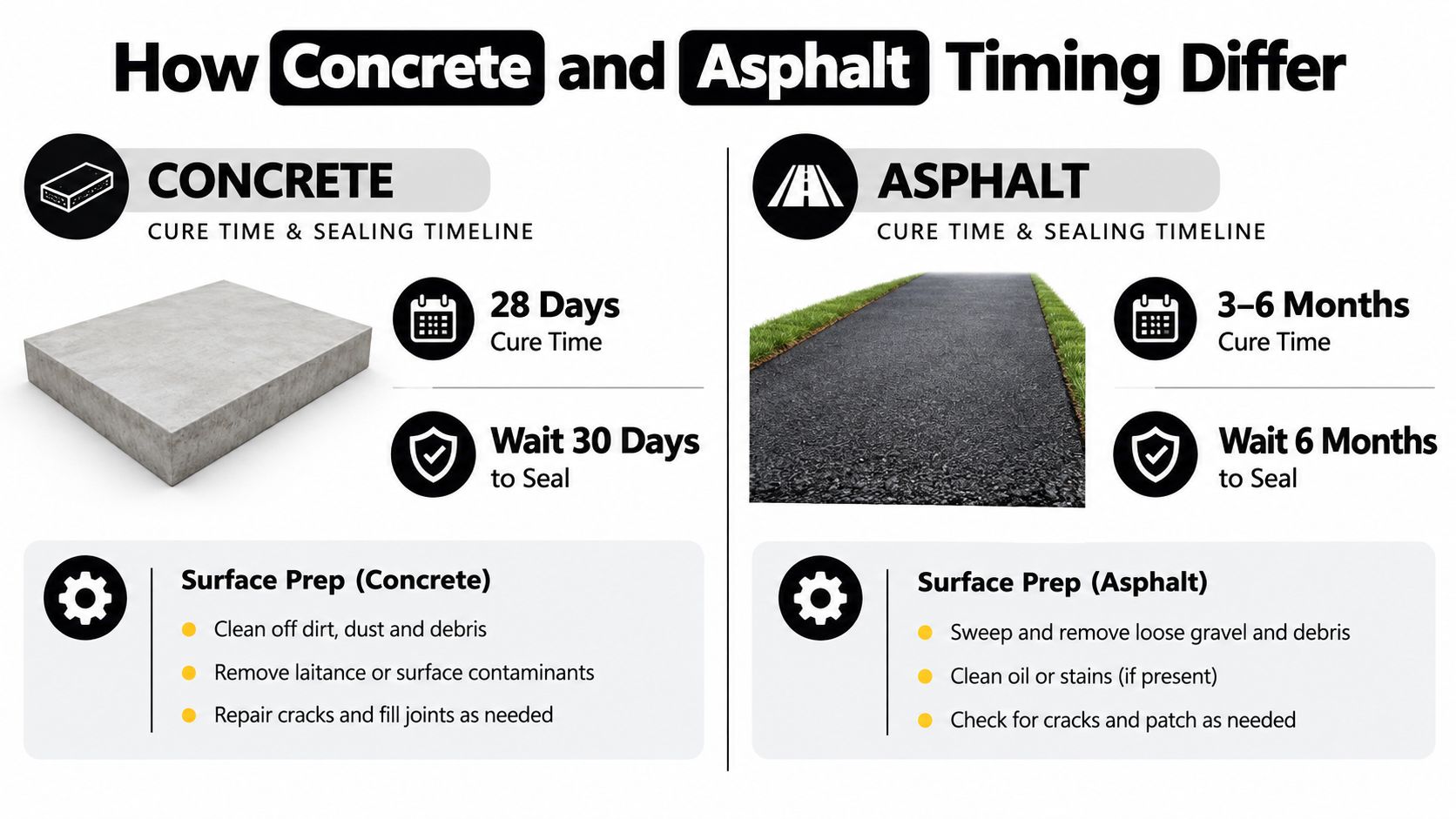
Concrete and asphalt also follow different curing schedules. A new concrete slab needs at least 28 days before sealing, while newly placed asphalt needs substantially more time to mature before receiving a protective treatment. The right decision combines the material, the surface condition, and the weather window.
Why Calendar Months Get Driveway Sealing Wrong
“Seal in May” is easy advice, but it falls apart quickly in Atlanta. A spring cold front can leave the air warm in the afternoon and the pavement too cool or damp the following morning. Summer brings the opposite problem. Direct sun and excessive heat can make some water-based products dry on top before they spread and bond evenly.
Fall isn't automatically safe either. A tropical system or fast-moving storm can send heavy rain across an otherwise suitable job site. Uncured sealer may streak, dilute, or wash away. The date didn't cause the failure, but relying on the date ignored the conditions that did.
The pavement is the decision-maker
Federal Highway Administration guidance for fog seals recommends a pavement surface above 60°F (16°C) with no rain expected. Related slurry-seal guidance uses a minimum air and pavement temperature of about 50°F (10°C), requires several rain-free hours, and prohibits freezing within 24 hours. Those preservation-treatment thresholds explain why late spring through early fall often works in Atlanta, but they don't guarantee that every day in those seasons is suitable. FHWA pavement preservation guidance provides the technical basis for checking the surface and forecast instead of trusting the month.
A pavement-industry specification gives a more conservative target, with temperatures above 70°F, direct sunlight, and relative humidity below 60%. It also calls for at least two hours of remaining daylight after application. Those conditions help because sealers harden through evaporation and solar heat, but Atlanta's humidity and tree cover can make the practical cure slower.
For homeowners comparing exterior projects, the same conditions-first thinking applies to fall vs spring house painting. A season can narrow the choices, but the actual surface and forecast determine whether the work holds up.
Local rule: Don't book driveway sealing because the calendar looks right. Book it when the pavement is dry, the temperature is comfortably above the minimum, and the next weather system won't interrupt curing.
Reading the Weather Conditions That Actually Matter
A dependable sealing day has four ingredients: a dry pavement surface, suitable air and pavement temperatures, manageable humidity, and a protected period after application. Miss one of those, and the forecast can look favorable while the driveway still fails the bond test.
Check the surface, not just the phone app
Air temperature is only a starting point. The pavement may remain cool under dense tree cover, beside a shaded garage, or in a low spot that holds moisture. A warm reading at the front of the house doesn't prove that the entire driveway is ready.
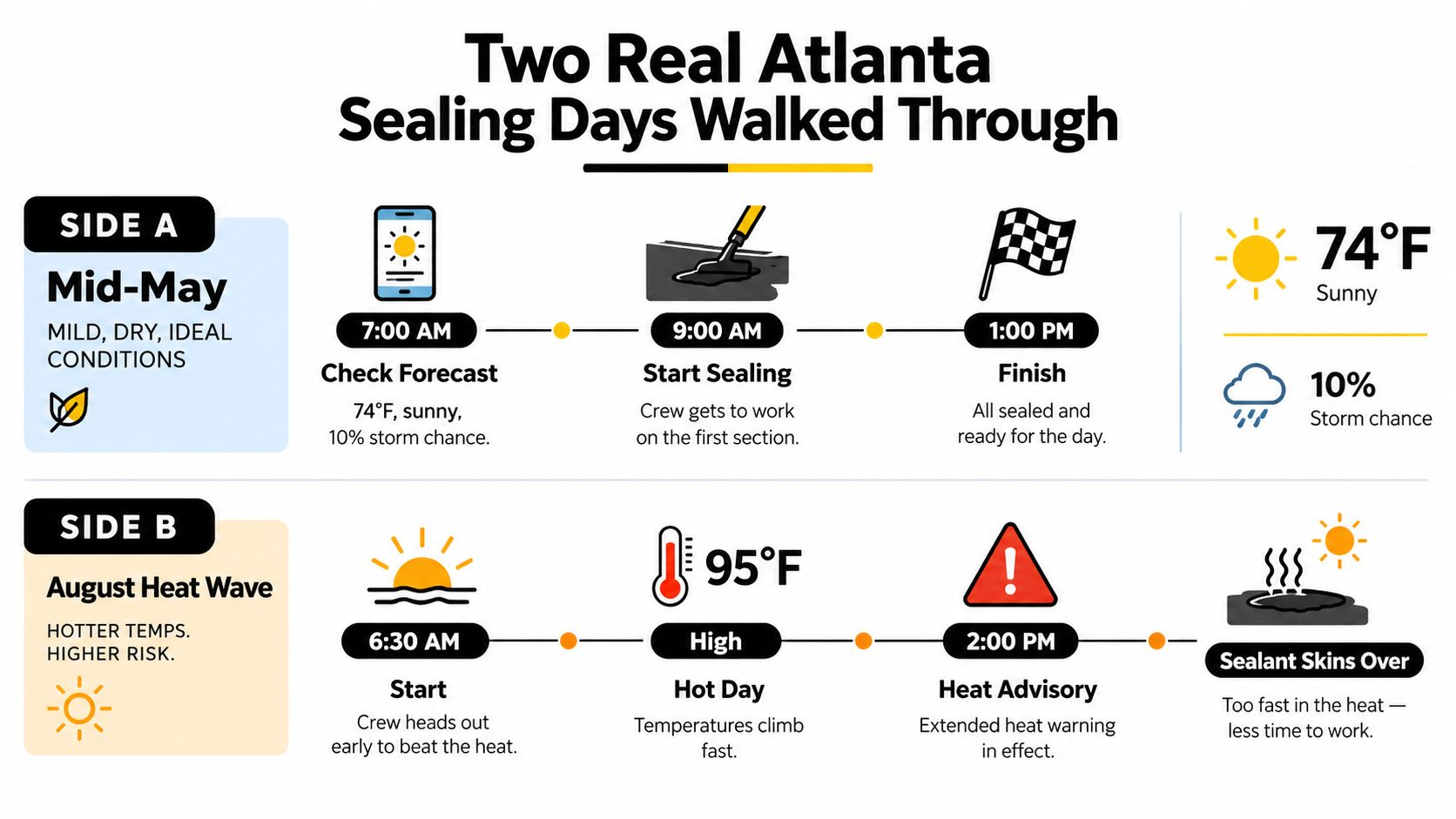
Look for a temperature comfortably above 50–60°F, with the pavement warming rather than cooling. The stricter industry target is above 70°F with direct sunlight and humidity below 60%, but product labels control when their requirements are different. Avoid a hot surface that causes the sealer to skin over before it levels.
Dew point matters because air near its moisture limit encourages condensation as the evening cools. If the overnight low approaches the dew point, shaded sections may develop moisture even after a sunny afternoon. Atlanta's pop-up thunderstorms create another hazard. A morning can begin perfectly and still become a bad sealing day if the storm line arrives before the material has cured.
| Condition | Acceptable Range | Why It Matters | How to Check |
|---|---|---|---|
| Pavement temperature | Above roughly 50–60°F, preferably rising | Supports adhesion and curing | Use an infrared thermometer on sunny and shaded areas |
| Rain | No imminent rain, with a protected 24–48-hour window | Fresh sealer can streak, dilute, or lose adhesion | Check radar, hourly forecast, and storm timing |
| Humidity and dew | Moderate conditions are preferable | Moisture slows evaporation and can settle on the surface | Compare dew point with overnight low and inspect shade |
| Surface moisture | Completely dry | Trapped water interferes with bonding and penetration | Use a plastic-sheet test and inspect low spots |
| Daylight | At least two hours remaining after application | Solar warmth helps the material harden | Start early enough to finish with daylight left |
Use a physical moisture test
Tape a 2-by-2-foot square of clear plastic tightly to the pavement and leave it overnight. Condensation underneath, darkening, or visible dampness means the slab is still too wet. Remove the plastic, let the surface dry longer, and test again.
This matters after washing, overnight dew, recent rain, or prolonged shade. A dry-looking surface can still hold moisture in pores and cracks. In Atlanta, the shaded side of a driveway often needs more time than the section exposed to open sun.
Don't assume hotter is better. A mild, dry morning with gradually rising temperatures can outperform a scorching afternoon. Product chemistry matters, but the safe principle is consistent: choose moderate conditions, avoid imminent storms, and allow the surface to warm without forcing the sealer to flash-dry.
How Concrete and Asphalt Timing Differ
Concrete and asphalt don't need the same waiting period or the same kind of protection. Treating them as interchangeable is how homeowners end up sealing a slab too early or coating asphalt that is still releasing oils.
Concrete needs maturity and moisture control
A new concrete driveway should cure for at least 28 days before sealing. Before application, clean the slab and let it dry for at least 24 hours. The concrete and surrounding air should remain above 60°F (16°C). Concrete curing guidance supports treating the 28-day interval as a minimum technical benchmark, not an automatic green light.
Shaded areas, poor drainage, recent washing, high humidity, and dense decorative finishes can extend drying. A penetrating silane or siloxane product behaves differently from an acrylic film-former, so follow the selected product's instructions and apply a test patch first. Don't seal over curing compounds, laitance, oil, efflorescence, or trapped construction moisture.
Asphalt needs time for the binder to settle
New asphalt should not be sealed immediately. A sealer engineering specification recommends waiting at least 30 days, extending to 60 days under favorable weather, and using a water test. If an oil film appears during that test, the asphalt isn't sufficiently cured. SealMaster's engineering specification also calls for at least 24 hours before reopening treated pavement to traffic.
Asphalt preparation focuses on removing dust, oil, loose aggregate, and debris, then repairing structural failures and treating cracks with compatible materials. Concrete preparation focuses more heavily on moisture, surface porosity, curing compounds, joints, and sealer penetration. Properly prepared asphalt can accommodate some movement from Atlanta's clay soils, while concrete depends heavily on sound subgrade preparation, control joints, drainage, and slab design.
For concrete installation, replacement, or evaluation, homeowners can review residential driveway concrete alongside the sealing decision. Sealing protects a sound surface. It doesn't correct a weak base, poor drainage, or an incorrectly cured slab.
Prepping the Surface the Day Before You Seal
Sealer bonds to a clean, dry surface. It doesn't bond to pollen, oil, moss, loose dust, or water trapped in the driveway's pores. Most premature peeling begins before the sealer bucket is opened.
Start with cleaning and repairs
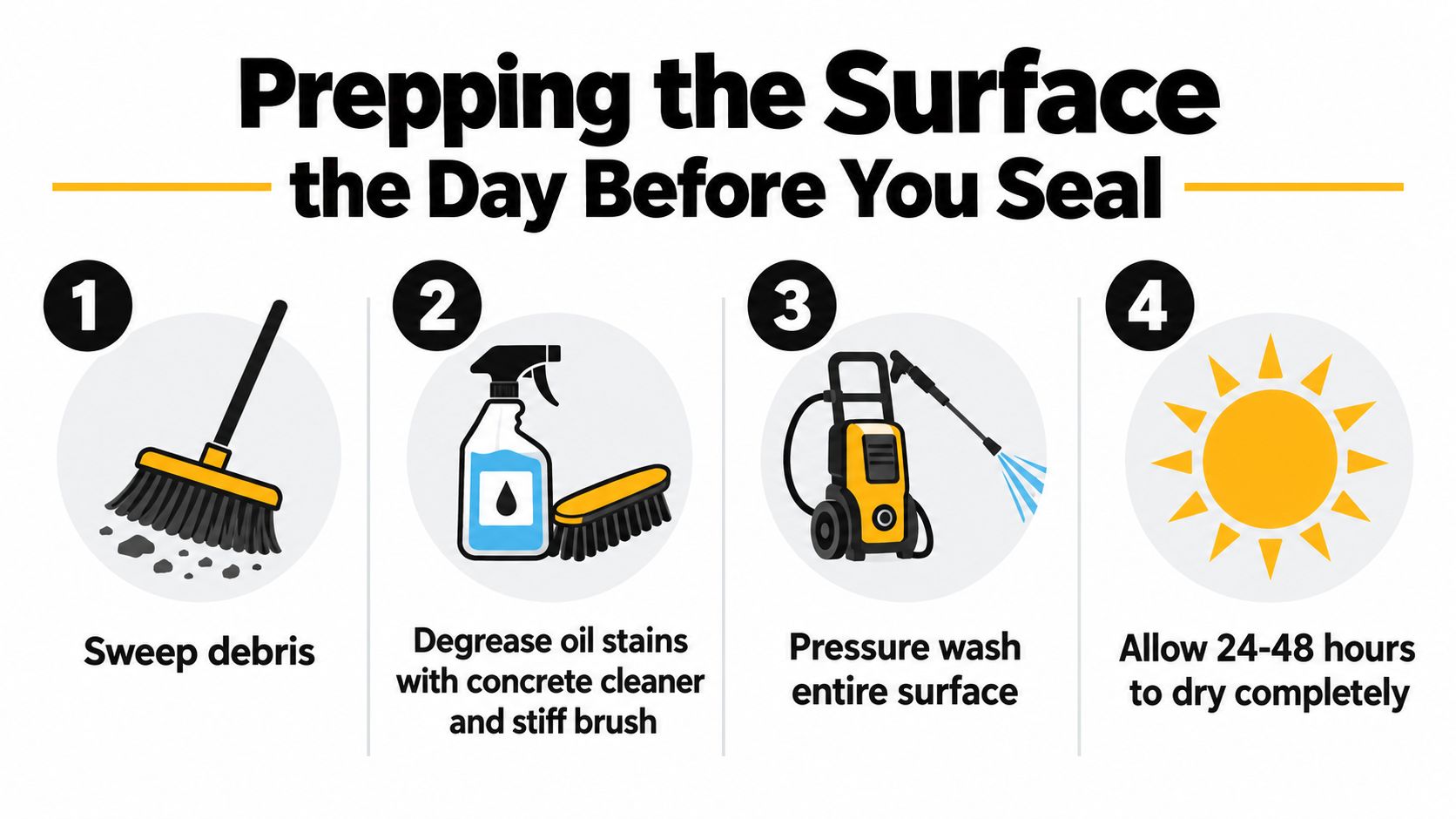
Sweep the entire driveway, including the edges and the area beside the garage door. Use a concrete cleaner or dish detergent on oil stains, scrub with a stiff brush, and rinse thoroughly. Pressure-wash or hose-rinse the full surface, clear debris from joints and cracks, and treat moss or mildew on shaded sections.
Wash in the morning, not at night. Atlanta humidity can leave a cleaned slab damp well into the following day, especially beneath trees and along retaining walls. If the driveway has potholes, structural cracks, sinking, or drainage failures, repair those issues before sealing. A surface treatment won't rebuild a failed base.
A practical cleaning reference is this guide to driveway cleaning for Flagstaff homeowners. The climate differs, but the basic lesson transfers well: thorough cleaning and complete drying determine whether the coating has a chance.
Verify dryness before masking
Allow 24–48 hours of drying after washing when Atlanta humidity or shade is high. Perform the plastic-sheet test overnight. Condensation under the plastic means you should postpone the seal, even if the top of the driveway feels dry.
Before application:
- Protect edges: Mask garage doors, expansion joints, curbs, and nearby landscaping.
- Clear the joints: Remove dirt, leaves, grass, and loose crack filler where the product must not bridge.
- Check low spots: Look for standing water or dark, damp areas that indicate drainage or moisture problems.
- Sweep again: Remove dust, grit, and debris immediately before sealing.
- Block traffic: Move vehicles away and prevent foot traffic until the product has cured according to its label.
For repair work involving joints, transitions, or damaged concrete, residential concrete and masonry repair is a more appropriate starting point than coating over the defect.
Two Real Atlanta Sealing Days Walked Through
A forecast can be technically favorable and still require judgment at the property. These two Atlanta examples show why the driveway, not the app, gets the final vote.
The mid-May storm mistake
A homeowner checks the forecast and sees 74°F, sunny conditions, and a 10% storm chance. Those figures alone aren't verified local measurements here, so treat this as a realistic example rather than a reported event. The driveway is clean, dry, and in open sun, so the homeowner starts in the morning.
Six hours later, a pop-up thunderstorm crosses the property. If the sealer film hasn't cured, rain can dilute the surface, create streaks, soften the finish, or wash material toward the street. The homeowner should keep traffic off the driveway, photograph the affected areas, and inspect for washout, uneven sheen, soft spots, and exposed pavement after the surface dries.
A second coat may improve uniform color if the first layer remains bonded and only shows cosmetic unevenness. It won't rescue sealer that has peeled, moved, or failed because water reached the substrate. The verdict is clear: the surface preparation may have been correct, but the post-application weather window wasn't reliable enough.
The shaded Decatur delay
A late-September morning in a tree-lined Decatur driveway has suitable air temperature, but the pavement remains dark and damp in shaded sections past noon. The homeowner applies the plastic-sheet test and finds condensation underneath. Instead of forcing the job, they wait, improve airflow where possible, and retest.
The surface finally dries in the early afternoon. Application proceeds only after the entire driveway is dry, with enough daylight remaining for the sealer to harden before evening dew. This is the right kind of delay. Shade, not the calendar, controlled the schedule.
The first homeowner trusted a low rain probability. The second trusted a physical moisture test. For planning, repairs, or a full replacement, Atlanta concrete projects can provide useful examples of how site conditions shape the work.
Choosing the Right Sealer for Atlanta Conditions
Sealer chemistry should follow the surface and the job, not the color of the label. A contractor who recommends one product for every driveway is skipping the important questions.
Concrete options
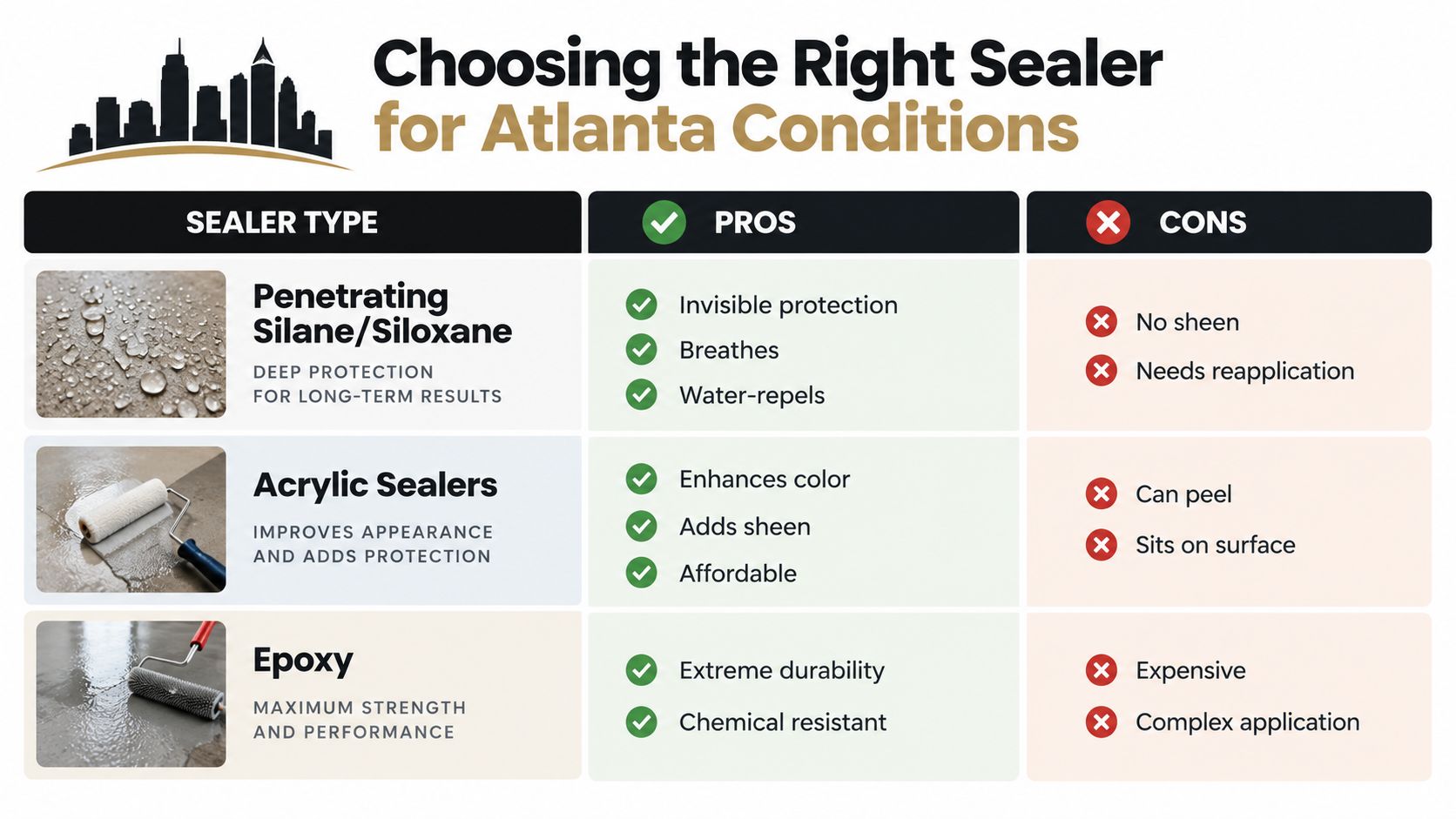
Penetrating silane or siloxane sealers repel water without creating a thick surface film or changing the appearance dramatically. They're a sensible choice when you want invisible protection and a breathable surface rather than a glossy finish.
Acrylic film-formers can deepen color and add sheen, which suits stamped or decorative concrete. They sit closer to the surface, so poor preparation, trapped moisture, and excessive humidity can lead to peeling, whitening, or uneven appearance. Use a test patch, especially on shaded Atlanta slabs.
Epoxy is not the default answer for an ordinary exposed driveway. It can provide a durable, chemically resistant surface, but application is more involved and the appearance and traction must suit the site. For decorative surfaces, compare the product requirements with the advice used for professional paver sealing before choosing a film-forming approach.
Asphalt choices and environmental limits
Coal-tar sealers face restrictions in many U.S. municipalities because of concern about polycyclic aromatic hydrocarbons in stormwater runoff. Local rules vary, so check Atlanta-area city and county requirements, the product label, runoff precautions, and disposal guidance before scheduling work.
For properties near storm drains, creeks, ponds, or sensitive drainage routes, coal-tar-free asphalt-based or other approved alternatives deserve serious consideration. Don't assume a product is acceptable because it performs well technically. A sealer can cure properly and still be unsuitable for the location or local regulations.
Choose based on four questions:
- Is the surface concrete or asphalt?
- Do you want invisible water repellency or a visible wet look?
- How much traffic and turning stress does the driveway receive?
- Does the product match the manufacturer and local environmental requirements?
The cheap choice that most often disappoints is a generic film-former applied to damp, humid concrete. The material isn't always the problem. Timing and preparation usually are.
Maintenance Schedule and When to Call a Professional
A sealed driveway still needs inspection. On concrete, look for water entering the surface, peeling film, white residue, spalling, and joint deterioration. On asphalt, watch for fading, raveling, open cracks, potholes, rutting, and interconnected alligator cracking.
The commonly used maintenance rhythm is to evaluate concrete for resealing every 3–5 years and asphalt every 2–3 years, with exposure and surface condition controlling the actual decision. FHWA preservation guidance emphasizes dry, stable conditions for asphalt sealing and crack treatment. High sun exposure, heavy oak shade, pollen buildup, and repeated moisture can change how quickly a driveway needs attention.
Use a quarterly inspection habit
- After pollen season: Sweep the surface and inspect for film loss, staining, and blocked joints.
- In summer: Pour water on a small area and see whether it beads or immediately darkens and absorbs.
- In fall: Clean leaves, organic debris, and moss before they remain wet against the surface.
- In late winter: Map cracks, edge failures, settlement, and drainage changes before the next sealing window.
Stop sealing and call a contractor when the asphalt has widespread alligator cracking, when concrete shows spalling or rebar shadowing, when sealer peels in sheets, when white efflorescence persists, or when a joint near the garage apron has failed. Those are repair or replacement signals, not invitations to add another coat.
For Atlanta-area driveway replacement, GDOT details identify a 6-inch concrete driveway section over a 6-inch graded aggregate base in residential driveway details, while another applicable option uses 8 inches. GDOT's Design Policy Manual also states that reconstructed driveways should generally be replaced in kind. Thickness, reinforcement, joints, loading, and subgrade conditions must come from the applicable design, not a guess.
Have these details ready when you call a professional:
- Slab age: When was the concrete or asphalt installed?
- Last treatment: When was it sealed, if ever?
- Approximate area: Measure the driveway as accurately as you can.
- Surface history: Note repairs, drainage problems, oil stains, and previous coatings.
- Photos: Send clear phone photos of the full driveway, close-up cracks, edges, joints, and low spots.
Atlanta Concrete Solutions can inspect driveway conditions, repair damaged concrete and masonry, replace failed driveways, and advise on sealing after the surface is ready. Visit Atlanta Concrete Solutions to request an evaluation and discuss the right weather window for your Atlanta property.