
A delivered yard of ready-mix concrete in the Atlanta area currently runs roughly $125 to $195 per cubic yard. Most residential Atlanta pours are small enough to trigger short-load fees, so the effective price can land materially above that headline range.
That's the situation many homeowners discover after measuring a driveway repair, patio, or sidewalk. The supplier quotes a reasonable rate per yard, then delivery minimums, distance charges, weekend scheduling, reinforcement, forming, and finishing change the invoice. If you're pricing a small Atlanta project, the useful question isn't only “What does concrete cost per yard?” It's “What will my exact order cost after every charge is included?”
What Cement Cost Per Yard Actually Means
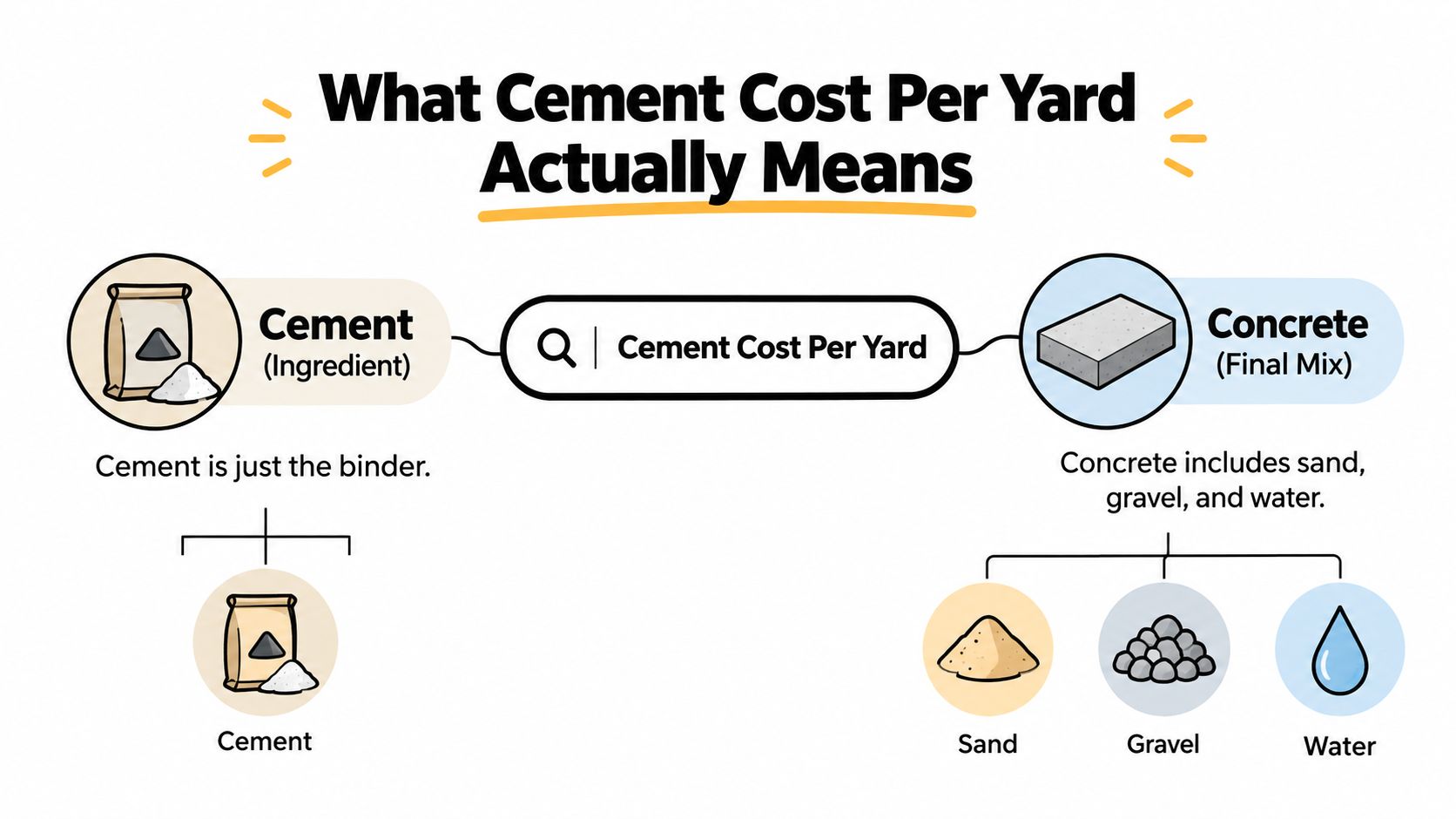
People usually type “cement cost per yard” when they're trying to budget a concrete project. The terminology matters because cement and concrete aren't the same product. Cement is the powdered binder. Concrete is the finished mixture that combines cement with sand, gravel, water, and often other materials.
A contractor quoting “per yard” is normally pricing delivered ready-mix concrete, measured in cubic yards. They aren't quoting a pallet of Portland cement bags from a hardware store. The ready-mix truck delivers a prepared material designed for the specified strength, consistency, and use.
One cubic yard equals 27 cubic feet, as explained in Concrete Network's concrete pricing guidance. A practical way to visualize it is as a solid cube about the size of a standard washing machine, although the actual pour spreads across a much larger surface when it's placed at driveway or patio thickness.
Why the wording changes your budget
A typical residential pour can use between 2 and 10 cubic yards, depending on the project size and slab thickness. A small patio may need only a few yards, while a larger driveway or foundation requires more. The material volume is calculated from length, width, and thickness, then converted from cubic feet into cubic yards.
That distinction prevents a common mistake. A homeowner may compare the price of cement bags with a ready-mix quote, but the two options include different materials, labor demands, delivery arrangements, and consistency. For a finished driveway, the relevant benchmark is the delivered concrete mix, followed by the cost of preparing and finishing the site.
Current Per-Yard Prices and the National Trend
National pricing has moved substantially. The NRMCA benchmarking survey shows the U.S. average selling price for ready-mix concrete rose from $116.43 per cubic yard in 2019 to $159.68 in 2023, an increase of about 37.1%. The same source records a rise from $137.99 in 2022 to $159.68 in 2023, or about 15.7% year over year.
Pricing guides place the national market around $160 to $195 per cubic yard, with a reported 2025 average of $179.95 per cubic yard, according to the NRMCA-linked benchmark above. Other guides place delivered ready-mix in a broader $119 to $180 range, depending on mix, delivery, order size, and jobsite conditions, as summarized by HomeGuide's concrete price guide.
For Atlanta homeowners, a reasonable working benchmark for standard 3,000 to 4,000 PSI delivered ready-mix is roughly $125 to $195 per cubic yard. That isn't a guaranteed supplier quote. Higher strength, fiber reinforcement, accelerators, colored mixes, difficult access, and timing can move the figure upward.
| Mix Type | National Avg / Yard | Atlanta Avg / Yard | Typical Use |
|---|---|---|---|
| Standard ready-mix | $160 to $195 | $125 to $195 | Patios, sidewalks, residential slabs |
| Standard 3,000 to 4,000 PSI | Broadly $119 to $180 | Roughly $125 to $195 | Driveways and general flatwork |
| Higher-strength or enhanced mix | Above the standard range | Above the standard range | Heavy loads, structural or specialty work |
The upward pressure comes from several places, including cement inputs, fuel, aggregates, transportation, and labor. Atlanta-specific logistics matter too. A truck delayed by I-285 congestion can affect scheduling and standby exposure, while competition between plants serving Cobb and Fulton County can create different delivered quotes. Spring demand can also tighten availability.
Use the range as a comparison benchmark, not as the final project price. For a small residential order, the material rate is only one part of the landed cost.
What Really Goes Into an Atlanta Concrete Quote
A professional quote should let you identify what you're buying. If it shows only “concrete, total,” you can't tell whether the contractor included reinforcement, disposal, forming, delivery, or finishing.
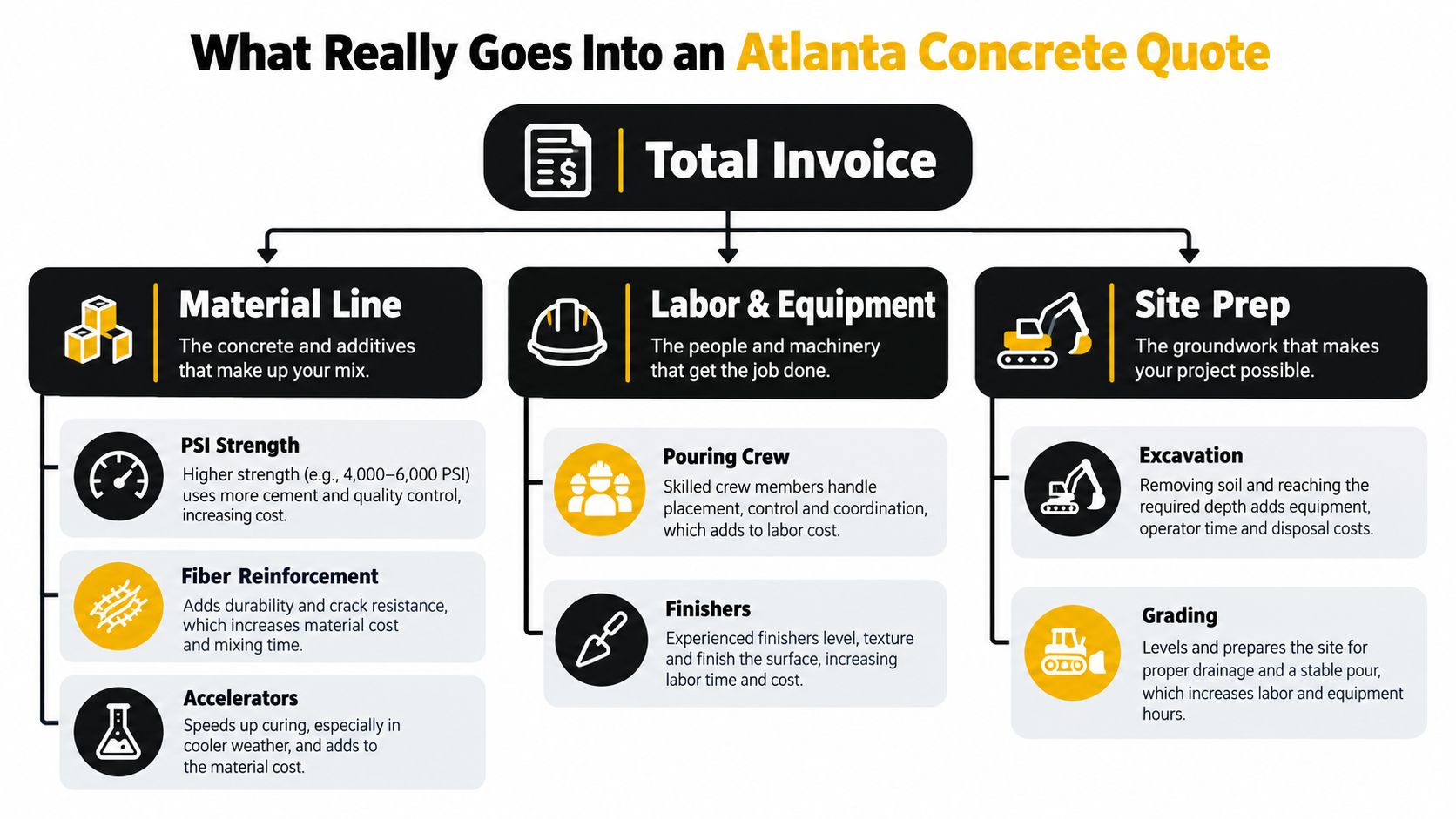
The material line
The first line should identify the mix design. PSI strength affects the price and the performance requirement. A driveway may need a different specification from a decorative patio, garage floor, or structural foundation.
The quote may also list:
- Fiber reinforcement, which can improve crack-control support in the mix but doesn't replace structural reinforcement where rebar is required.
- Accelerators, used when the crew needs the concrete to set or gain strength faster.
- Air entrainment, selected when durability against freeze-thaw exposure matters.
- Color or specialty additives, which change both the material and finishing process.
Ask the contractor to explain why each addition is specified. Paying for a stronger or more specialized mix than the project needs doesn't automatically create a better result.
Delivery and placement
Delivery can include the batch plant's standard service area, but small orders may carry a short-load fee, while distance, fuel, Saturday scheduling, after-hours work, and truck waiting time can appear separately. A surcharge that looks minor on a large order can become a major per-yard increase on a small one.
For example, a quote might show a base material rate, a short-load charge, and a Saturday adder. Don't compare only the first line. Add all delivery-related charges before comparing suppliers.
Practical rule: Ask whether the concrete price is material only, delivered material, or the complete installed scope.
Labor, preparation, and permits
Labor commonly includes excavation, grading, forming, placement, screeding, edging, broom texture, curing, cleanup, and sometimes saw-cut control joints. Wire mesh or rebar should appear as its own line if included. Removing an existing slab can also change the quote sharply because the crew must break, load, haul, and dispose of the old concrete.
Driveway aprons and sidewalk work may require permitting or inspection, particularly in the City of Atlanta and unincorporated DeKalb. Confirm who handles that process and whether the quoted price includes the applicable permit work.
The construction job costing guide is useful background for understanding how contractors separate materials, labor, equipment, and overhead. For a local scope review, homeowners can also compare services from Atlanta Concrete Solutions.
The finishing sequence is where workmanship shows. A basic broom finish is simpler than stamped concrete, exposed aggregate, or a carefully polished surface. Those choices can change labor even when the cubic-yard quantity stays nearly identical.
The Small-Order Problem Most Buyers Miss
A supplier's quoted yard rate often assumes a commercially practical delivery. Residential work rarely fits that model. A patio, sidewalk section, or driveway repair may need fewer than the supplier's preferred load, so the company adds a short-load charge or applies a minimum.
A short-load fee typically applies when the order falls below a supplier's stated volume threshold. Verified pricing guidance places these fees broadly around $60 to $200, while another guide describes charges of roughly $40 to $80 per yard under 6 to 8 yards, depending on the supplier and order structure. The exact policy varies, so request it in writing.
Suppose a four-yard patio has a $145 base rate. A supplier may add a short-load charge, a distance fee, or a weekend premium. Spread over only four yards, those fixed costs can push the effective material rate close to or above $190 per yard, even though the quoted base rate remains $145.
| Pour Size (cubic yards) | Base Rate | Short-Load Fee | Effective Cost Per Yard |
|---|---|---|---|
| 2 | $145 per yard | $60 to $200 total | Higher than the base rate |
| 4 | $145 per yard | $60 to $200 total | Often materially above $145 |
| 6 | $145 per yard | $60 to $200 total, supplier dependent | Closer to the base rate |
Why the smallest pour suffers most
With two yards, every fixed charge is divided across a very small volume. With four yards, the same charge has less impact. At six yards, the effective rate usually moves closer to the advertised material figure, although delivery minimums and supplier thresholds still control the final result.
Saturday and after-hours scheduling can add more. Verified pricing information places those premiums around $15 to $30 per yard in some pricing structures, while other guides describe broader Saturday surcharges. Distance beyond a plant's included zone can add another charge, especially when a truck travels through congested Atlanta corridors.
Minimum-order rules can also require payment for a minimum quantity, even if the slab needs less. Before ordering, ask:
- What is the short-load threshold?
- Is the charge flat, per yard, or based on the missing volume?
- Does Saturday delivery carry a separate premium?
- What distance or fuel charges apply to my address?
- Will I pay a minimum quantity even if I order less?
If a neighbor needs concrete around the same time, combining deliveries may distribute mobilization costs more efficiently. Scheduling midweek can also avoid weekend availability problems. For project-specific planning, review residential poured concrete options with the full delivery scope in mind.
Real Example Projects You Can Price Yourself
The fastest way to understand cement cost per yard is to run the dimensions yourself. These examples use standard 3,000 to 3,500 PSI assumptions and exclude permits and demolition. Actual reinforcement, access, soil, and finish requirements can change the final bid.
A single-car driveway replacement
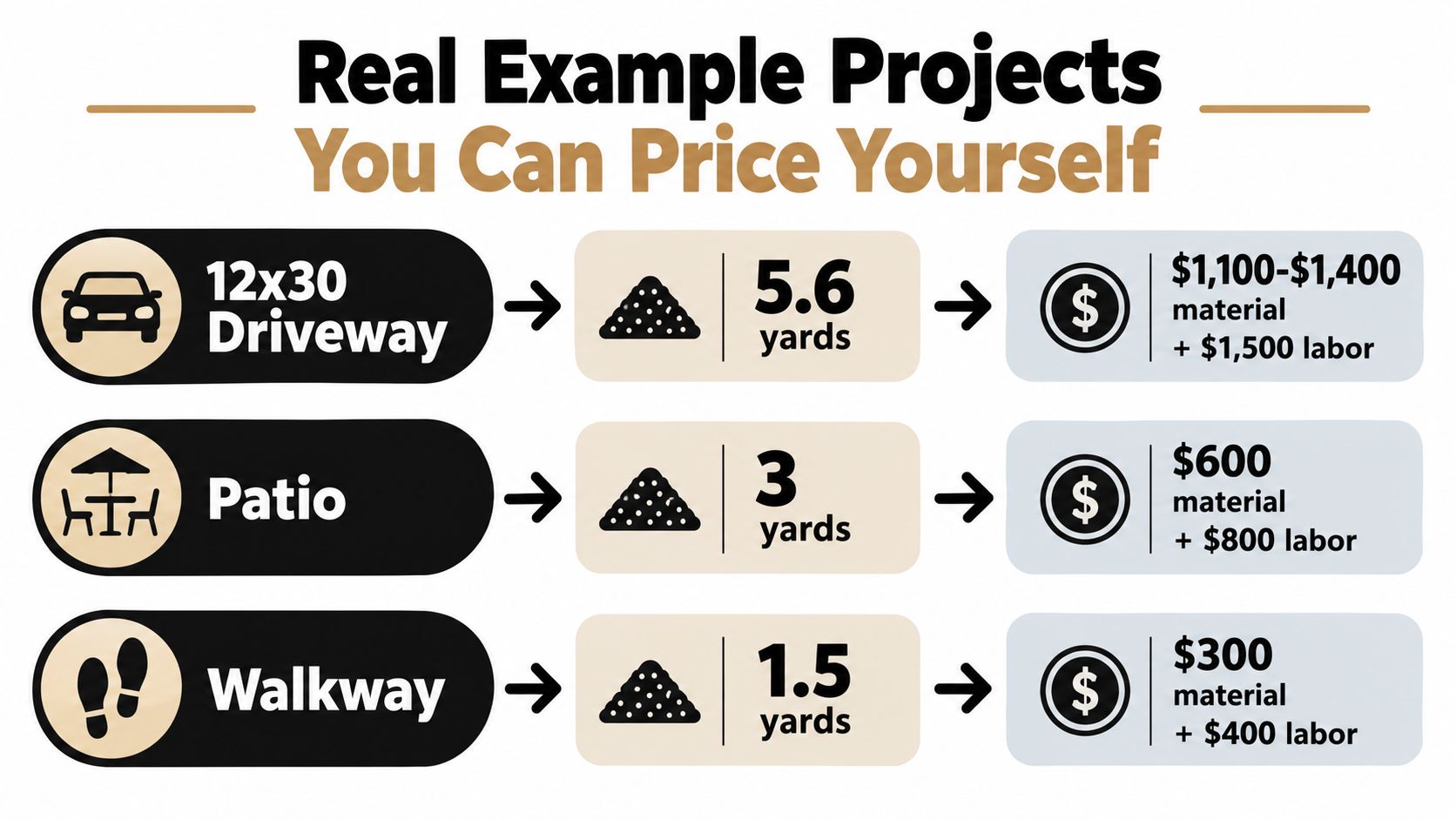
A 12 by 30 foot driveway at 5 inches thick contains approximately 5.6 cubic yards.
A practical material allowance is $1,100 to $1,400, with labor and finishing adding about $1,500 to $2,500, according to the verified project guidance supplied for this article. The material range should be checked against the delivered quote, including any short-load or distance charges.
The line items to confirm are:
- Concrete: Approximately 5.6 yards at the quoted delivered mix rate.
- Delivery: Ask whether the order clears the supplier's short-load threshold.
- Reinforcement: Confirm whether wire mesh or rebar is included.
- Finish: A broom finish is the basic comparison point. Stamped or decorative work adds finishing labor.
- Labor: Forming, removal, placement, slope management, brooming, curing, and cleanup.
That produces a practical project range of roughly $2,600 to $3,900 before demolition and permits.
A two-car driveway
A 20 by 24 foot driveway at 5 inches thick uses approximately 7.4 cubic yards. The material portion is about $1,400 to $1,800, while labor can bring the project total to roughly $3,000 to $4,200.
At this size, the order may receive more favorable delivery economics than a tiny patio, but don't assume that automatically. Confirm the plant's minimum, truck access, and whether the crew needs a pump or can place the concrete from the chute.
The Atlanta Concrete Solutions project gallery can help homeowners compare the visual difference between basic and decorative work before selecting a finish.
A backyard patio
A 12 by 16 foot patio at 4 inches thick requires approximately 2.4 cubic yards. Because that order is small, delivery surcharges can make the material portion roughly $600 to $850, with the full project commonly landing between $1,800 and $2,800 under the supplied Atlanta assumptions.
The patio's finish deserves careful attention. A broom finish keeps the scope straightforward. Stamped patterns, color, exposed aggregate, or sealing add labor and materials, while difficult backyard access may require extra placement equipment.
Estimator's check: Measure the slab, convert thickness to feet, divide cubic feet by 27, and then ask the supplier to price the exact quantity with every fee shown separately.
Smart Ways to Lower Your Concrete Bill
The best savings decisions are trade-offs, not shortcuts. Lowering the material rate means little if the slab fails because its thickness, reinforcement, drainage, or mix design doesn't match the use.
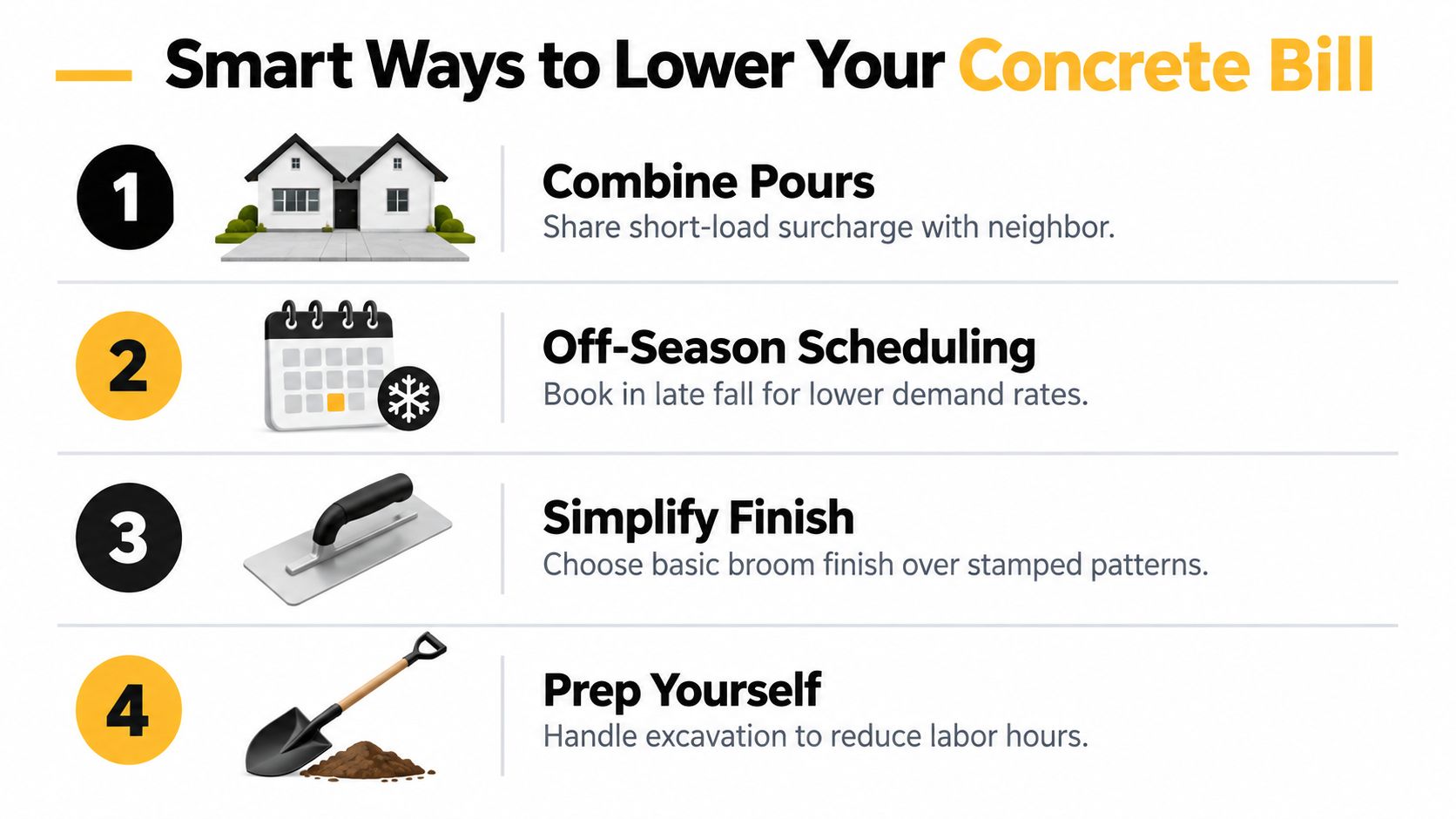
Combine nearby pours. If a neighbor needs a patio or driveway section, coordinating deliveries may spread short-load costs across both projects. The supplier must approve the arrangement, and both sites need to be ready at the same time.
Schedule for the supplier, not just your calendar. Midweek delivery can reduce the risk of weekend premiums and limited availability. Ask whether mid-month scheduling offers a cleaner production slot, but get the actual charge in writing rather than assuming a discount.
Choose thickness based on traffic. A standard residential driveway is commonly 4 inches thick for passenger vehicles, while 5 to 6 inches is recommended for vehicles that park or turn on the slab, according to Racine Premier Concrete's driveway guidance. For RVs, boat trailers, or regular delivery and dumpster trucks, 6 inches with #4 rebar is commonly recommended by that same source.
A thinner slab can reduce material, but it isn't a responsible choice where heavier loads require more capacity. SlabCalc's driveway guide similarly links thickness to vehicle loading and describes 5 to 6 inches as the common range for residential driveways supporting cars, SUVs, and light trucks.
Keep the finish simple. A broom finish usually requires less labor than stamped or exposed aggregate work. Choose decorative finishing only when the appearance justifies the added cost and maintenance.
Prepare what you safely can. Clear loose items, identify access constraints, and confirm utility locations before the crew arrives. Don't excavate or alter grading without understanding drainage and structural requirements.
Bundle compatible work. Combining concrete work with grading or a retaining-wall scope may improve scheduling efficiency, but any bundled price should still identify the tasks and materials included.
Questions to Ask Before You Hire a Contractor
Take these questions to the bid meeting. A reliable contractor should answer them without turning the discussion into a guessing game.
- Is this estimate measured on site or based on a phone description? A site visit should identify slope, access, drainage, existing concrete, and the actual dimensions.
- What PSI mix is specified, and what slump is being ordered? The quote should state the performance requirement rather than just saying "standard concrete."
- Are delivery, short-load, fuel, Saturday, and after-hours charges included? Ask for the total landed material cost.
- Who handles permits and inspections? This matters for driveway aprons and sidewalk work in jurisdictions that require review.
- What reinforcement is included? Confirm wire mesh or rebar, including the placement details and spacing where applicable.
- Which finish is priced? Broom, smooth, stamped, and exposed aggregate are different scopes.
- How is overage handled? Ask whether unused concrete is your responsibility and who pays if the measured quantity is short.
- Who removes the existing slab and disposes of it? Demolition and hauling should never be assumed.
- How will the contractor manage drainage? A new slab that sends water toward the garage or foundation creates a more expensive problem.
- What happens if the truck waits? Clarify standby charges and make sure forms, access, crew, and reinforcement are ready before delivery.
Red flags in a quote
Be cautious with cash-only deposits, a proposal without a written breakdown, vague scheduling, no pre-pour site walk, or pressure to book immediately. A low per-yard number can hide omitted labor, disposal, reinforcement, or delivery costs.
A quote should show enough detail for you to compare the same scope with another contractor. Atlanta Concrete Solutions states that it provides free written estimates and flexible financing, which gives homeowners a way to review a defined number before committing to a pour date.
Atlanta Concrete Solutions can prepare a written Atlanta-area estimate that separates concrete volume, delivery, site preparation, reinforcement, labor, and finish selections. Visit Atlanta Concrete Solutions to request a quote and discuss the right mix, thickness, and scheduling approach for your driveway, patio, slab, or commercial concrete project.