
The warehouse manager gets the call before the morning shift starts. Pallet jacks are bouncing across a worn slab, a polished entrance has become slippery after cleaning, or a coating is lifting near a loading door. The floor may still look acceptable from a distance, but small failures are already interrupting traffic, maintenance, and tenant operations.
That's why commercial concrete flooring deserves more attention than a finish sample and an installation price. The slab has to carry loads, tolerate abrasion, support safe movement, and remain compatible with coatings, sealers, or polishing work. In Atlanta, heat, humidity, renovation schedules, and active facilities make preparation especially important.
A residential driveway and a commercial floor may both use concrete, but they don't face the same demands. A driveway serves passenger vehicles and weather exposure. A commercial floor may handle forklifts, pallet traffic, cleaning chemicals, customers, healthcare requirements, food operations, or precision storage equipment every day.
This guide starts with the slab and works upward. You'll learn how floor systems function, where each finish fits, how Atlanta cost comparisons can mislead, which installation controls matter, and how to verify that a contractor has documented the conditions beneath the final surface. The central lesson is straightforward: choose the floor by lifecycle proof, not appearance alone.
Introduction to Commercial Concrete Flooring for Busy Facilities
A retail tenant can't wait for a floor crew to solve an avoidable moisture problem after merchandise has arrived. A warehouse can't easily shut down a shipping lane because the slab is too uneven for pallet traffic. An office owner may accept a decorative finish, then discover that cleaning marks and dark stains show every day near the entrance.
Those problems begin before anyone chooses polished concrete, epoxy, or stain. They begin with the slab's condition, the building's traffic pattern, and the evidence collected during planning.
Commercial concrete flooring has moved from basic industrial utility to a refined architectural surface. Market reporting places the global polished concrete market at USD 2.72 billion in 2025, with an estimated rise to USD 3.77 billion by 2031 at a 5.59% CAGR. North America held 37.45% of global share in 2025, according to Mordor Intelligence's polished concrete market data. Those figures reflect demand across warehouses, retail properties, institutional facilities, and industrial buildings, not merely decorative interiors.
The business case comes from more than market size. A durable floor can help keep carts moving, simplify cleaning, reduce recurring repairs, and support a consistent appearance during a long operating life. A poor installation can create the opposite result, including dusting, cracks, coating failure, trip concerns, and unplanned downtime.
Commercial floors carry operational consequences
Start with the questions a facility manager faces.
- What crosses the surface? Foot traffic, forklifts, pallet jacks, carts, vehicles, or heavy equipment each create different wear patterns.
- What reaches the surface? Water, oil, food products, disinfectants, salts, and cleaning chemicals can affect the finish.
- How much downtime is acceptable? A vacant shell offers flexibility, while an operating store or warehouse may require phased work.
- What must the floor look like? A showroom and a back-of-house storage area don't need the same appearance standard.
- What proof will the owner receive? Testing records, preparation notes, finish specifications, and maintenance instructions matter after the crew leaves.
Field rule: A floor is part of the facility's workflow. If it slows traffic, complicates cleaning, or fails under routine use, an attractive finish won't rescue the specification.
The right decision therefore connects structural readiness, surface performance, maintenance habits, and future repair access. Atlanta owners evaluating a new slab, renovation, or resurfacing project should treat those items as one system rather than separate purchases.
How Commercial Concrete Flooring Systems Actually Work
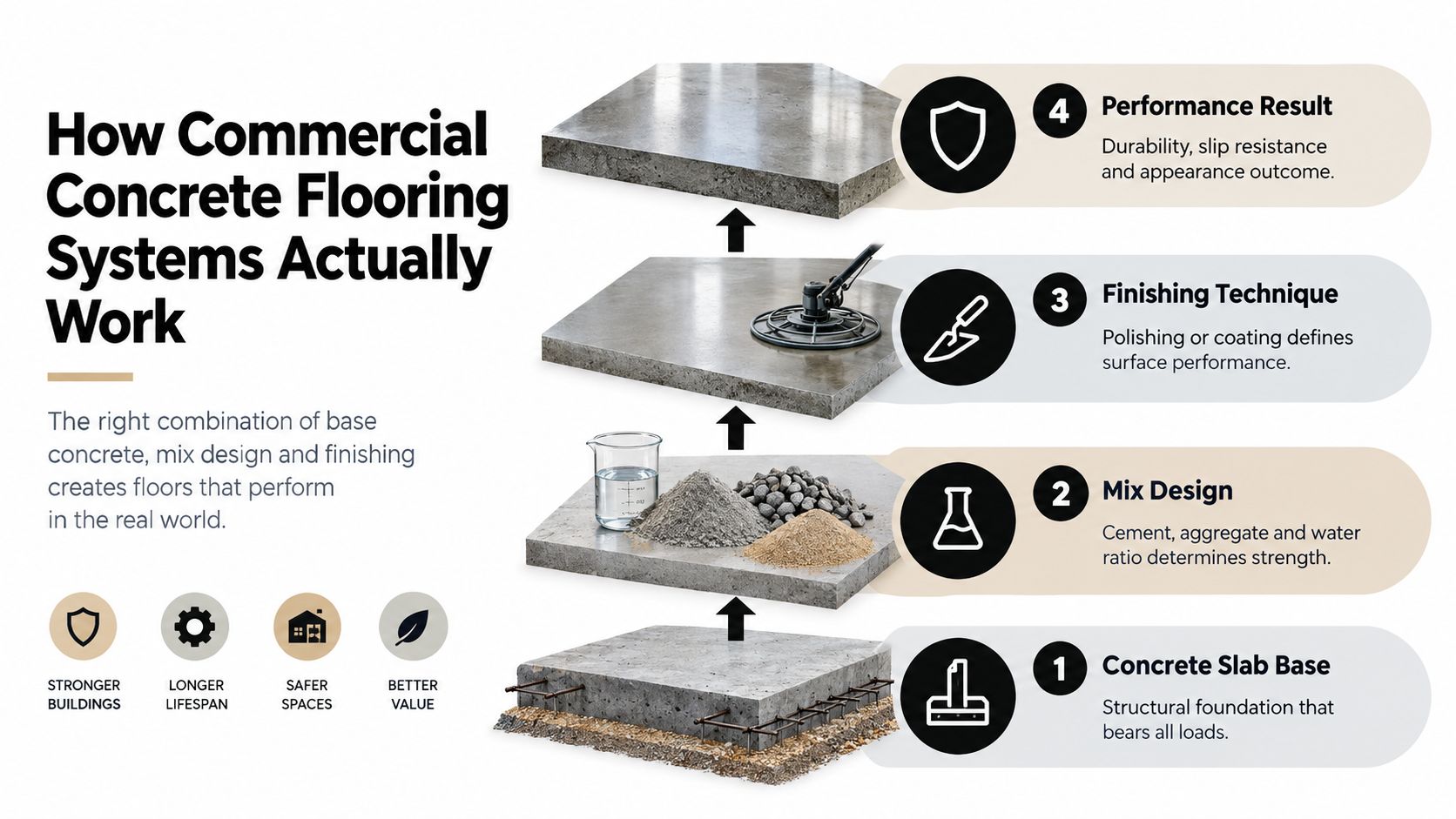
A facility can have an attractive finish and still experience bouncing pallet jacks, dusting, cracks, or early coating failure. The reason is simple: commercial concrete flooring is a connected system. The slab carries the load, the mix controls density and shrinkage behavior, the surface geometry supports equipment, and the finish handles the final service demands.
Start with slab readiness
The concrete slab base is the structural starting point. It transfers loads to the supporting ground or building structure. Settlement, severe cracking, contamination, or inadequate capacity cannot be corrected by polishing, staining, sealing, or coating. A surface treatment may hide those conditions briefly, while the underlying problem continues to affect performance.
Moisture testing belongs in this early review. Excess moisture can interfere with coatings, adhesives, and other finish systems, so the project team needs test results before selecting the final surface. Slab condition and moisture readiness are part of the same decision.
The mix design then determines how the concrete develops strength and density. Cement, aggregate, water, admixtures, and reinforcement must work together. Water can make placement easier, but excess water increases bleed water, shrinkage, and the risk of surface dusting. The Concrete Network commercial floor design resource connects strength, water-cement ratio, slump, admixtures, reinforcement placement, hardeners, and curing as related specifications.
Control the surface geometry
A strong floor can still cause operational trouble if it is too uneven for the equipment or finish system. The F-number system, used with ASTM E1155 and ACI methods, separates two measurements:
- FF, or flatness, describes local waviness over one-foot slope changes.
- FL, or levelness, describes overall elevation across ten-foot sample lines.
A general warehouse may need a different target from a precision logistics area. Guidance from the Floor Covering Reference Manual's floor flatness guidance describes benchmarks from FF 20/FL 15 for noncritical areas to FF 45+/FL 35+ for demanding air-pallet or industrial uses. Tighter tolerances can reduce pallet-jack bounce, vibration, and installation problems.
Finish for the actual service
Polishing refines the surface into a dense, reflective floor. Sealing limits absorption. Coatings add a separate wear and chemical-resistant layer. Staining changes color, but it does not correct flatness, moisture, or structural defects.
For Atlanta projects, Atlanta Concrete Solutions' commercial poured concrete team may handle the slab or broader concrete scope. Require a written system description that identifies slab readiness, moisture results, mix requirements, geometry targets, curing, and the finish to be applied.
Types of Commercial Concrete Flooring and Where Each Performs Best
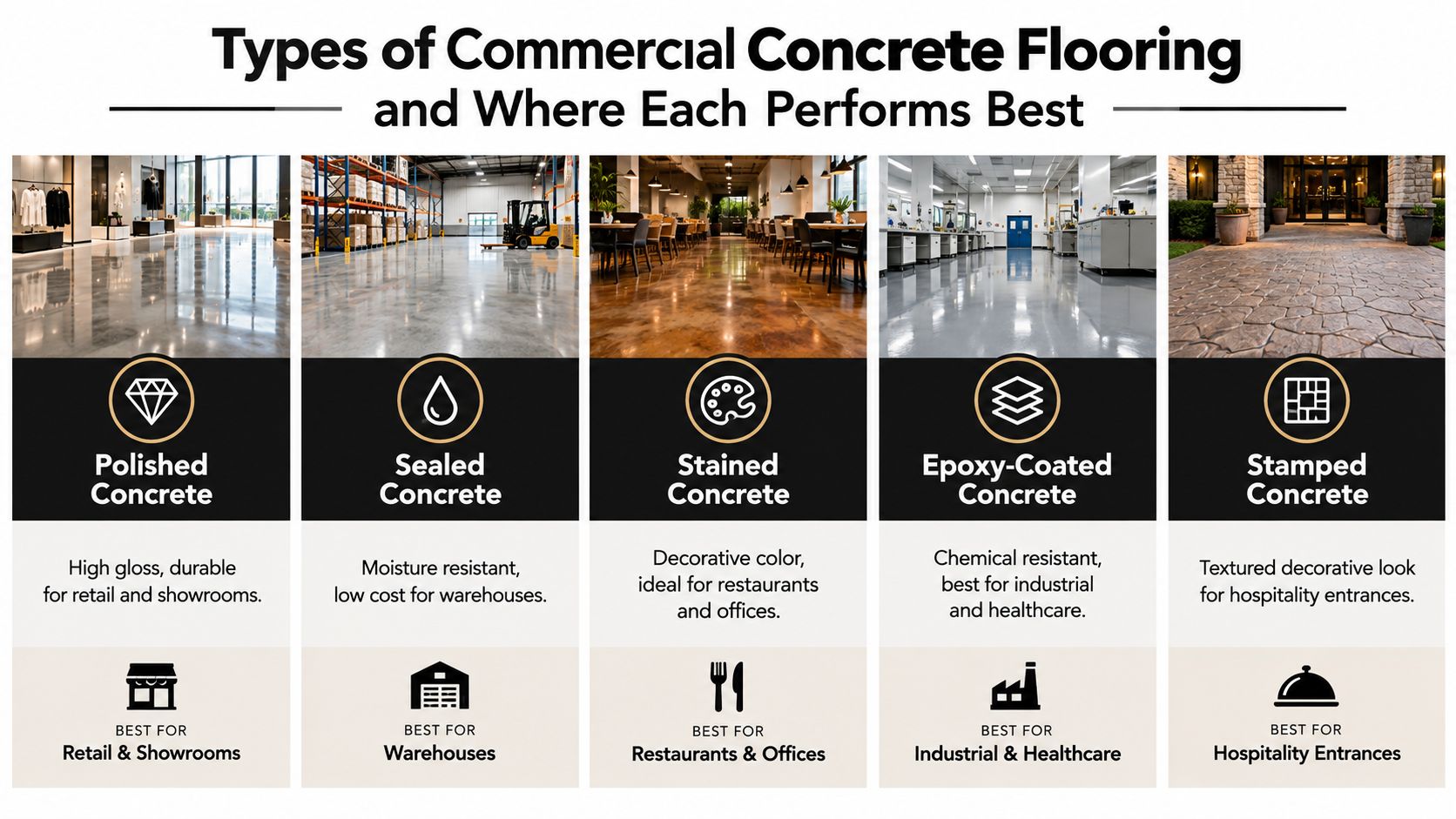
The best system depends on what the floor must tolerate. A glossy retail floor, a chemical-resistant industrial surface, and a textured hospitality entrance may all use concrete, but they solve different problems.
Match the finish to the environment
Polished concrete suits retail stores, showrooms, offices, and public interiors where appearance and cleanability matter. The process can expose aggregate and create varying sheen levels, but the slab must be suitable for grinding and polishing. A commercial polished concrete resource from Atlanta Concrete Solutions can help owners evaluate that finish as part of a larger concrete scope.
Sealed concrete is a practical choice for warehouses, utility areas, and back-of-house spaces. It can reduce absorption and simplify cleaning, but the sealer's performance depends heavily on preparation and the product's compatibility with moisture and traffic.
Stained concrete adds color and visual variation. Restaurants, offices, lobbies, and boutique commercial interiors may use it to create character without covering the slab with another material. Stain changes appearance, though, so it shouldn't be confused with a heavy-duty protective coating.
Epoxy-coated concrete creates a layered surface suited to areas exposed to chemical contact, frequent cleaning, or industrial wear. Healthcare, manufacturing, food service, and maintenance rooms may benefit from this approach. The slab must be dry enough, clean enough, and mechanically prepared for reliable adhesion.
Stamped or decorative concrete provides a patterned finish for hospitality entrances, exterior walkways, and branded public areas. Texture can improve visual interest and may contribute to traction, but the owner should review cleaning, snow or grit exposure, and long-term resealing requirements.
| Flooring System | Best For | Key Strength | Maintenance Level |
|---|---|---|---|
| Polished concrete | Retail and showrooms | Refined appearance with a dense surface | Moderate |
| Sealed concrete | Warehouses and utility areas | Moisture resistance and practical upkeep | Low to moderate |
| Stained concrete | Restaurants and offices | Decorative color and visual variation | Moderate |
| Epoxy-coated concrete | Industrial and healthcare spaces | Chemical and wear resistance | Moderate |
| Stamped concrete | Hospitality entrances and public areas | Textured decorative appearance | Moderate to high |
The comparison should guide the conversation, not replace a site review. A restaurant kitchen and dining room may need separate systems even though they share one address. A warehouse entrance may also require a different slip and cleaning strategy than the storage aisles.
Ask the installer to explain the transition details, edge conditions, joints, drains, and moisture plan. Those small interfaces often determine whether the floor performs as one system or develops isolated failure points.
Cost Durability and Lifecycle Value in Atlanta Context
A facility manager reviewing two bids may see only the first invoice. The working cost is larger: repairs, cleaning requirements, resurfacing, replacement, and the disruption caused when an active area closes. A lower initial price can become expensive if the slab is not flat, the mix does not suit the traffic, or moisture undermines the finish.
Atlanta driveway pricing offers a useful starting point. A standard no-frills concrete driveway is commonly estimated at $8 to $15 per square foot, while stamped or colored options can reach $10 to $18 or more per square foot, according to Atlanta Concrete Solutions' driveway cost guide. Commercial interiors have different access, preparation, loading, and specification requirements, so these figures are not a commercial bid. They show how finish complexity can change the starting price.
A separate Atlanta comparison places concrete driveways at roughly $6 to $12 per square foot, compared with $3 to $7 per square foot for asphalt, as reported by MHBPaving's Atlanta concrete versus asphalt comparison. For commercial interiors, use those figures only as an anchor for how finish complexity shifts price, then apply the worksheet below. The decision should also account for service life, maintenance cycles, drainage, traffic, and interruption risk.
Think in ownership periods
Concrete driveways are described as lasting 30 years or more when properly installed. The Atlanta comparison gives concrete a typical lifespan of 30 to 50 years, while asphalt is listed at 15 to 20 years. Commercial flooring needs its own specification, but the operating principle remains clear: the cheapest installation isn't automatically the cheapest surface to own.
Build a lifecycle worksheet with these categories:
- Installation: slab work, preparation, finish, joints, edges, and access controls.
- Maintenance: cleaning products, resealing or polishing, inspections, and spot repairs.
- Downtime: lost production, closed aisles, blocked entrances, or tenant disruption.
- Failure exposure: moisture-related delamination, dusting, cracking, slip concerns, and replacement scope.
The finish must match the room's work. A polished floor may remove the need for separate floor covering, while an epoxy system may earn its cost in a chemical-exposed room. A sealed slab can suit storage areas with modest appearance standards and convenient maintenance access.
Budget test: Ask what the proposed system will require after installation, not just what it costs on handover day.
Separate repairable wear from structural failure. A worn sealer, isolated stain, or small surface defect may call for maintenance or localized restoration. Settlement, widespread delamination, severe curling, or inadequate operational flatness can require a larger corrective plan. In Atlanta, ask the contractor to support the recommendation with slab flatness records, mix details, and moisture testing, because those records show whether the quoted finish has a sound base and a credible service life.
Installation and Resurfacing What Determines a Floor That Lasts
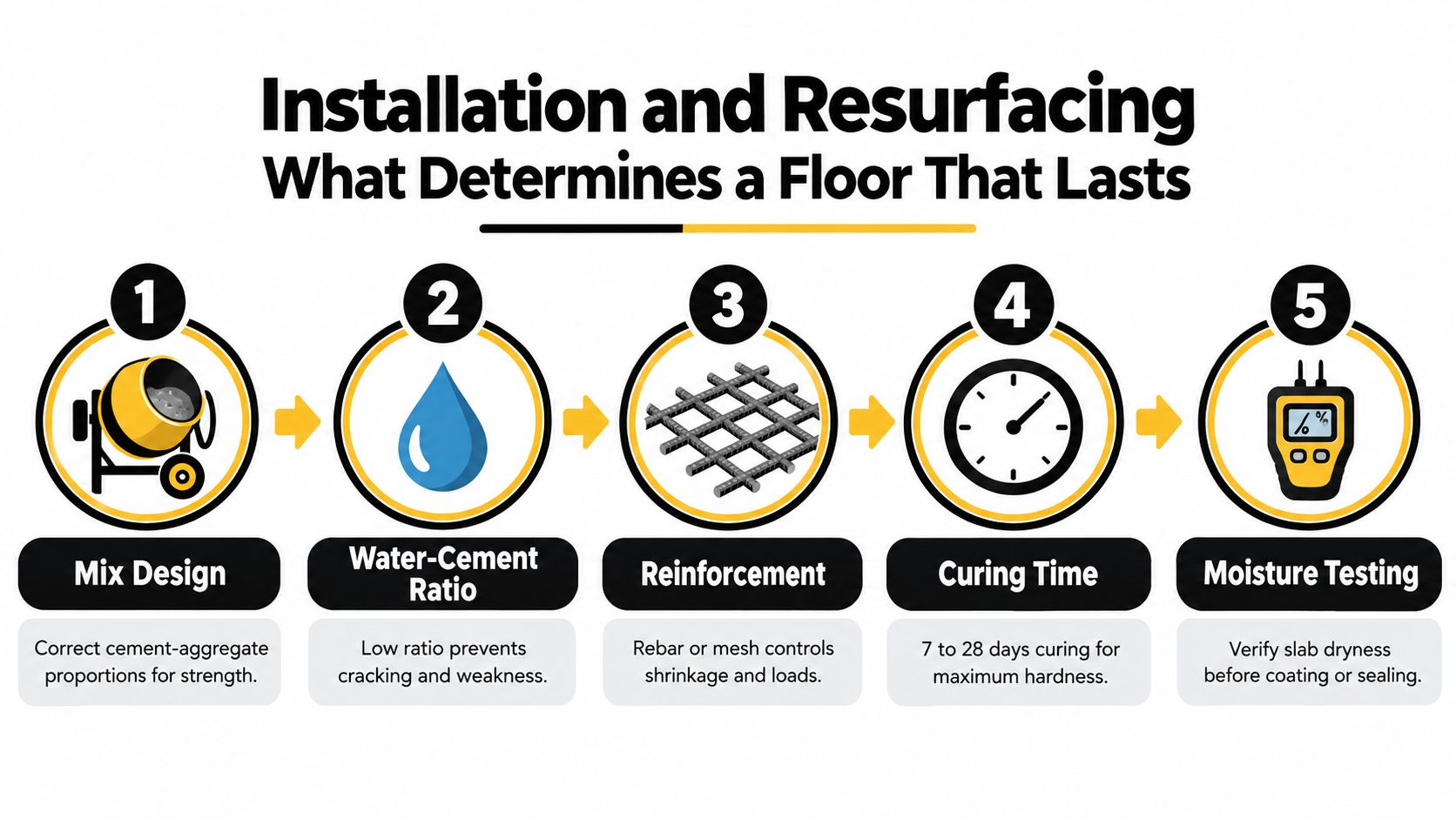
With the mix specified, lasting performance depends on placement controls: water added at the truck, reinforcement position, curing, and documented moisture testing. In a busy Atlanta facility, these details work like the floor's supporting frame. A polished finish cannot compensate for a slab that is wet, poorly prepared, or outside the required flatness range.
Control placement, not just the finish
The crew should follow the approved mix rather than add uncontrolled water at the truck to make placement easier. The batch ticket, delivery timing, slump checks, reinforcement location, and placement records help confirm that the installed slab matches the specification.
The project documents should identify compressive or flexural strength, slump, admixtures, reinforcement, surface hardeners, curing requirements, and applicable ACI 117 tolerances. Reinforcement must remain in its designed position to help manage shrinkage and service loads. It cannot correct weak subgrade preparation or replace properly planned joints.
Flatness also deserves a field check. Forklifts and pallet jacks respond to floor irregularities much like a cart responds to a rough track. Ask for flatness records in travel aisles, turning areas, and other locations where operating equipment depends on a consistent surface.
Treat curing as part of construction
Curing gives concrete time to develop density and hardness. A driveway reference describes about 7 days before vehicle traffic, with full cure continuing through 28 days, as summarized by US Calculators' concrete driveway guidance. Commercial facilities need a project-specific traffic plan, especially when forklifts, pallet jacks, or heavy equipment will use the surface.
Surface hardeners, including mineral or metallic products, may improve wear resistance where turning loads and frequent cleaning create abrasion. They still require a suitable slab, correct application, and adequate curing. A hardener placed over a weak or contaminated surface only covers the problem temporarily.
Decide whether to resurface or replace
Resurfacing can fit a structurally sound slab with limited surface defects. It becomes a risky shortcut when the substrate moves, moisture enters actively, cracks are widespread, or the new material cannot bond to the prepared surface. Atlanta contractors should document grinding or profiling, repairs, bond conditions, and the areas tested before recommending a system.
Moisture testing should be completed and recorded before coating or sealing. Flooring guidance reports that independent third-party testing is increasingly required in writing and that ASTM F2170 relative humidity testing has displaced calcium chloride as the only defensible moisture test in warranty disputes. Renovation is projected to grow at 6.43% through 2031, while non-residential facilities held 68.11% of 2025 value, according to IFTI's commercial flooring specification and testing guidance.
Inspection question: Don't ask only which finish the contractor recommends. Ask what moisture, profile, flatness, reinforcement, and repair evidence supports that recommendation.
Require photographs, test locations, readings, preparation details, product data sheets, curing instructions, and acceptance criteria. Those records give the owner a verifiable basis for accepting the work and a clearer starting point if a coating later blisters or releases.
Maintenance Safety and Compliance for High Traffic Commercial Floors
Maintenance starts with matching the cleaning method to the finish. A polished slab may need a neutral cleaner and controlled burnishing or polishing plan. A coated floor may require products approved by the coating manufacturer. Aggressive chemicals, abrasive pads, or standing water can shorten the service life of a system that was otherwise installed correctly.
Build habits around traffic
Daily crews should remove grit and spills before forklifts or carts grind them into the surface. Managers should inspect entrances, turning zones, loading areas, joints, drains, and places where water repeatedly collects. These locations tell you where wear is developing before it spreads across the facility.
Use a simple operating routine:
- Clean promptly: Remove oil, food residue, metal shavings, and tracked grit before traffic spreads them.
- Inspect visually: Look for dusting, exposed aggregate, peeling, cracks, curled joints, and gloss changes.
- Control slip conditions: Address spills and wet-cleaning areas quickly, and verify that the selected finish suits the expected contamination.
- Record repairs: Note the location, cause, product used, and date so recurring defects can be identified.
- Follow product instructions: Keep the sealer or coating manufacturer's cleaning and recoating requirements with the facility records.
Mineral deposits can leave white or dark marks that ordinary cleaning won't remove. For practical background on treating those conditions without damaging the surrounding surface, consult this cleaning mineral stains on concrete guide.
Protect people and the asset
Slip resistance is a use-specific issue. A smooth showroom surface may work well in a dry interior, while a restaurant entry, washdown area, or loading zone may need a different texture and drainage strategy. The owner should coordinate flooring decisions with housekeeping procedures, accessibility requirements, workplace safety practices, and applicable building standards.
Don't wait for a dramatic failure. Peeling at coating edges, recurring damp spots, powder under tires, and growing joint damage are all reasons to schedule a professional assessment. Early maintenance can preserve more of the original system and may reduce the need for disruptive resurfacing.
How to Choose the Right Commercial Concrete Flooring Contractor in Atlanta
A qualified contractor should explain the floor as a complete assembly, not sell a finish in isolation. Ask how the team evaluates the existing slab, what testing it performs, how it handles repairs, and which acceptance criteria appear in the proposal.
Verify technical capability
Look for a contractor who can discuss:
- Flatness and levelness: Can the team identify whether the floor suits office, retail, warehouse, or precision traffic requirements?
- Surface preparation: Will workers mechanically prepare the slab, remove contamination, repair defects, and document the profile?
- Moisture readiness: Does the proposal identify ASTM F2170 testing or another defensible process appropriate to the system?
- Mix and curing controls: For new concrete, will the team address water-cement ratio, reinforcement, curing, joints, and strength requirements?
- Phasing: Can the contractor protect occupied areas and maintain safe routes during renovation?
- Closeout support: Will the owner receive maintenance instructions, product records, test reports, and repair recommendations?
A portfolio should include work similar to your facility, not merely attractive residential driveways. Ask to see examples involving warehouses, retail interiors, offices, industrial areas, or other spaces with comparable traffic and cleaning demands. References should speak to communication, schedule control, cleanup, change management, and post-installation responsiveness.
Evaluate the working relationship
Atlanta Concrete Solutions describes services covering commercial concrete installation and repair, including flooring, with work across Alpharetta, Marietta, Johns Creek, Duluth, and surrounding communities. The company also offers free quotes and financing options. Those services can be useful during early budgeting, but the owner should still compare the proposed scope, testing plan, finish system, and warranty terms with other qualified bids.
Review Atlanta Concrete Solutions' project examples alongside competing portfolios. A strong bid should make the hidden work visible, including demolition, substrate repairs, moisture testing, protection, access planning, curing, and final documentation.
The best contractor conversation ends with fewer unknowns. Before signing, request a written sequence of work, product data, testing responsibilities, traffic restrictions, maintenance requirements, and a process for handling unforeseen slab conditions.
If your Atlanta facility needs a new slab, resurfacing plan, polished finish, or commercial concrete repair, Atlanta Concrete Solutions can evaluate the existing conditions and prepare a documented scope around your traffic and maintenance needs. Visit Atlanta Concrete Solutions to request a free quote and discuss scheduling, financing, and service options for your property.