
Foundation repair is usually worth it when the problem is real, because the typical U.S. job runs about $5,172 to $5,179, while unrepaired foundation damage is commonly reported to knock 10% to 20% off home value (Angi). On a $400,000 house, that gap can get ugly fast, and in Atlanta's clay-heavy ground it tends to get worse if you wait.
A homeowner in Marietta feels that right away. The crack by the window looks small in the morning, then you keep staring at it while the floor feels a little off and the door starts sticking, and now you're doing the same math every homeowner does, patch it, ignore it, or call somebody and brace for a painful bill.
The Moment Every Homeowner Reaches
You notice the crack while making coffee, then spend the rest of the morning testing doors, floors, and your bank balance. A tube of sealant may hide the symptom, but it will not answer the question: is the house stable, or is movement continuing?
What a homeowner is really deciding
Foundation repair is a cash-flow and insurance decision before it becomes a property-value question. Decide whether you can fund the work now, whether your policy might apply, and what delay could do to the structure. Call your insurer before authorizing repairs, then get an inspection that identifies the cause rather than selling you a patch.
A cosmetic shrinkage crack may need observation. Active movement, shifting load transfer, or recurring water intrusion deserves a professional evaluation. Look at the whole system, including doors that stick, uneven floors, drainage, and moisture around the foundation.
National cost data shows that repairs can range from manageable work to a serious household expense, depending on severity and method (Angi). Build the repair into your cash-flow plan instead of waiting until the problem forces an emergency decision. A delayed repair can also complicate a sale and reduce buyer confidence, even when the damage is not immediately visible.
Treat the crack as a warning, not a diagnosis. Confirm whether the home is moving, why it is moving, and what repair stops it.
Atlanta clay soil raises the stakes. It swells when wet and shrinks during dry periods, putting repeated stress on foundations. After a wet season followed by drought, schedule an evaluation sooner rather than later.
Reading the Cracks in Your Foundation
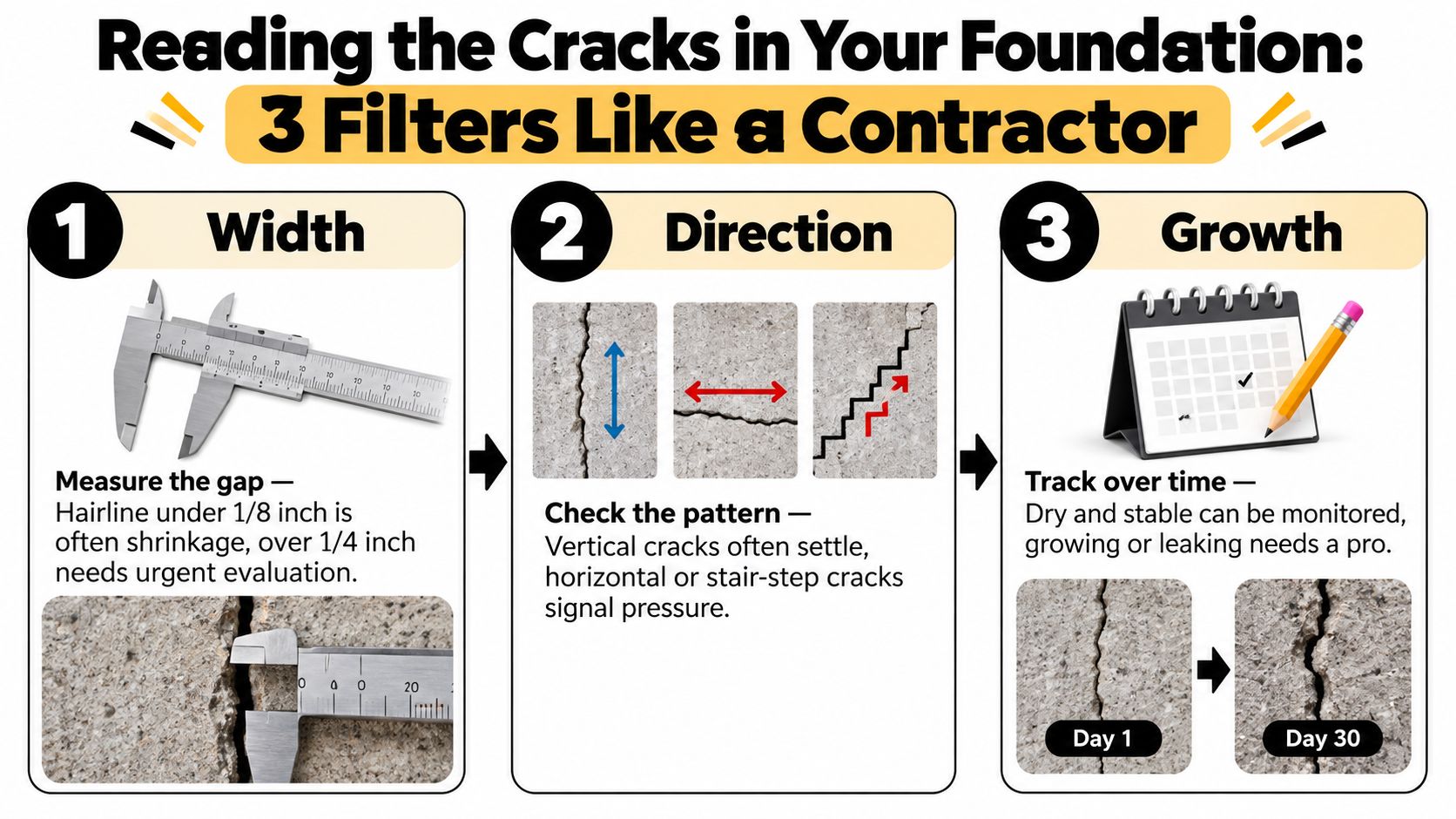
Width first, then direction, then growth
Start with the gap itself. Hairline vertical cracks under about 1/16 inch are usually low-risk monitoring items, not an emergency (The Basement Guide). Once a vertical crack reaches 1/8 to 1/4 inch, or you see stair-step movement through block or brick, stop guessing and get it checked.
Direction matters just as much. Vertical cracks often line up with shrinkage or settlement. Horizontal cracks usually mean wall pressure and deserve faster attention. Growth matters most of all, because a stable crack is one thing, and a crack that keeps moving is another.
A Gwinnett County slab that widened by roughly 1/2 inch over one rainy season is the kind of change that stops being a cosmetic issue. That sort of movement often points to a failing perimeter pier, not a tube of sealant.
Keep a ruler, a pencil mark, and dated photos. If the crack stays dry, stays narrow, and does not change, monitor it. If it grows, leaks, or changes shape, call a pro.
If you want a broader exterior reference point, the residential poured concrete work at Atlanta Concrete Solutions shows how slab behavior and structural work connect in real homes.
What a contractor would want to see
A good contractor does not just eyeball the wall and guess. They look for displacement, repeated seasonal movement, and symptoms that match settlement, not just surface cracking.
The same discipline shows up in what RICS surveyors say about subsidence, because the point is to track movement, not appearance.
If a crack is dry, thin, and unchanged, keep records. If it widens, lets in water, or starts affecting doors and floors, stop treating it like a cosmetic defect.
Atlanta homes need that discipline. Clay soil and moisture swings keep stressing the foundation, so repeated measurement beats a one-time opinion every time.
What Foundation Repair Costs
The job has tiers, and the tier tells you the underlying problem
Foundation work is priced by scope, not by a single menu. A crack seal, a slab lift, and a pier system are different jobs because they solve different levels of movement, leak risk, or structural loss.
| Repair Tier | Typical Cost | Problem It Fixes |
|---|---|---|
| Crack sealing | Low, usually the cheapest repair level | Minor leaks, non-structural shrinkage, cosmetic cracks |
| Slab jacking | Moderate | Sunken porches, garage floors, small settled slab sections |
| Piering or underpinning | Higher, structural work | Active settlement and load transfer problems |
| Full replacement | Highest and rare | Foundation failure that can't be stabilized economically |
That table matters more than the first quote. A cheap sealant job will not stop settlement, and piering is wasteful when you are dealing with a dry hairline crack.
Atlanta homeowners should also treat this as a cash-flow decision, not just a resale question. Clay soils and moisture swings keep pushing and pulling on foundations here, so the longer you wait, the more likely you are to turn a repair into a larger insurance and financing problem.
A broad market summary puts the U.S. foundation repair market at $4.8 billion in 2023, with projected growth to $7.5 billion by 2032 at a 5.1% CAGR (iBuyer). That does not tell you what your house will cost, but it does show how common this work has become.
Atlanta changes the bid
Local pricing moves with access, soil depth, and how hard it is to reach stable support. A house on expansive clay may need more aggressive stabilization than a home built on friendlier ground.
If you are budgeting the work against other projects, the approach in estimating renovation costs for investors is the right way to think about it. Price the repair by scope, then decide whether the house can carry that cost without breaking your monthly budget.
The right diagnosis saves money. The wrong repair still drains cash, and the right repair is usually cheaper than the damage it prevents.
Repair Methods and When Each One Fits
Sealing, lifting, and supporting are not the same thing
Crack sealing with epoxy or polyurethane belongs at the low end of the spectrum. It's used when the crack is stable, narrow, and not part of active structural movement. On site, the crew cleans the crack, injects the material, and seals the surface so water doesn't keep finding the same path.
Slab jacking is different. The crew drills small access points and lifts settled concrete with grout or foam, which makes sense for garage floors, porches, and driveways that have dropped but haven't lost structural support. If you've ever dealt with a slab leak, the signs described in signs of a concrete slab leak make clear why water and settlement often show up together.
Piering is for movement, underpinning is for severe loss
Piering uses steel or helical piers to transfer load deeper into stable soil. It's the right call when the house is still moving and the structure needs a new path to support the weight. Underpinning goes further and is usually reserved for severe cases where the existing footing system has failed or needs full reinforcement.
Atlanta Concrete Solutions also handles residential foundation concrete and residential concrete and masonry repair, which fits the reality that foundation work and related concrete damage often overlap on the same property.
The important part is matching the fix to the symptom. If doors stick and cracks widen seasonally, don't let somebody sell you a cosmetic patch before an engineer or a serious foundation specialist looks at the movement.
Why Putting It Off Usually Costs More
Delay turns one repair into three
A cracked foundation in Atlanta does not stay a simple crack for long. Clay soil moves with wet and dry cycles, and each round of movement can widen the opening, stress framing, and pull moisture deeper into the house.
As noted earlier in the cost breakdown, the repair bill is only part of the decision. A homeowner who waits can face a resale hit, interior repairs, and the kind of lender or insurer questions that show up once movement becomes visible. On a $400,000 home, a small monthly payment on a HELOC can be easier to absorb than a much larger loss when the house finally hits the market.
Insurance usually doesn't rescue you
Standard homeowners policies usually pay for foundation damage only when a covered peril causes it. Settling, soil movement, and drainage problems usually sit outside that protection, which leaves Atlanta owners responsible for the bill.
If the movement is gradual, plan to fund it yourself.
That is why timing matters. Delaying repair does not improve the claim picture, and it rarely makes the work cheaper.
Moisture also creates a second bill. Once water starts finding the same weak spots, you can end up with plumbing stress, mold cleanup, and interior restoration on top of the foundation work. If the damage has already spread beyond the structure, residential concrete and masonry repair often becomes part of the fix too.
Paying for the Work Without Going Underwater
Start with the funding source that protects your monthly cash flow. If you have enough equity, a HELOC or cash-out refinance can cover a $5,000 to $10,000 repair at a lower rate than unsecured debt. Contractor financing may close faster, but that convenience can cost more. A personal line of credit is a backup when the repair cannot wait.
Use a credit card only for a small sealing job or short-term bridge. Structural work deserves financing with payments you can sustain, because high-interest revolving debt can turn a manageable repair into a long financial burden.
Before signing, verify the contractor's insurance, confirm that required county permits will be pulled, and demand a written diagnosis explaining the cause of movement. The proposal should identify the repair method, scope, payment schedule, and warranty terms. A transferable warranty can protect you if you sell later.
The bid is only half the story. The diagnosis, permit, and warranty show whether the work is properly defined.
Atlanta's clay soil and wet-dry swings make timing a cash-flow decision. Waiting for a perfect season rarely saves money if movement continues. Set aside room in your budget for drainage or moisture work when the site conditions require it, rather than treating the foundation invoice as the entire project.
Your Decision Rule for Foundation Repair
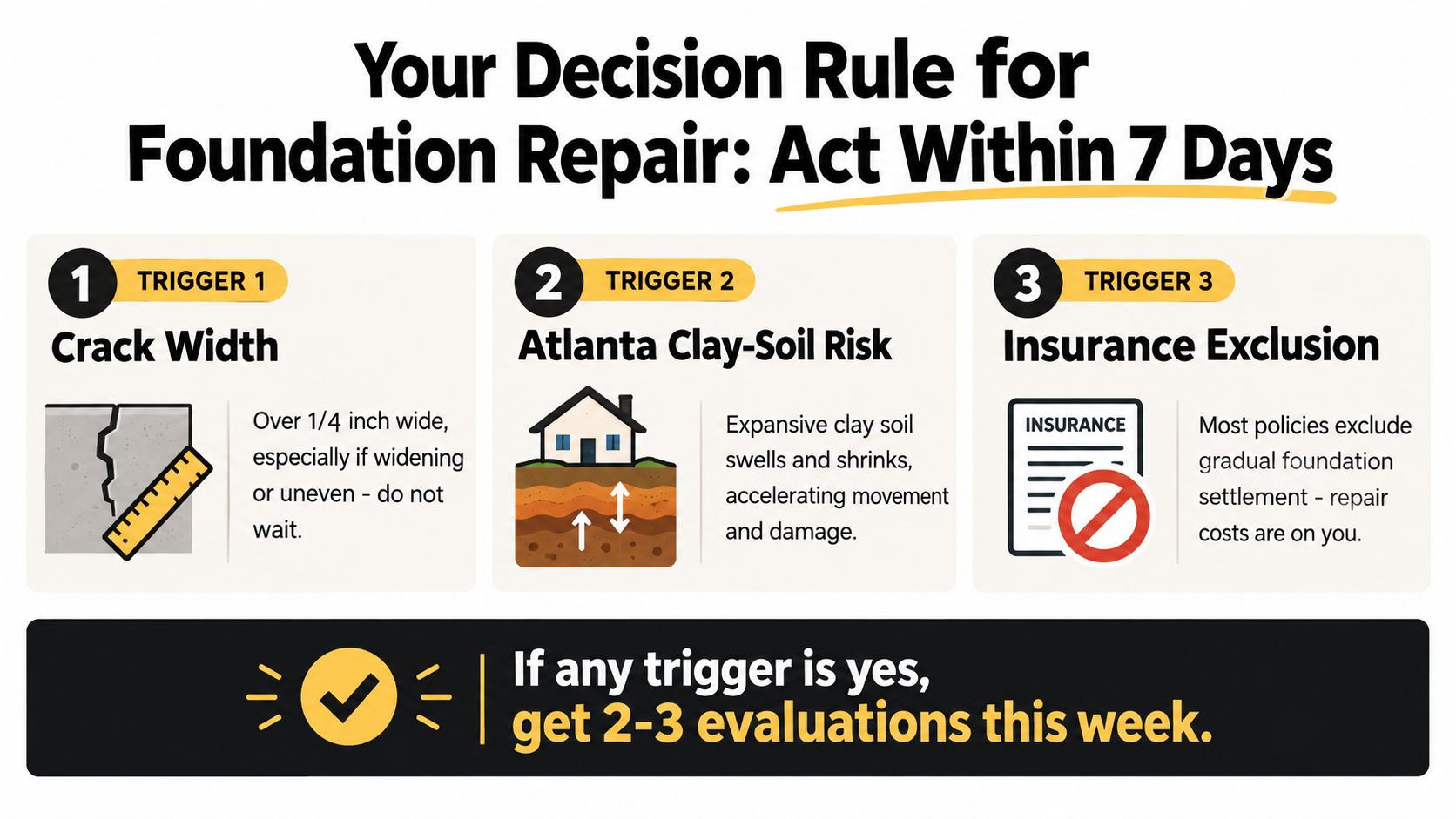
Use the same rule every time
A cosmetic crack that stays dry and unchanged can be monitored. Keep the expense limited to sealing and routine checks. A local structural problem deserves a repair budget, including piering or underpinning within the next twelve months when the diagnosis calls for it. Cracks spreading across several walls require a full structural evaluation, not another round of patching.
Three warning signs justify prompt professional attention: Over 1/4 inch wide cracks, active water intrusion at the slab, and doors or windows that no longer latch properly. Call a structural engineer when any one appears.
Atlanta's reactive clay soil and wet-dry swings make delay a cash-flow decision. Continued movement can turn a defined repair into a larger project, while unrepaired damage can affect resale and insurance discussions. Georgia disclosure rules still apply when you sell, so waiting does not erase the condition.
Use this one-week plan:
- Photograph and measure each visible crack.
- Request two Atlanta-specific written quotes and compare the scope, not only the price.
- Call your insurance carrier to confirm exclusions before assuming the policy will pay.
- Decide before the next wet season if the evaluation shows active movement.
Red flags call for diagnosis, not cosmetic paint.
For an evaluation of Atlanta concrete and foundation problems, Atlanta Concrete Solutions can inspect the damage, identify what is moving, and provide a plain-language repair quote. Get the condition assessed while the repair remains manageable, then decide whether the work fits your cash flow and insurance position.