
The typical cost to pave a driveway in 2026 lands between roughly $2,523 and $7,292 nationally, with average spend around $4,908. In Atlanta, that number spreads fast because the invoice usually turns on demolition, clay-heavy subgrade, drainage fixes, reinforcement, and slab thickness, not just the surface material.
That's why two homeowners can both say they got a quote for a “new driveway” and be talking about two very different jobs. One quote may cover a simple surface replacement over a solid base. The other may include tear-out, haul-off, deeper excavation, fresh stone, rebar, and a thicker concrete section for heavier vehicles.
A lot of pricing pages stop at a national average and leave it there. That average is useful, but it doesn't help much when a bid that looked like a $4,000s project starts reading like an $8,000 one after the line items show up. The number moves when the existing driveway has failed underneath, when runoff has nowhere to go, or when the slab needs to carry more than passenger cars.
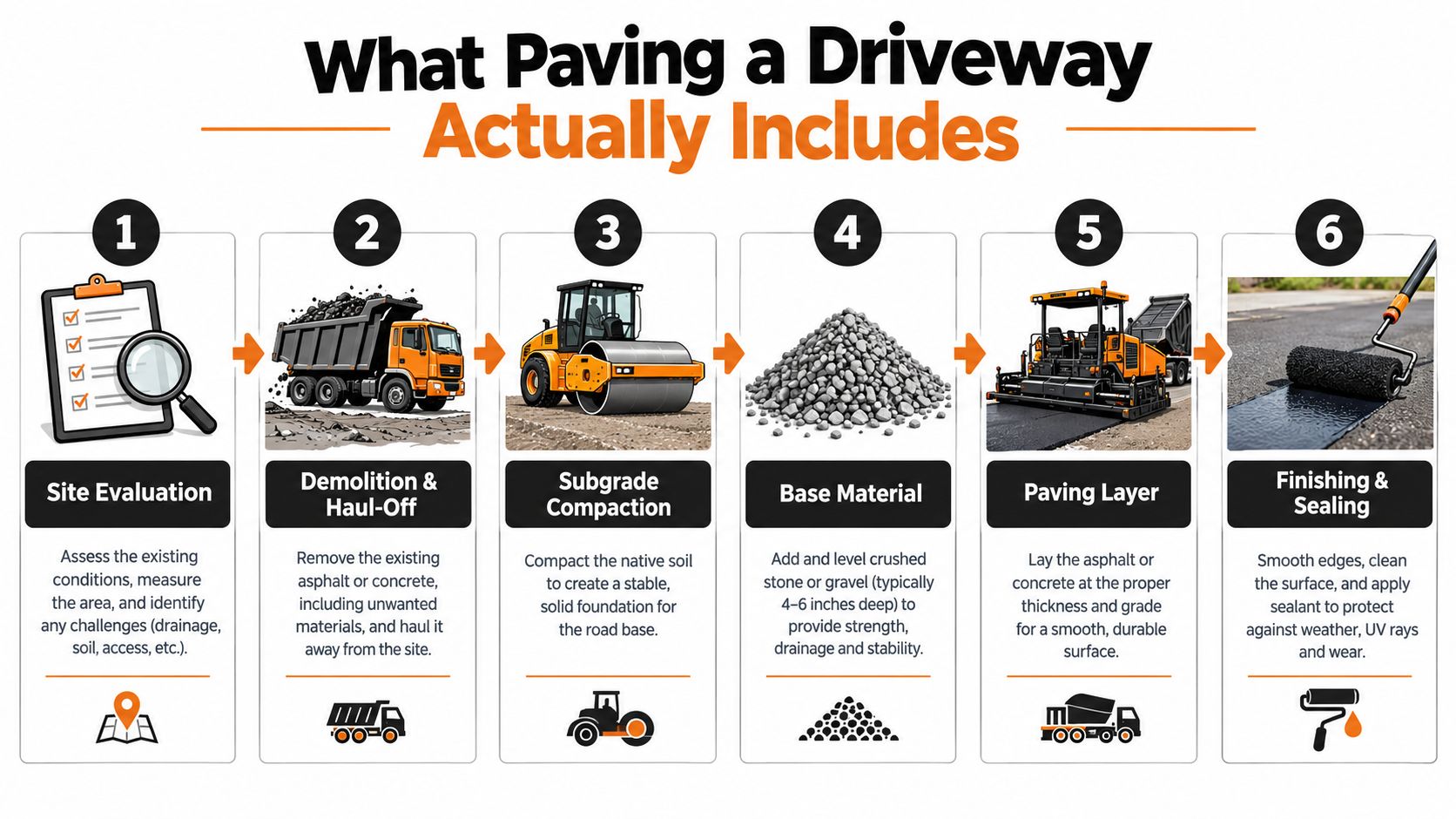
What Paving a Driveway Actually Includes
A driveway quote covers a lot more than the surface you can see. On real jobs in Atlanta, the expensive part is often underneath. Removal, haul-off, grading, stone base, reinforcement, thickness, and drainage are the items that turn a simple replacement into a full rebuild.
A proper install usually includes site review, layout, removal of the old driveway if needed, excavation, subgrade compaction, base installation, forms, reinforcement where specified, the finished paving layer, joints or seams, edge support, cleanup, and cure time or compaction time before traffic. Skip one of those steps and the driveway may still look clean at handoff. It just tends to crack, settle, or hold water sooner.
Surface install versus full replacement
A resurfacing job and a full replacement are priced differently because they solve different problems. If the existing base is stable and the driveway has only surface wear, the crew may be able to install a new top layer with limited prep. If the slab is cracked through, the asphalt is failing in wheel paths, or water is moving under the driveway, the old work has to come out and the support under it has to be rebuilt.
That is where many homeowners get surprised. The low quote often covers placement of new material. The higher quote may include saw cutting, demo, export, deeper excavation, fresh aggregate base, steel, and slope corrections. Both can be described as a "new driveway," but they are not the same scope.
Practical rule: If a quote does not spell out demo, disposal, base work, reinforcement, and thickness, the price is incomplete or the scope is.
What is usually bundled into one quote
Many contractors present one lump sum. That keeps the proposal short, but it also hides the line items that move the invoice.
For a standard residential driveway, a bid often includes:
- Existing driveway removal: Saw cutting, breakout, loading, disposal, and dump fees.
- Subgrade work: Proof-rolling, recompaction, and correction of soft spots.
- Base material: Crushed stone placed and compacted to support the slab or asphalt.
- Forms and layout: Width, elevation, pitch, and tie-ins at the garage and street.
- Reinforcement: Rebar or wire mesh if the scope calls for it.
- Paving surface: Asphalt, concrete, decorative concrete, or pavers.
- Finish details: Control joints, edges, apron transitions, and final cleanup.
I tell homeowners to read the exclusions as carefully as the total. A quote can look competitive until you find out drain work, thicker sections, or haul-off are extra.
If you want a clear example of how residential flatwork scopes are separated, Atlanta concrete driveway and slab services shows the kind of work that often gets broken out before final pricing is set.
National Cost Ranges and What Drives Them
A national average can miss the job by thousands.
Broad market guides put installed driveway paving in a wide band, often around $8 to $25 per square foot, with total projects commonly landing somewhere in the low thousands to the low five figures. That range is useful for one thing. It tells you whether a quote is wildly out of line before you look at scope. It does not tell you why one Atlanta driveway prices at $4,000 and another similar-looking job lands at $8,000.
That gap usually comes from work that sits below the surface or around the edges. Demo, haul-off, stone base, reinforcement, thicker concrete, drainage correction, and difficult access change the invoice fast. Homeowners tend to compare finish material first. Contractors price the whole build.
Square-foot pricing only helps after the scope is defined
A clean rectangle with easy truck access and stable soil is the cheapest version of almost any driveway material. Add a failed base, soft spots near the garage, a steep approach, or a section that needs to carry heavier vehicles, and the per-square-foot number starts climbing.
Concrete is the clearest example. A standard residential slab may be poured at 4 inches for normal passenger vehicle use. If the driveway needs to handle heavier loads or has weak support conditions, contractors may price a thicker section, added steel, or both. That is where a low headline rate stops being useful.
The finish gets the attention. The prep work sets the price.
What actually pushes a national range higher
Surface material
Asphalt usually starts lower than concrete. Concrete usually starts lower than pavers with decorative work. That is only the surface line item.Removal and disposal
New construction on open ground prices differently than replacing an old cracked driveway. Breakout, loading, dump fees, and extra labor can add real money before the new surface even starts.Base preparation
If the subgrade is solid, base work stays light. If the ground pumps, shifts, or holds water, expect added stone, grading, and compaction.Thickness and reinforcement
A basic passenger-car driveway costs less than one built for heavier traffic, delivery trucks, or RV parking. More concrete and more steel raise the total quickly.Drainage and layout complexity
Straight drives are easier. Tight curves, aprons, retaining edges, trench drains, and slope corrections all increase labor.
Here is a practical baseline for a 500 square foot driveway using common national installed ranges already noted earlier in the article.
| National 2026 Driveway Paving Cost Ranges | Cost Per Sq Ft | Typical Total (500 sq ft) | What Usually Changes the Price |
|---|---|---|---|
| Asphalt | $3 to $7 | $1,500 to $3,500 | Base condition, edge support, access, removal |
| Concrete | $6 to $15 | $3,000 to $7,500 | Thickness, reinforcement, finish level, drainage |
| General installed paving range | $8 to $25 | $4,000 to $12,500 | Full scope, not just surface material |
For homeowners trying to sanity-check square-foot pricing, Firm Foundations driveway cost details give another useful reference point. Use that kind of guide carefully. The quote still comes down to scope, site conditions, and how much hidden prep the contractor included.
Comparing Asphalt, Concrete, and Pavers by Total Cost
A driveway that starts around a few thousand dollars can end up costing twice that over its life if the surface choice does not match the site, traffic, and maintenance tolerance.
Asphalt usually comes in with the lowest initial quote. Concrete lands in the middle. Pavers sit at the top on install price. That part is straightforward. Where homeowners get surprised is total cost after repairs, upkeep, and partial replacement start showing up.
CostFlock's driveway paving cost guide puts a standard two-car driveway at roughly $2,000 to $4,800 for asphalt, $2,400 to $6,000 for plain concrete, and $6,000 to $18,000+ for pavers. It also notes that repaving or replacement later can add a substantial second round of cost. That matters because the cheapest install is not always the cheapest 10 years later.
What each material really costs over time
Asphalt wins on entry price, but it asks for more upkeep. In Atlanta heat, turning tires, oxidation, and edge breakdown show up faster on weak base work or thin sections. Homeowners who choose asphalt usually do it for budget, and that can make sense, especially on a long rural-style drive where square footage pushes the total hard.
Concrete costs more upfront, but it usually gives homeowners a steadier maintenance cycle. If the slab is thick enough, reinforced where needed, and sitting on a properly compacted base, it tends to hold its shape better under daily car traffic. That is why many suburban homeowners end up choosing concrete even when the opening number is higher.
Pavers are the premium option on install cost. They can be a good fit for curb appeal and for localized repairs because individual sections can be reset. The catch is the base still has to be built right. A badly prepared paver driveway moves just as surely as any other surface, and the labor cost is much higher from day one.
Side-by-side comparison
| Asphalt vs Concrete vs Pavers: 20-Year Cost Comparison | Upfront Cost/Sq Ft | Expected Lifespan | Maintenance Cycle | 20-Year Total Cost (500 sq ft) |
|---|---|---|---|---|
| Asphalt | Lower installed cost in most quotes | Depends heavily on climate, base, and upkeep | Sealing, crack repair, and possible resurfacing | Often starts low, then rises with maintenance and earlier replacement |
| Plain concrete | Mid-range to higher upfront cost | Strong long-term performer if base and slab are built correctly | Lower routine upkeep, with joint and crack repair as needed | Usually more stable over time |
| Pavers | Highest upfront cost in many markets | Depends on base quality and installation detail | Easier spot repairs, more joints to maintain | High initial spend, but targeted repairs can help control future work |
In practice, I tell homeowners to compare materials based on how long they plan to stay in the house and how much maintenance they are willing to deal with. A starter-home buyer may accept asphalt's lower entry price. A homeowner planning to stay put for 15 years often leans toward concrete because the cost curve is easier to live with.
For a second perspective on how install price and long-term cost compare, the Riverside Sealing & Striping guide is a useful companion read.
Appearance changes the number too. Plain broom-finish concrete is one budget. Stamped, colored, or exposed-finish work is another. Homeowners comparing curb appeal options can review decorative concrete driveway options in Atlanta to see how design choices change both price and final look.
A clean comparison is this. Asphalt is often cheapest to install. Concrete is often cheaper to own over a long stretch when the slab and base are built right. Pavers cost the most upfront and make the strongest visual statement.
Line Items That Quietly Reshape Your Quote
On paper, a driveway quote can look simple. In the field, five line items usually decide whether that quote stays close to the headline number or climbs fast: demolition, base prep, reinforcement, drainage, and slab thickness.
Atlanta homeowners get tripped up here. A contractor throws out a surface price, then the job starts showing itself after the site visit. Old concrete has to come out. Soft spots need to be cut deeper. Water has to be redirected. A 4-inch slab may not be enough for the vehicles that use the driveway.
Site work is often the first cost jump. Independent estimates from Home Project Calculator's driveway cost estimator put site prep at about $1 to $3 per square foot, with slope or grading adding roughly $500 to $2,000 and drainage corrections adding another $500 to $3,000. Those numbers line up with what contractors see every week. The driveway surface is only part of the invoice. What sits under it often decides whether the job holds up or starts failing early.
The line items that matter most
When I review a quote with a homeowner, I tell them to focus less on the finish and more on these entries:
- Demolition and haul-off: Old concrete, asphalt, brick borders, and buried debris all cost money to remove and dump.
- Excavation and subgrade correction: If the soil is weak, wet, or pumping under load, the crew has to cut deeper and rebuild the support.
- Base depth and stone: Thin base is one of the easiest ways to make a bid look cheap. It is also one of the fastest ways to buy settling later.
- Reinforcement: Rebar costs more than light mesh, but on the right site it does a better job controlling slab movement and crack separation.
- Thickness upgrade: A driveway used by delivery trucks, work vans, or an RV should not be priced the same as one carrying two sedans.
- Drainage work: Channel drains, swales, pipe extensions, and tie-ins add cost, but water left under the slab causes a much bigger repair bill later.
- Permit and tie-in details: Aprons, sidewalks, curb connections, and garage transitions can add labor that never shows up in a basic square-foot price.
Typical cost impact by line item
| Hidden Line Items and Their Typical Cost Impact | Typical Added Cost | Optional? |
|---|---|---|
| Site prep | $1 to $3 per sq ft | Sometimes, depends on site condition |
| Slope or grading correction | $500 to $2,000 | Often required when runoff is poor |
| Drainage correction | $500 to $3,000 | Often required when water collects or undermines base |
| Thickness increase from 4 inches to 5 to 6 inches | Raises material cost noticeably | Optional only if light passenger traffic is the true use case |
Thickness deserves special attention because it changes both material volume and, in some cases, reinforcement and edge detail. Going from a standard 4-inch residential slab to 5 or 6 inches is one of the fastest ways for a modest quote to move higher. As noted earlier, thicker concrete can raise material cost by roughly 25% to 50%. In real quotes, the total increase can be even more noticeable once base prep and steel are adjusted to match.
The same pattern shows up in any residential build. Labor, materials, site work, and contingency items stack on top of each other, not side by side. PropLab's 2026 construction budget breakdown is a useful reference if you want to see how those categories typically build into the final contract price.
Bid check: If the estimate lists “site prep” as one lump sum, ask what that includes. You want to know demolition depth, base material, compaction, drainage scope, reinforcement type, and finished slab thickness before you sign.
Atlanta-Specific Pricing and Site Conditions
Roughly the same driveway can price very differently across metro Atlanta once the crew sees the lot. The square footage matters, but the site often matters more.
Current Atlanta pricing for concrete driveway installation is commonly reported at $4 to $8 per square foot, with a typical 600 to 800 square foot two-car driveway totaling about $3,000 to $7,000, according to ProMatcher's Atlanta driveway cost guide. SlabCalc's Atlanta driveway guide lists a local installed figure of $5.01 per square foot, with a reported range of $3.34 to $6.67 per square foot, plus repair pricing that can run high enough that replacement makes more sense on badly failed slabs.
In Atlanta, the quote usually changes for five reasons: demolition, base repair, drainage, reinforcement, and slab thickness. Those are the line items that turn a clean-looking $4,000 quote into a real-world $6,500 or $8,000 contract after the site visit.
I see it all the time on older properties. The old driveway looks flat enough from the street, then the tear-out exposes soft clay, thin stone, roots at the edge, or a low spot that has been holding water for years.
Why Atlanta jobs often cost more underneath than they do on paper
Atlanta-area driveways fail from below as often as they fail at the surface. Clay-heavy soils hold moisture. Runoff from downspouts, garages set low, and older lots with patched additions create base problems that do not show up in a quick online estimate.
Access is another local pricing factor. In intown neighborhoods, a short driveway with tight side clearance can cost more per square foot than a larger suburban pour because trucks, demo equipment, and haul-off have less room to work. Apron tie-ins and sidewalk transitions also add labor because the finish elevations have to meet what is already there.
What changes the invoice on Atlanta jobs
- Soft or wet clay subgrade: Often requires extra excavation, new crusher run, and compaction before concrete goes down.
- Tear-out and haul-off: Old concrete, buried brick, failed patches, and thickened sections near the garage add disposal cost.
- Drainage correction: Water moving toward the house or pooling at the apron usually has to be fixed before the new slab is poured.
- Reinforcement choice: Wire mesh is cheaper. Rebar costs more, but it is often the better call on driveways with marginal base conditions or heavier use.
- Tight access: Smaller equipment, more hand work, and slower debris removal raise labor cost.
- Edge and tie-in work: Garage entrances, curbs, sidewalks, and street aprons need cleaner grade control than an open rectangular pour.
Here's a practical local baseline for a 500 square foot comparison.
| Atlanta Metro Driveway Paving Cost Ranges | Per Sq Ft (Installed) | Typical Total (500 sq ft) | Local Driver |
|---|---|---|---|
| Concrete, lower local reported range | $3.34 to $6.67 | $1,670 to $3,335 | Simpler installs and lower-end local pricing conditions |
| Concrete, common metro guide range | $4 to $8 | $2,000 to $4,000 | Typical two-car residential driveway pricing baseline |
| Concrete, local reported average point | $5.01 | $2,505 | Neutral point estimate for Atlanta concrete installation |
Standard residential pours in this market are commonly 4 inches thick. Jobs that need to carry work trucks, delivery vehicles, or repeated edge loading often move to 5 or 6 inches, and that change usually brings more stone, more concrete, and stronger reinforcement. For homeowners comparing scopes, this overview of Atlanta concrete project services is a useful reference for what a local replacement job may include.
The practical takeaway is simple. In Atlanta, the site visit matters more than the teaser price. If two bids are far apart, check whether both contractors included the same demo depth, base rebuild, drainage work, steel, and slab thickness. That is usually where the gap is.
Financing, ROI, and Resale Value
A driveway replacement often starts as a repair problem and ends as a budget decision. I see that on Atlanta quotes all the time. The homeowner expects a simple surface swap, then the number shows up after demo, base repair, steel, drainage correction, or extra thickness get added.
That is why financing matters. The bill is rarely just for new concrete on top. It is usually for everything under it that failed first.
The common payment routes are straightforward. Some homeowners use a same-as-cash offer and pay it off before interest hits. Some use a HELOC because the rate is better and the draw stays flexible if the scope grows after tear-out. Some use a contractor payment plan because the driveway has already become a safety issue, a drainage problem, or both.
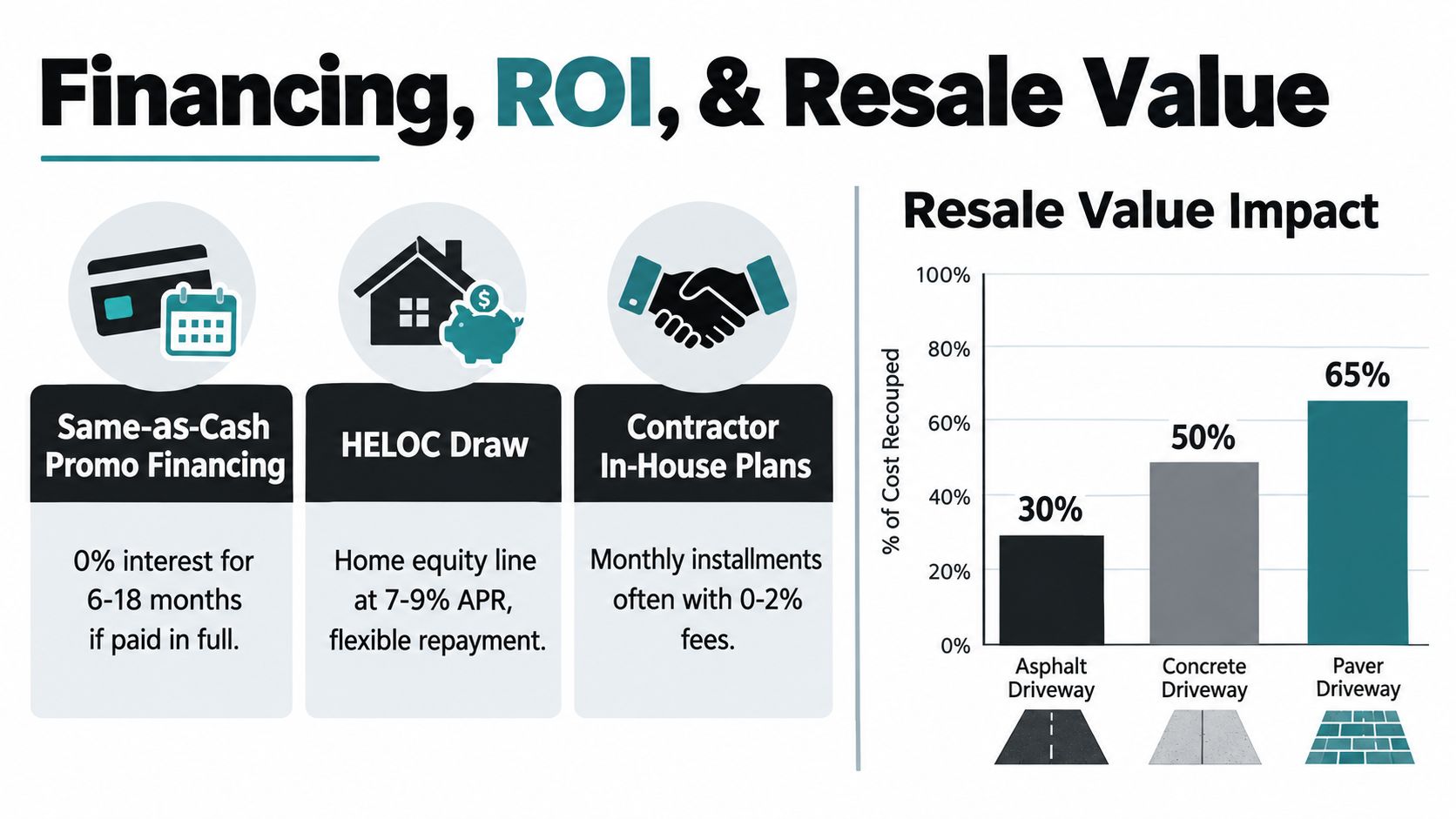
Think in lifetime cost, not only sticker price
The cheapest quote is not always the lowest-cost driveway to own.
As noted earlier, asphalt usually lands lower on upfront price, while concrete usually costs more to install. The part many cost guides skip is what happens after year one. If one option needs more patching, more edge repair, more sealing, or an earlier replacement cycle, the lower entry price can disappear fast. That matters even more when the original quote was already pushed up by site work.
Ownership timeline matters. A homeowner planning to sell soon may care more about clean appearance, safe access, and avoiding an obvious defect during showings. A homeowner planning to stay put for years usually gets more value from a surface and structure that will hold up with less repeat spending.
When paying more makes sense
Spending more up front usually pencils out under a few conditions:
- You are already paying for structural work: If the job includes demolition, subgrade correction, drainage fixes, and fresh base, the savings from choosing the cheapest surface often shrink.
- The driveway sees heavier use: SUVs, work vans, trailers, and repeated delivery traffic justify a stronger section and a material that handles that use better.
- Curb appeal affects the sale: A clean new driveway helps the front of the house read as maintained, which matters more than homeowners think.
- You want fewer repeat repairs: Paying once for a properly built driveway is often cheaper than paying for patches, overlays, and another replacement sooner than expected.
There is no automatic winner on every house. If the property is temporary, the budget is tight, and the existing base is in decent shape, a lower-cost option can be the right call. If the quote already includes the expensive line items that double the invoice, it makes sense to judge the job by total cost over time, not just the number at the bottom of page one.
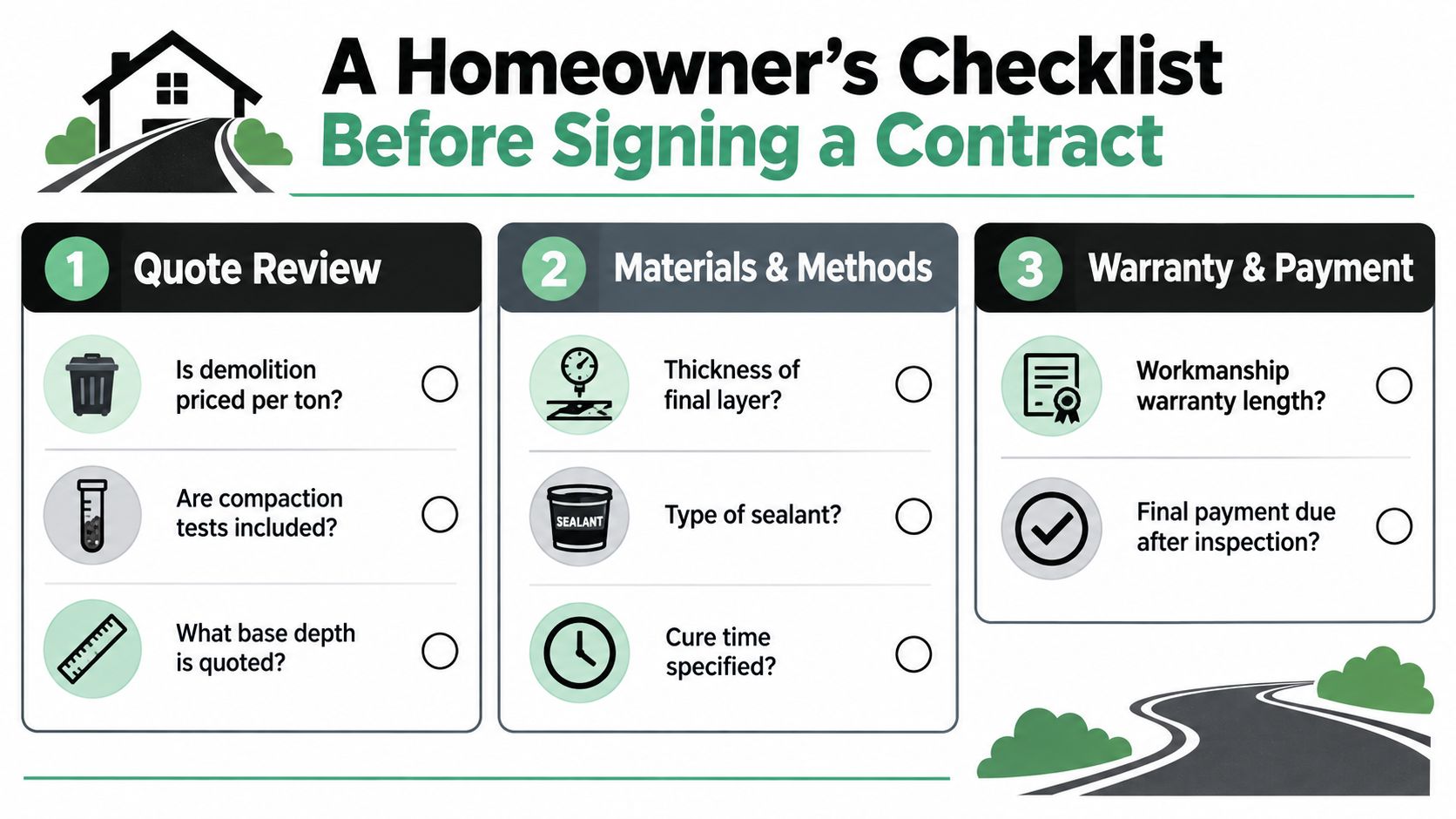
A Homeowner's Checklist Before Signing a Contract
A low quote can hide thousands in omitted work. I see that gap all the time in Atlanta. One contractor prices a basic replacement on paper, then the invoice grows after demolition, soft subgrade, extra stone, drainage correction, thicker concrete, or reinforcement show up on site.
The contract needs to spell out what you are buying, not just the final number.
Quote review items
Read the scope line by line before you look at the total.
- Demolition and haul-off: Make sure removal, loading, dump fees, and disposal are listed. If they are not written down, ask whether they are excluded or just assumed.
- Base prep: Ask what happens if the crew finds pumping soil, buried organic material, or weak spots near the garage. Those repairs often change the price fast.
- Concrete thickness: Get the planned thickness in writing and tie it to the traffic the driveway will carry. Standard passenger-car use is different from work trucks, trailers, or frequent delivery vans.
- Reinforcement: Ask whether the slab includes wire mesh, rebar, or no steel at all, and where that reinforcement will sit in the slab. The Tennessee Concrete Association notes that steel placement matters as much as the steel itself.
- Joints and edges: Control joints, thickened edges, and tie-ins at the garage or sidewalk should be described, not left to jobsite discretion.
Site and curing questions
A satellite quote is a guess. For replacement work, that is how a $4,000 number turns into an $8,000 invoice after the crew starts digging.
Ask these before signing:
- Has the contractor walked the site: Slope, access, existing thickness, and edge failure are hard to price from a screen.
- Where will water go after the new driveway is poured: Drainage should be planned in advance. Water running toward the garage or holding at the apron is an expensive mistake.
- Did they check for roots, settled shoulders, or broken areas beyond the visible crack pattern: Those conditions usually mean more excavation and more base material.
- What is the drive-on timeline: Cure time should be written into the contract so there is no argument later. The Portland Cement Association explains why proper curing affects strength and long-term performance.
If a contractor has not seen the property, the quote is missing information.
Contract and final acceptance checks
Before you pay a deposit, make sure the contract answers the jobsite questions that cause the most disputes:
- Payment schedule: Tie payments to clear milestones such as demolition complete, base approved, pour complete, and final walkthrough.
- Allowances and unit pricing: If unsuitable soil, extra stone, or drainage pipe are not included, ask how those additions will be priced.
- Warranty terms: Read the exclusions. Many owners assume cracking, settlement, or drainage issues are covered when they are not.
- Cleanup and restoration: Confirm whether the contractor will repair disturbed lawn edges, remove debris, and leave a usable transition at the street and garage.
- Final inspection standard: Check slope, finish, joint layout, edge quality, and whether the slab matches the agreed thickness and footprint.
The best bids are itemized. You can compare them. You can challenge them. You can also see which contractor is low because they run lean and which one is low because half the job is missing from the page.
Atlanta Concrete Solutions handles concrete driveway replacement, new driveway installation, decorative finishes, and related site work across the metro area, including the line items that usually decide the cost to pave a driveway. If you want a quote that separates demolition, base prep, reinforcement, drainage, and slab thickness instead of hiding them in one number, visit Atlanta Concrete Solutions.