
Each dollar spent on timely preservation can save up to six dollars later, according to the rule of thumb cited in the Federal Highway Administration pavement preservation evaluation. That ratio changes how you should judge commercial concrete resurfacing. It's not a cosmetic purchase. It's a decision about pavement life, accessibility, closure time and risk.
I would approve resurfacing only when three conditions align. The damage must match the treatment, the base must be sound enough to hold it, and the schedule must protect curing and reopening. When the base has failed, replacement isn't the expensive failure. It's often the lower risk option.
Matching the Treatment to the Damage
| Treatment | Problem it addresses | Reported service life | Relative cost |
|---|---|---|---|
| Diamond grinding | Roughness and surface profile | 4 to 17 years | Moderate |
| Joint sealing | Water entry at joints | About 4 years | Low |
| Full-depth concrete repair | Localized deterioration | 3 to 14 years | Moderate to high |
| Dowel-bar retrofit | Load transfer across joints | 2 to 16 years | High |
| Thin overlay or decorative resurfacer | Surface wear and appearance on sound concrete | Varies with substrate condition | Moderate |
| Full replacement | Structural failure or unsound base | Designed for decades of service | High |
Choose a treatment by identifying what has failed. Roughness may call for grinding; open joints that admit water call for sealing. Isolated broken panels may need full-depth repair, while faulting at joints points to lost load transfer. A worn but stable surface can suit an overlay. Settlement, rocking slabs and widespread cracking point to a base or structural problem, where resurfacing carries a higher risk of early failure.
Reading the Service Life Ranges Honestly
These reported ranges come from transportation pavements, so they are not guarantees for a commercial parking lot, warehouse apron or sport court. They show how targeted preservation can extend service on structurally sound concrete while avoiding demolition, hauling, longer curing closures and the capital cost of replacing an entire section.
The spread between the low and high values matters. The same treatment can perform very differently on stable concrete and on a slab affected by voids, poor drainage or ongoing movement. Treat a top-of-range service life as an uncertain outcome until the concrete has been assessed and the damage mechanism identified. For a resurfacing decision, weigh expected pavement life against closure time and the cost of reopening work if the bond fails.
Match the treatment to the failure mechanism first. Compare prices only after every bidder is pricing the same repair.
Mixed damage may call for a sequence rather than one product: stabilize and patch localized areas, restore joints, then resurface the slab field. Atlanta Concrete Solutions offers commercial concrete and masonry repair services; define each repair and its order in the scope so the overlay is not being asked to cover unresolved damage.
Shortlist one or two methods that address the documented problem before requesting quotes. Ask each proposal to identify the damage it will correct and how the work supports the reopening schedule. If the proposal cannot tie its treatment to a specific failure, it is not ready for approval.
How to Assess a Slab Before Choosing a Method
A coating can't compensate for settlement, water intrusion, expansive cracking, poor drainage or corrosion. The National Institute of Standards and Technology research publication cites guidance that long-term repair on sound concrete should be designed to last at least 20 years, while repair on unsound concrete, or with the cause unaddressed, may last only 5 to 7 years. That gap is why assessment comes before product selection.
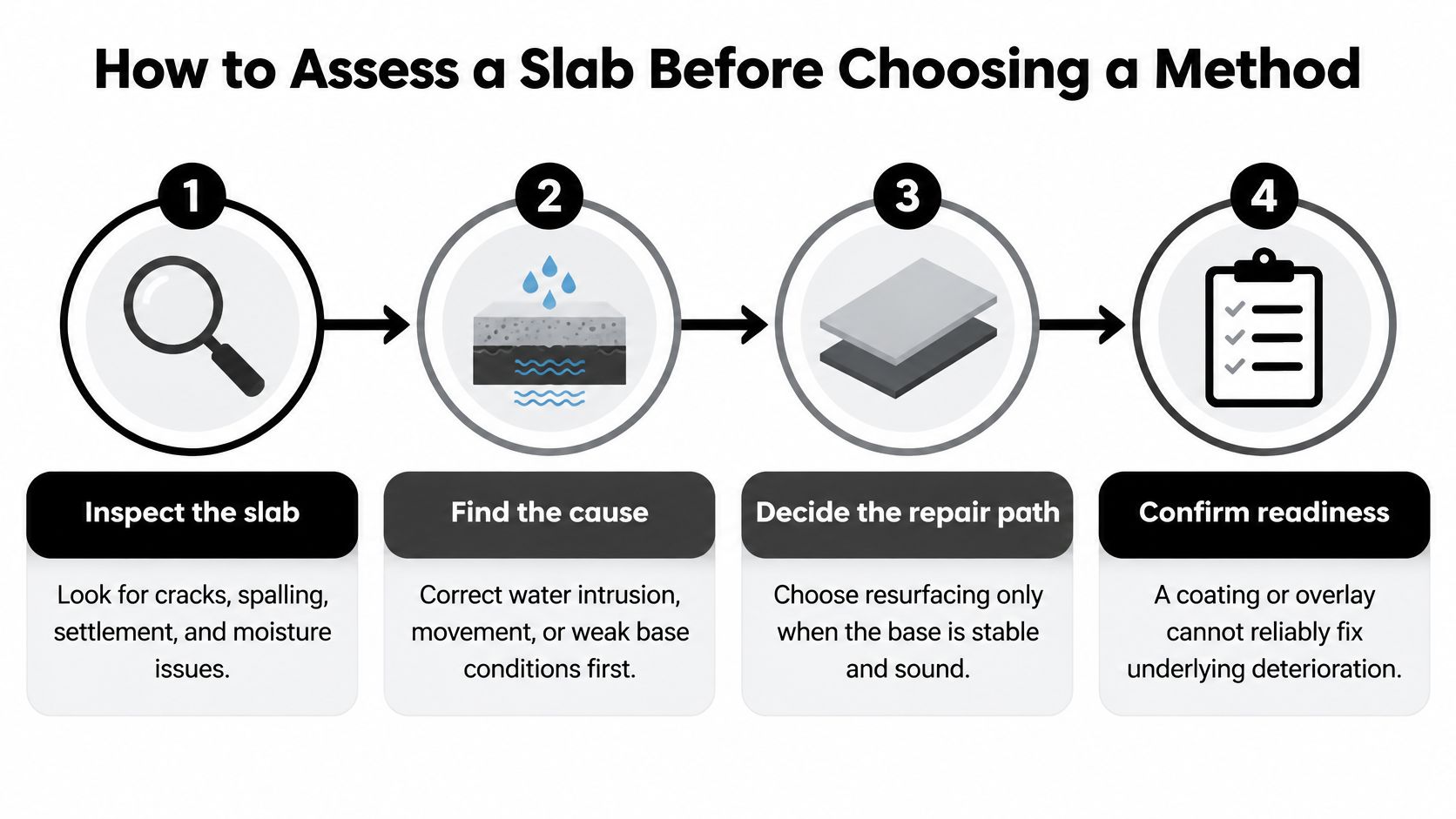
Six Assessment Steps
- Sound the slab. Use a hammer or chain drag to map hollow, delaminated areas. Mark them in paint, because weak concrete that sounds hollow won't hold an overlay.
- Map cracks, joints and settlement. Record crack widths, joint condition and elevation differences across panels. A pattern tells you whether you're looking at shrinkage, overload or movement.
- Walk drainage paths after rain. Find ponding, downspout discharge and joints that collect water. The common miss is a slope that sends water back into the joint you just sealed.
- Name the active cause. Decide whether moisture, structural movement, traffic overload or corrosion is driving the damage. If the cause is still active, surface work is premature.
- Test where failure is costly. Take cores or run pull-off tests on parking decks, loading areas and industrial floors. Testing is cheap compared with removing a debonded overlay under traffic.
- Write a scope memo. Record findings, repair limits, treatment choice and maintenance expectations. Every bid should price that memo, not a bidder's separate interpretation.
Apply a clear go or no-go test at the end. If the base is unsound, stop and specify structural repair or replacement before any surface work. Don't let a finish schedule overrule a failed substrate.
How to Prepare Concrete for a Lasting Bond
A durable overlay depends on the condition of the substrate and overlay interface. The Federal Highway Administration guidance on concrete overlays explains that when pull-off specimens fail within roughly 8 mm of the interface, the underlying concrete is weaker than the bond. Treat preparation as structural quality control, not housekeeping.
Preparation Sequence
- Remove weak concrete. Cut out delaminated material until the substrate is sound. Feathering new material over fractured edges leaves a weak boundary that can spall.
- Clean mechanically. Use abrasive blasting or an equivalent method to remove dust, laitance, grease and fractured fines. Pressure washing alone may leave bond-breaking material behind.
- Create the specified profile. Roughen the surface or expose aggregate to meet the overlay system's bond requirements. Hydrodemolition may provide higher bond strength than scarification on high-performance work.
- Stabilize moving areas. Fill voids beneath slabs and repair active cracks and patches before placing an overlay. A surface layer cannot reliably bridge a slab that rocks under a forklift.
- Control substrate moisture. Bring cement-based repairs to saturated-surface-dry condition so dry concrete does not draw mixing water from the new layer. Scrubbing in a bond coat can fill pores and improve contact.
- Verify before placement. Use direct-tension pull-off testing where debonding could interrupt operations. Confirm the substrate is sound while the scope can still be changed.
- Protect the cure. Keep traffic off for the cure period specified for the project and system. Early loading can damage edges even after the surface feels hard.
Practical rule: Specify the required condition, sound, clean, profiled and tested, rather than naming a cleaning method alone.
Preparation and curing belong on the reopening schedule as separate phases. Show removal, repairs, profiling, placement, curing and reopening, with each duration confirmed in writing. Keep vehicles off until the contractor confirms in writing that the concrete is ready for reopening.
| Milestone | Rule or reference | Planning note |
|---|---|---|
| Curing period | Follow the project-specified curing period | Keep vehicles off until the contractor confirms reopening in writing |
| Design strength | Commonly evaluated at 28 days | Strength testing is not the same as approval to reopen |
| Reopening to traffic | Depends on mix, weather, thickness and strength testing | Confirm the reopening date in writing with the contractor |
Resurfacing Versus Replacement by Cost, Time and Carbon
| Decision factor | Resurfacing | Replacement |
|---|---|---|
| Demolition and hauling | Minimal, existing slab often stays | Full removal, hauling and disposal |
| Traffic disruption | Shorter closure, set by the system | Longer closure while new concrete cures |
| Structural problems | Can't correct settlement, voids or movement | Corrects the base and the slab |
| Expected life | 2 to 17 years by treatment in transportation data | Designed for decades when built to specification |
| Carbon driver | Less new concrete, repeated recoats erode the benefit | Full new concrete, low carbon mixes cut emissions |
| Best when | Slab is sound, damage is surface or joint related | Base has failed or slab is structurally unsound |
Read each row against your assessment. A sound slab with worn joints favors preservation because you keep the structure you already own. A slab with voids and differential settlement favors replacement because resurfacing would pay twice, once for the overlay and again when movement tears it apart.
The Carbon Trade-off Is Not Automatic
Concrete production accounts for roughly 7 to 10% of global carbon dioxide emissions, and the New Jersey environmental advisory report on low carbon concrete estimates traditional concrete at about 350 kg CO2e per cubic meter versus approximately 175 kg CO2e per cubic meter for low carbon mixes using supplementary cementitious materials, blended cements or optimized designs. Resurfacing places less new material, so it usually starts ahead.
That advantage disappears with premature failure. Poor preparation, moisture exposure and repeated recoating can consume more material and closure time over the asset's life than one durable replacement. Replacement also isn't automatically wasteful when demolished concrete is recycled or reused on site, reducing trucking.
Require bidders to price overlay, partial-depth repair and full replacement on the same criteria. Ask for service life, traffic disruption, mix carbon intensity, demolition recycling and maintenance frequency for each option. I would not accept a claim that resurfacing is greener until those five items are on one page.
ADA Scope Review Before You Approve Resurfacing
Accessibility scope can change the budget and the reopening plan. Missouri transportation guidance on project category and ADA explains that concrete pavement rehabilitation or resurfacing of any thickness can qualify as an alteration, potentially requiring compliant curb ramps where pedestrian routes meet the work. Isolated crack sealing, surface sealing and patching are generally maintenance and do not automatically trigger the same upgrades.
A low-cost overlay can therefore bring a larger compliance obligation than a repair-only approach. Avoiding resurfacing solely to sidestep that work is also a poor trade if cracked or heaved pavement remains in service.
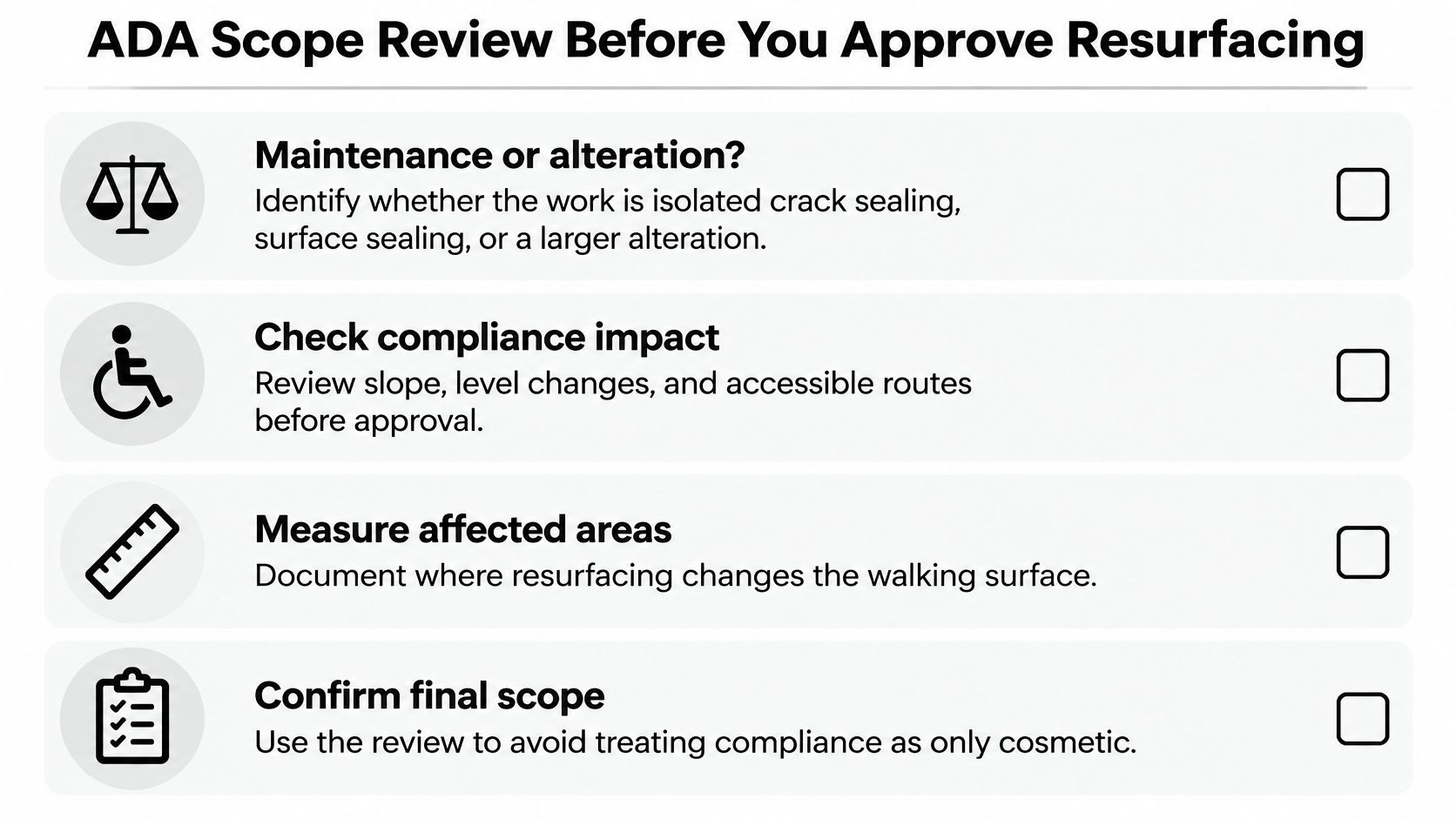
Document the Review Before Approval
- Accessible route: Map pedestrian crossings and paths through or beside the work area.
- Slopes: Measure running and cross slopes, not just surface condition.
- Detectable warnings: Check curb ramps and transitions within the project limits.
- Edges and drainage: Ensure the new surface creates no lip and does not direct water across the walking path.
- Adjacent deficiencies: Record which nearby noncompliant elements fall within the alteration scope.
Plan the closure before signing. Keep newly placed pedestrian pavement closed to traffic for the full curing period required by the project specification, and include that time in tenant and customer routing plans. Confirm applicable standards with your design professional and local permitting office, then record the maintenance-versus-alteration determination in the scope memo.
For commercial properties, commercial sidewalk concrete work may involve both restoring sidewalk appearance and coordinating accessible routes around the work. Approve the resurfacing scope only after the compliance review and reopening schedule are clear.
Overlay Systems and What Drives the Price
A thin cosmetic resurfacer can't correct structural movement, unstable slabs, voids or severe settlement. Choose the system by failure mechanism and traffic demand. Conventional cementitious overlays suit straightforward wear. Polymer-modified systems improve bond and flexibility. Fiber-reinforced mixes help control cracking. Ultra-high-performance concrete, or UHPC, serves severe abrasion and loading where a thin, durable layer justifies its material cost.
Selection turns on exposure, wheel loading, abrasion, freeze-thaw cycles and the reopening time your operation can tolerate. Appearance comes last. A decorative finish on the wrong system is still the wrong system.
Specification details protect performance. On asphalt substrates, milling promotes bond and reduces interface shear, and effective bonding after milling and thorough cleaning can reduce concrete stresses in thin whitetopping. Define minimum profile, overlay thickness, joint layout and cure requirements in writing, so bidders can't thin the system to win on price.
| Cost driver | Why it moves the price | Effect on budget |
|---|---|---|
| Base condition | Voids, settlement and active cracks must be stabilized first | Raises cost, often the largest factor |
| Repair scope | Full-depth patching costs more than surface work | Raises cost |
| Surface preparation method | Abrasive blasting or hydrodemolition adds equipment time | Raises cost |
| Overlay system | Polymer-modified, fiber-reinforced and UHPC materials cost more | Raises cost |
| Site access and phasing | Work around live operations adds labor and nights | Raises cost on constrained sites |
| Accessibility upgrades | Curb ramps and detectable warnings may be triggered | Raises cost |
| Maintenance interval | Periodic cleaning and sealing protect the surface | Lowers lifetime cost |
For projects where appearance is part of the brief, our commercial decorative concrete options still need the same substrate discipline. Request bids on one named system and thickness. Written bids on identical scope are the only prices worth comparing.
Maintenance, Lifespan and Real Project Scenarios
A resurfaced surface lasts as long as its maintenance plan allows. Clean oil, salt and debris routinely, because contaminants held against the surface accelerate wear. Seal periodically where moisture and chemicals are present, and repair new cracks promptly before water enters and works under the overlay.
The cleaning routine below is basic, and that's the point. Most lifespan is lost to neglected joints and small cracks, not to dramatic failures.
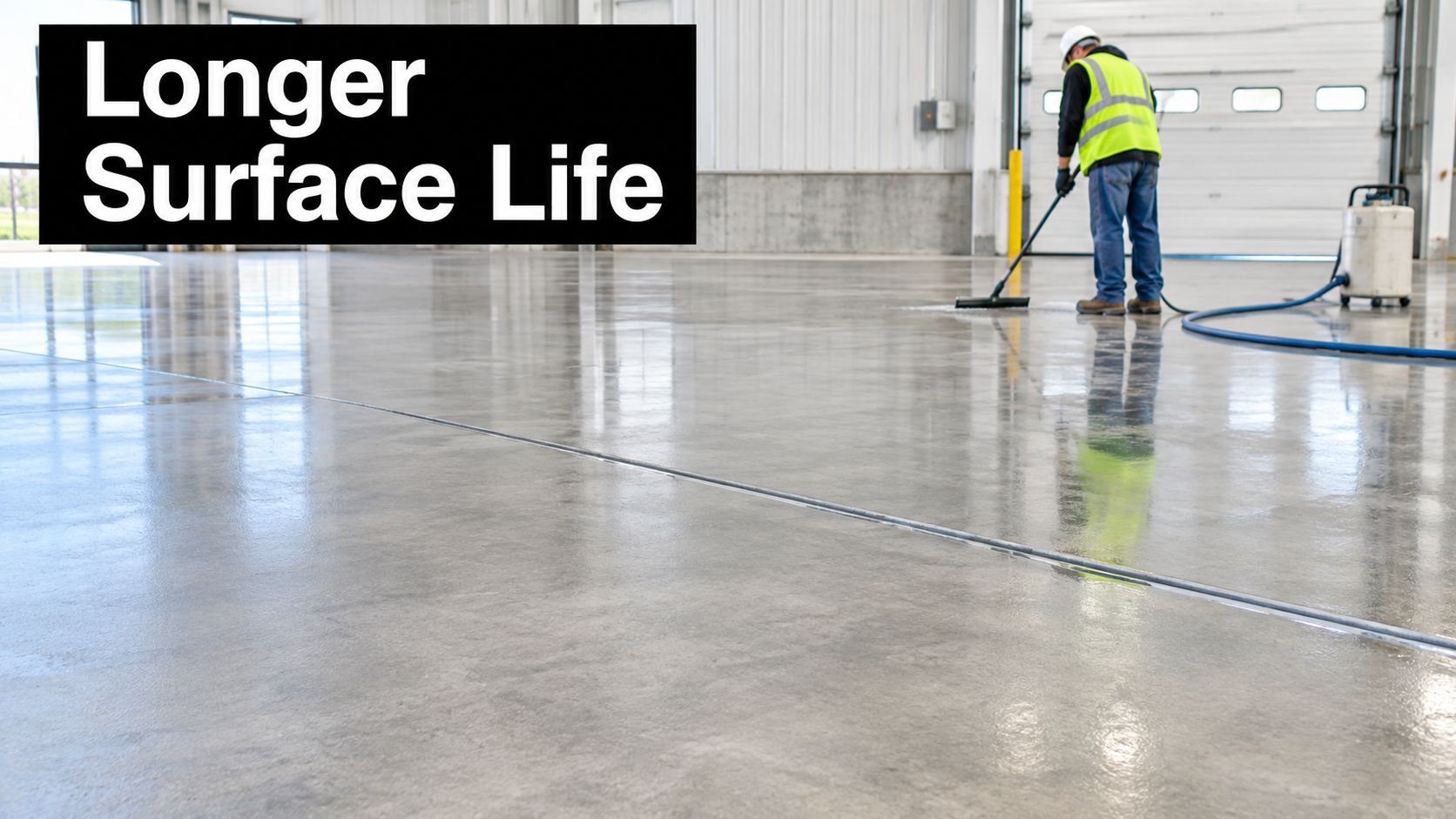
Three Illustrative Scenarios
Scenario one, warehouse apron. Say sounding shows a sound base with hairline surface wear and open joints. A thin resurfacer plus a joint sealing schedule fits the closure window, because the diagnosis is wear, not movement. Set joint inspection into the annual maintenance walk.
Scenario two, retail plaza. Say panels have settled and water ponds against storefronts. Stabilizing voids and correcting drainage must come first, and partial or full replacement may be lower risk than an overlay that traps the problem. Maintenance starts with keeping drains and joints clear after storms.
Scenario three, sport court. Say a basketball or pickleball court is rough and heavily abraded but stable. Compare diamond grinding with a polymer-modified overlay on reopening time, texture and cost. The maintenance interval should include surface cleaning and early crack sealing to protect playability.
The video below shows the kind of surface work and finish quality to discuss with your contractor before you commit to a system.
Frequently Asked Questions About Commercial Resurfacing
Can a Thin Overlay Fix Cracks
Only when cracks are inactive and the base is sound. Active cracking reflects movement, and movement will telegraph through a thin layer. Correct the cause first, then resurface.
Is Resurfacing Always Cheaper Than Replacement
No. On a failed base you're buying a short lived repair and a second mobilization. Replacement costs more upfront but removes the structural risk in one project.
How Long Before Vehicles Can Drive on New Concrete
Keep vehicles off through the contractor's specified curing period. Reopening should rest on the mix, weather, thickness and strength results, confirmed in writing, not on how hard the surface feels.
Does Resurfacing Trigger ADA Work
It can. Rehabilitation or resurfacing may count as an alteration where pedestrian routes are affected, while isolated sealing and patching generally count as maintenance. Document the determination before approval.
How Often Should Sealer Be Reapplied
Follow the interval written into your maintenance plan for your traffic, moisture and chemical exposure. Inspect joints and cracks at the same visit, because sealing a surface with open joints wastes the trip.
Can a Resurfaced Slab Be Repaired Later
Yes, if the substrate stays sound. Localized repairs work when new damage is caught early and bonded to properly prepared concrete.
Choose an Atlanta Contractor and Request a Scope Review
Compare Atlanta area bids on one written scope, not on the lowest number. A low bid that omits void stabilization, joint work or accessibility items isn't cheaper. It's incomplete.
Selection Criteria
- Commercial experience: Documented work on sites like yours, with references you can call.
- Licensing and insurance: Current proof in writing before award.
- Written assessment: Sounding, crack and drainage mapping, plus substrate testing where failure is costly.
- Named system: Overlay type, thickness, preparation profile and joint treatment stated plainly.
- Accessibility review: Maintenance versus alteration determination included in the proposal.
- Phased schedule: Cure times, closure limits and reopening criteria by area.
- Warranty terms: Duration and conditions stated, including what maintenance you must perform.
Atlanta Concrete Solutions is licensed and insured and provides free estimates for concrete projects, with commercial services spanning repair, decorative work, sidewalks and polished concrete. Still ask us, and every bidder, to confirm commercial slab experience and warranty conditions in writing.
Confirm permitting with Atlanta or the surrounding jurisdiction before work starts, including any public works specification that controls thickness at aprons and sidewalk connections. Then gather your slab assessment, traffic and closure constraints, and accessibility concerns, and request a site scope review with bids on one specification.
If your slab needs a diagnosis before it needs a finish, Atlanta Concrete Solutions can assess the surface, identify whether resurfacing or replacement fits, and price the work on a written scope with a free estimate. Visit Atlanta Concrete Solutions to request your commercial scope review and get a schedule built around curing, access and reopening.