
You've got a cracked, settled driveway in Atlanta, two quotes on the kitchen counter, and one is nearly double the other. Both contractors measured the same slab. The difference usually isn't the breaking itself. It's thickness, rebar, haul distance, tipping, or permit work buried in one quote and missing from the other.
That's why concrete demolition rates only make sense as a full invoice. If you separate breaking, loading, hauling, tipping, and permits, you can spot what's included, what's assumed, and where a cheap quote will grow.
Concrete Demolition Rates at a Glance
There's no single universal rate for concrete demolition. Atlanta contractors quote through four models, and most real bids blend two of them, for example per square foot breaking plus per ton disposal.
Four Ways Contractors Quote
| Pricing model | How it is quoted | Planning range | Best fit |
|---|---|---|---|
| Per square foot | Price per sq ft of slab area | Example assumption, $1.50 to $3.00 per sq ft for unreinforced 4 in slab, $2.50 to $4.50 for reinforced 6 in slab | Driveways, patios and sidewalks with clear access |
| Per ton | Weight removed, usually including disposal | Example assumption, $90 to $150 per ton all in | Heavy or mixed loads and weighed commercial removals |
| Per hour | Machine and operator plus laborer time | Example crew total built from machine, operator, and laborer rates in the hourly calculation below | Unknown conditions, hidden reinforcement, tight access, small repairs |
| Fixed scope | One total after a site visit and written scope | Set by site visit; no universal range | Full tear-outs with a defined scope and clear access |
Per square foot is the cleanest model when the slab is flat, accessible, and easy to measure. It works for a standard driveway or patio because area is known before anyone starts. Its weakness is thickness. Two slabs with identical footprints can contain very different volumes.
Per ton pushes the estimate toward weight, which is what trucks and facilities handle. I would use it for thick commercial pavement or mixed debris where the scale ticket matters more than the footprint. Ask whether the ton price includes loading and haul, or only the facility charge.
Pick the Model That Matches the Risk
Per hour protects both sides when nobody knows what's inside the slab or how tight the work will be. Hidden rebar, a backyard patio behind a narrow gate, or selective removal beside a house can wreck a fixed production assumption. Hourly billing needs a cap and a named equipment class, or the meter runs.
Fixed scope suits a full tear-out after a site visit. The contractor has seen access, thickness, utilities, and the street interface, then prices the whole job. It's the easiest quote to compare if the scope is written line by line.
Practical rule: Match the payment model to the uncertainty. Known slab, square foot or fixed scope. Unknown slab, hourly with a cap. Weighed debris, per ton with scale tickets.
Treat every range here as a planning estimate before site-specific factors. Use it to place your project in the right row, then force each bidder to state the thickness, reinforcement, disposal route, and permit scope behind their number. That's where quotes become comparable.
Physical Factors That Move the Rate
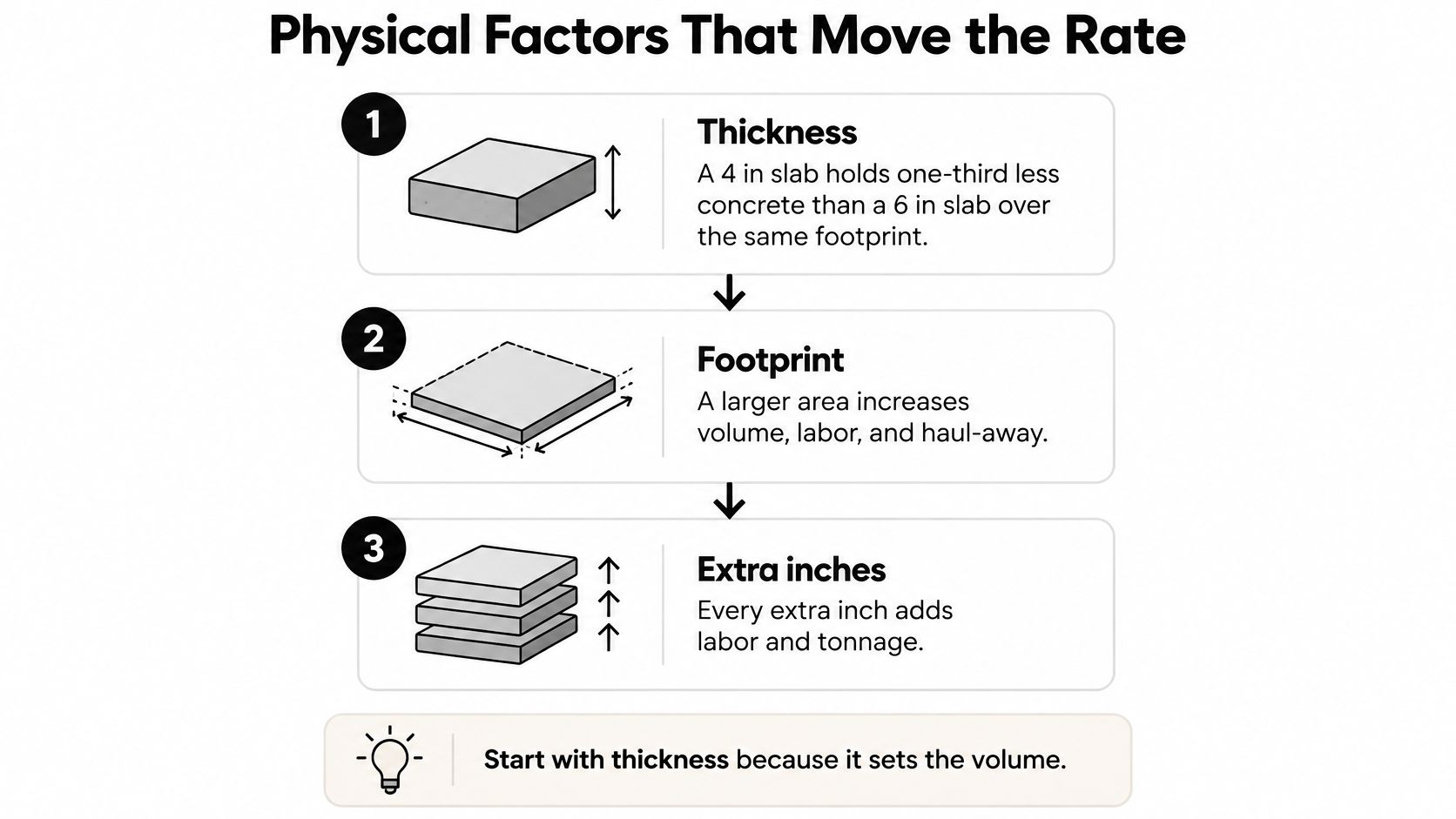
Start with thickness, because it sets volume. A 4 in slab holds one-third less concrete than a 6 in slab over the same footprint. Moving from 4 in to 6 in adds half again as much material to break, load, and haul, even though the driveway looks the same from the street.
The Methvin production-rate benchmark for demolishing concrete puts unreinforced slabs 50 to 150 mm thick at approximately 3.2 labor-hours/m³ with less productive methods and about 1.9 labor-hours/m³ under higher productivity. Reinforced slabs of the same thickness rise to roughly 5.2 and about 3.9 labor-hours/m³, while reinforced slabs at 150 to 300 mm rise to approximately 9.1 and 4.7 labor-hours/m³.
Rate Drivers and How They Move the Price
| Driver | How it changes the work | Typical effect |
|---|---|---|
| Thickness | Volume and tonnage scale with depth | 4 in to 6 in adds about 50 percent more concrete to break and haul |
| Reinforcement | Steel slows breaking and needs cutting and sorting | 5.2 vs 3.2 labor-hours/m³ at lower productivity, 3.9 vs 1.9 at higher productivity |
| Thick reinforced slab (150 to 300 mm) | Heavier breakout and more cutting | About 9.1 labor-hours per m³ at lower productivity (75 percent above 5.2); 4.7 at higher productivity |
| Site access | Narrow gates, backyard carries and dumpster placement | Can add a crew day or a separate haul-out |
| Adjacent structures and utilities | Vibration limits, utility locating and protection | Slower pace and added protection costs |
| Debris mix | Clean concrete versus soil, asphalt, brick or trash | Mixed loads are harder to recycle and often tip at higher rates |
Reinforcement doesn't just slow the breaker. Crews cut bar or mesh, separate steel from rubble, and handle jagged pieces that don't stack neatly in a truck. Measured breakout output therefore isn't the same as truckable debris volume.
Access can override a good production rate. A mini excavator that can't reach a backyard slab forces hand breaking and wheelbarrow carries. That's relevant on everything from patios to work tied into residential foundation concrete projects, where protection of the remaining structure matters.
A Simple Adjustment Method
Start with base labor for the slab class. Using the benchmark ratios as example allowances, add about 60 percent for reinforcement at lower productivity and about 105 percent at higher productivity. Then add about 75 percent more for a 150 to 300 mm reinforced slab over a thinner reinforced slab at lower productivity. Apply each allowance only when that driver is present, then adjust for access, haul distance, and utility protection.
Contractors tracking overhead beyond crew wages can compare software costs for service businesses before loading those costs into unit prices. Keep that exercise separate from field production. These benchmarks are estimating values, not guaranteed output.
Converting Crew Time into an Hourly Rate
Hourly demolition has three inputs: volume, production rate, and hourly crew cost. Get one wrong and the quote is fiction, even if the hourly rate itself looks reasonable.
Volume is area multiplied by thickness. A 600 sq ft slab at 4 in contains 7.4 cubic yards, calculated as 600 × (4 ÷ 12) ÷ 27. That number drives both breaking time and tonnage.
Run the Production Math
The Dodge Public Works and Cost Guide, as reported in JLC's discussion of concrete demolition production, uses approximately 12 cubic yards per eight-hour day for hand-held breakers, or about 1.5 yd³/hour before setup, breaks, loading, and cleanup. Divide 7.4 by 1.5 and you get roughly 5 hours of breaking time. Loading broken pieces, cutting any mesh, sweeping, and moving debris to a trailer sit on top of that.
Equipment changes everything. The same JLC source reports field ranges for unreinforced-concrete breakout from roughly 10 to 1,000 yd³ per eight-hour day and reinforced concrete at approximately 13 to 750 yd³ per day. A hand-held breaker, a skid steer with a hydraulic breaker, and an excavator with a thumb aren't interchangeable production units.
An hourly quote that doesn't name the machine isn't a production estimate. It's only a billing rate.
Build the Hourly Crew Cost
For a worked example, plug in your bidder's actual figures in this structure:
- Machine and operator: say $125 to $225 per hour as an estimating assumption
- Laborer: say $55 to $85 per hour for cutting, sorting, and cleanup
- Support costs: fuel, wear teeth or breaker tool, mobilization, and dump trailer time
Multiply the combined hourly cost by realistic hours, then add mobilization and disposal separately. I would require an hours cap and a short production trial on a large slab. Measure the first section, confirm the actual cubic yards per hour, and reset the forecast before the crew has committed days to a bad assumption.
Hourly billing fits unknown thickness, hidden reinforcement, narrow access, or selective demolition next to a foundation wall, steps, or utilities. For a wide-open driveway with known construction, a unit price usually gives you better cost control.
Disposal Fees and Per-Ton Pricing
Disposal isn't a minor add-on. On many residential tear-outs it rivals the breaking cost because concrete is dense, trucks hit legal weight limits quickly, and facilities charge by what crosses the scale.
A loader moving broken slab into a truck shows why loading method and truck capacity belong in the quote.

Use this estimating conversion: concrete weighs roughly 140 to 150 pounds per cubic foot, so one cubic yard is about 2 tons. A 7.4 cubic yard driveway therefore produces roughly 15 tons of debris. Even a modest per-ton difference becomes visible money at that weight.
What Sits Inside the Disposal Line
- Tipping fee: the facility charge per ton for clean concrete, mixed debris, or landfill material
- Hauling: roll-off delivery, dump truck trips, fuel, driver time, and waiting time
- Weight allowance: the tonnage included with a container before overweight charges apply
- Second load: another pull and fee when weight limits stop the crew filling the box
Haulers may limit how full a container can be with concrete. A box that looks half empty can already be at its safe or contractual weight. If a contractor prices one load and the slab needs two, the invoice changes fast.
The video below shows the loading and haul-off side of the work, which is where tonnage turns into trips and fees.
Sorting is the main lever you control. Keep concrete separate from soil, asphalt, brick, wood, and trash, and cut protruding rebar so loads stay manageable. Clean concrete has a better chance of acceptance for crushing and reuse as aggregate. Mixed loads are more likely to be priced as general debris.
Recycling only saves money when the route works. A lower gate fee doesn't help if a lightly loaded truck spends extra hours reaching a distant facility. Ask each bidder to name the receiving facility, state whether pricing is per ton or per load, and confirm who pays if the scale ticket exceeds the allowance.
Permits and Right-of-Way Costs in Atlanta
A slab inside your property line comes out on the crew's schedule. The apron where the driveway meets the street does not. The moment demolition reaches the apron, sidewalk, curb, or gutter, the work enters city-controlled space, and the same jackhammering becomes a permitted job with its own paperwork line on the invoice.
The flow below separates private work from work that touches public space.
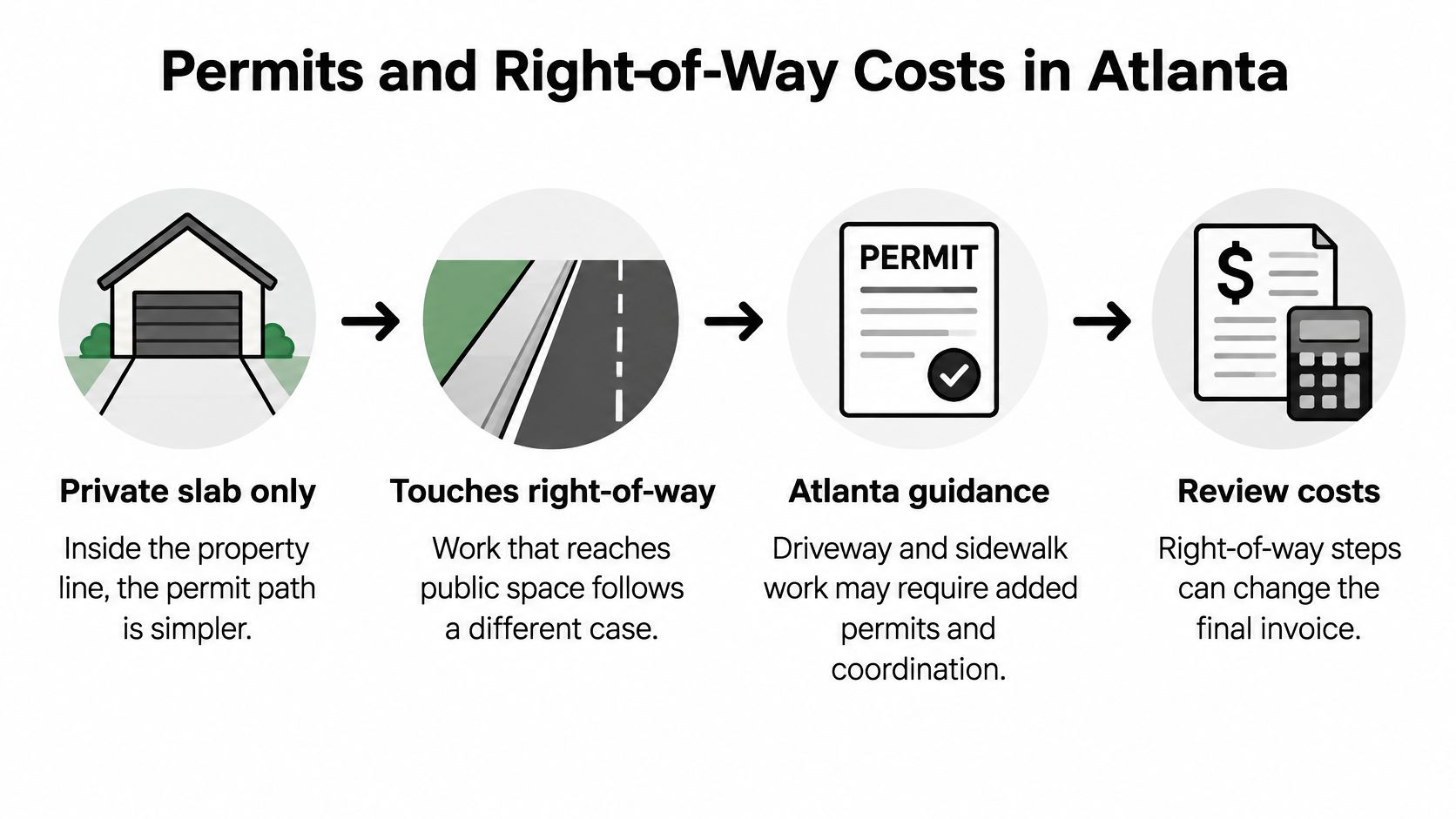
Atlanta Department of Transportation right-of-way guidance specifically identifies driveway-apron construction and repairs as work requiring an Atlanta Department of Transportation right-of-way permit. The city's published guidance also says permitted work must follow its standard right-of-way details.
Decide the Permit Path Before Booking the Crew
- Mark the limits: locate the property line, apron, sidewalk, curb, and gutter.
- Check every intrusion: include excavation, a staged dumpster, street blocking, and sidewalk closure.
- Apply through ATLDOT: use the Department of Transportation right-of-way application route when work crosses into public space.
- Build to standard details: match the city's requirements for the apron and street interface.
- Schedule after approval: don't mobilize demolition into the right-of-way before the required permit is in hand.
Widening and extension jobs trip this most often. Changing a curb cut, sidewalk crossing, gutter line, or drainage path can turn a straightforward slab removal into permitted work, and the same caution applies when demolition connects with residential sidewalk concrete work near the street.
Permit fees and plan review times depend on the scope of work and the city's current schedule, so treat any figure a bidder quotes as provisional until you confirm both with the right-of-way office before scheduling demolition. On your budget, carry the permit as its own line rather than folding it into the per-square-foot demolition rate, and carry review time, inspection, and restoration of public surfaces the same way. When those costs sit inside a lump sum, a permit delay or a failed apron inspection surfaces later as an unexplained invoice change.
Worked Atlanta Estimates for Three Common Jobs
Use one method for every slab: area × thickness in feet ÷ 27 = cubic yards, then multiply cubic yards by roughly 2 for tons. The examples below use clearly stated planning assumptions so you can swap in a bidder's actual rates.
Example One 600 Sq Ft Driveway at 4 In Unreinforced
Run the volume first: 600 × (4 ÷ 12) ÷ 27 gives about 7.4 cubic yards of concrete. At roughly 2 tons per cubic yard, the slab puts about 15 tons on the truck.
Now price it. Demolition at an assumed $1.50 to $3.00 per sq ft equals $900 to $1,800. Tipping at an assumed $30 to $60 per ton equals $450 to $900, and a $400 to $700 haul allowance produces an estimated demolition total of $1,750 to $3,400 before permits or apron work.
Demolition is only the first subtotal of a replacement project. Full replacement adds excavation, compacted base, placement, and finishing on top of the tear-out, and each of those scopes carries its own cost. Anyone pricing a residential driveway concrete replacement should collect tear-out and new work as separate subtotals so neither one hides inside the other.
Worked Atlanta Demolition Estimates by Project
| Project | Volume and tonnage | Demolition labor and equipment | Disposal (tipping plus haul) | Estimated total |
|---|---|---|---|---|
| 600 sq ft driveway, 4 in, unreinforced | 7.4 yd³, about 15 tons | $900 to $1,800 at $1.50 to $3.00 per sq ft | $850 to $1,600 ($450 to $900 tipping plus $400 to $700 haul) | $1,750 to $3,400 |
| 600 sq ft driveway, 6 in, reinforced | About 11 yd³, about 22 tons | $1,500 to $2,700 at $2.50 to $4.50 per sq ft | $1,060 to $2,020 ($660 to $1,320 tipping plus $400 to $700 haul) | $2,560 to $4,720 |
Example Two and Three Follow the Same Arithmetic
The reinforced 6 in driveway contains about half again as much volume as the 4 in slab. Its demolition assumption is also higher because crews cut and sort steel. Both effects stack, which explains why its planning total reaches $4,720 even though the footprint hasn't changed.
For a 5,000 sq ft commercial slab at 6 in, reinforced, volume is 5,000 × 0.5 ÷ 27, or about 93 cubic yards, roughly 185 tons. Using example assumptions of $2.00 to $3.50 per sq ft for demolition, $30 to $60 per ton for tipping, and $1,500 to $3,000 for hauling produces $10,000 to $17,500 for demolition, $5,550 to $11,100 for tipping, and a total of $17,050 to $31,600 before permits and restoration.
Estimator's check: If a bid total can't be traced back to cubic yards, tons, trips, and a facility charge, it isn't ready to compare.
Verify every assumption against local facility rates, measured thickness, reinforcement, and access. A core cut or exposed edge measurement is cheaper than discovering an extra two inches after the trucks arrive.
Compare Quotes Line by Line Before You Book Demolition
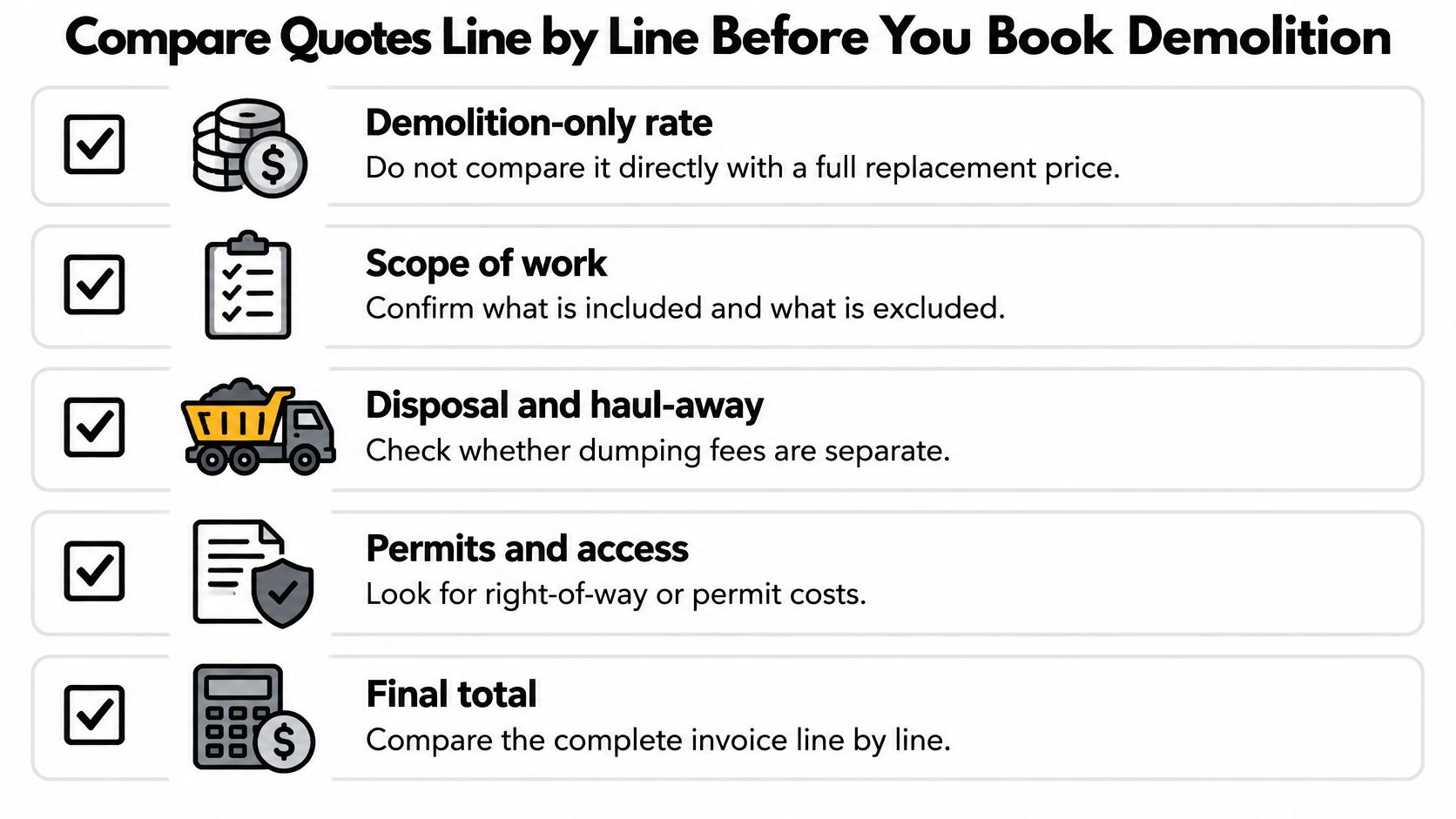
The most expensive comparison mistake is treating a demolition-only price as a replacement price. They're different scopes. One gets the old slab out. The other excavates, builds base, places and finishes new concrete, and cleans up.
Atlanta Concrete Solutions' 2026 Atlanta concrete demolition and replacement cost benchmark places a full residential driveway replacement at approximately $3,629 to $13,478, with an average near $7,258. That's for the complete replacement project rather than concrete demolition alone, so don't judge a tear-out quote against it without separating excavation, base preparation, drainage work, reinforcement, placement, finishing, and cleanup.
The Line-by-Line Quote Test
- Unit and assumptions: state sq ft, ton, or hour, plus assumed thickness and reinforcement.
- Separate lines: require sawcutting, breaking, loading, hauling, tipping, and cleanup as distinct items.
- Overweight risk: confirm the container or truck allowance and who pays excess tonnage.
- Permits: state whether private permits, right-of-way work, inspections, and restoration are included.
- Debris destination: name the facility and ask whether clean separated concrete can be recycled.
- Hourly controls: name the excavator, breaker, or hand crew, state crew size, and set an hours cap.
- Access protection: include utility locating, plywood or mats, dust control, and protection beside structures.
- Written scope: get measurements, exclusions, and the payment trigger in writing after a site visit.
Confirm the contractor is licensed and insured. We're licensed and insured and hold the necessary licenses to operate in our service area, and we provide free estimates for concrete projects. That site visit is where thickness at the edge, gate width, slope, drainage, and the apron can be checked before a total is locked.
Bring this checklist to that visit. Call (678) 554-4433 to request a free quote, and ask about financing options if demolition is part of a larger replacement. I would not book the lowest number until every bidder has priced the same thickness, same debris stream, same number of loads, and same permit boundary.
If your Atlanta slab needs removal before a driveway, patio, sidewalk, or commercial replacement, visit Atlanta Concrete Solutions to request a free, itemized estimate built from measured volume, tonnage, hauling, and permit scope. Call (678) 554-4433, bring your competing quotes, and we'll help you compare the full invoice before demolition begins.