
You've searched “concrete slab installation near me” because the driveway is cracking, the patio is settling, or a new foundation project is finally moving forward. In Atlanta, the crew you hire matters, but the work below the visible concrete matters just as much. Heavy rain, shifting soil, poor drainage, rushed finishing, and weak edge joints can turn an attractive pour into a repair problem.
Concrete is a global construction material. One industry summary reports 14.0 billion m³ of worldwide concrete volume in 2020, while another tracker places more recent annual world output at nearly 6 billion m³. Residential construction accounts for about 40% of global concrete demand, according to the Global Cement and Concrete Association's overview of concrete around the world. For Atlanta homeowners, that large market translates into a very local decision: whether the contractor is building a complete slab system or delivering a truckload of concrete.
What Concrete Slab Installation Near You Really Includes
A homeowner in Marietta calls after finding a low driveway estimate online. The quote says “concrete slab,” but it doesn't mention excavation, gravel, compaction, reinforcement, drainage, joints, or curing. Another contractor provides a higher figure and explains every layer. The second quote may look expensive at first, yet it often describes the work needed to keep the slab level and serviceable.
A professional installation usually starts with a site visit and layout. The crew studies access, existing concrete, grade changes, drainage routes, nearby walls, landscaping, and the intended load. From there, the work can include:
- Removal and excavation: Old asphalt, damaged concrete, organic soil, and unstable material need to come out where they would compromise the base.
- Subgrade correction: The crew establishes the proper elevation and creates a firm platform rather than pouring over loose fill.
- Aggregate base: Crushed gravel provides a stable working surface and helps manage water below the slab.
- Forms and reinforcement: Forms hold the planned shape, while wire mesh or rebar is selected according to use and site conditions.
- Concrete placement: The crew places, screeds, edges, and finishes the mix while maintaining planned slopes and transitions.
- Curing and protection: Moisture retention after finishing allows hydration to continue and helps the surface develop strength.
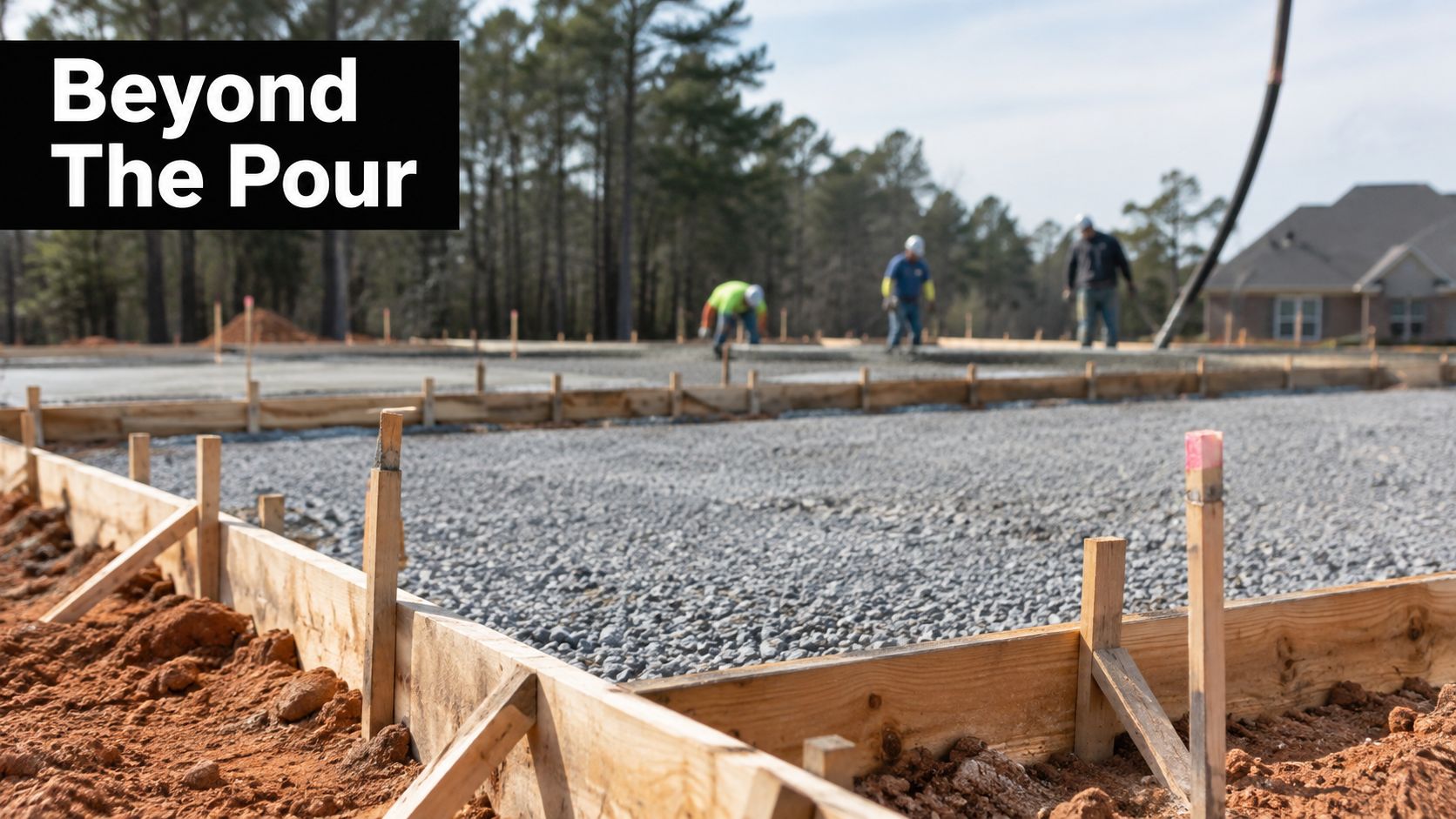
What slab-on-grade means
A slab-on-grade foundation is a concrete slab placed at or near ground level, supported by prepared soil and aggregate rather than a conventional crawl space. It can serve as a home foundation, garage floor, driveway, patio, sidewalk, parking pad, or equipment surface. Cost guides commonly describe slab-on-grade foundations as the least expensive residential foundation type, with installed ranges of about $5 to $14 per square foot, while standard residential slabs commonly fall around $6 to $12 per square foot. Decorative or stamped surfaces can reach $15 to $30 per square foot, according to concrete slab cost guidance from Estimators.us.
That price range only helps when the scope is comparable. A driveway with demolition, poor access, drainage correction, and a decorative finish isn't equivalent to a simple patio pour on a prepared site. Ask whether each estimate includes base depth, compaction, reinforcement, concrete thickness, control joints, finish, cleanup, and curing.
Atlanta Concrete Solutions describes its residential poured concrete service around slabs, foundations, driveways, patios, sidewalks, and related flatwork. You can review the residential poured concrete service to see how a complete project differs from a basic pour.
Practical rule: If a quote only describes the concrete itself, it isn't yet a complete installation proposal.
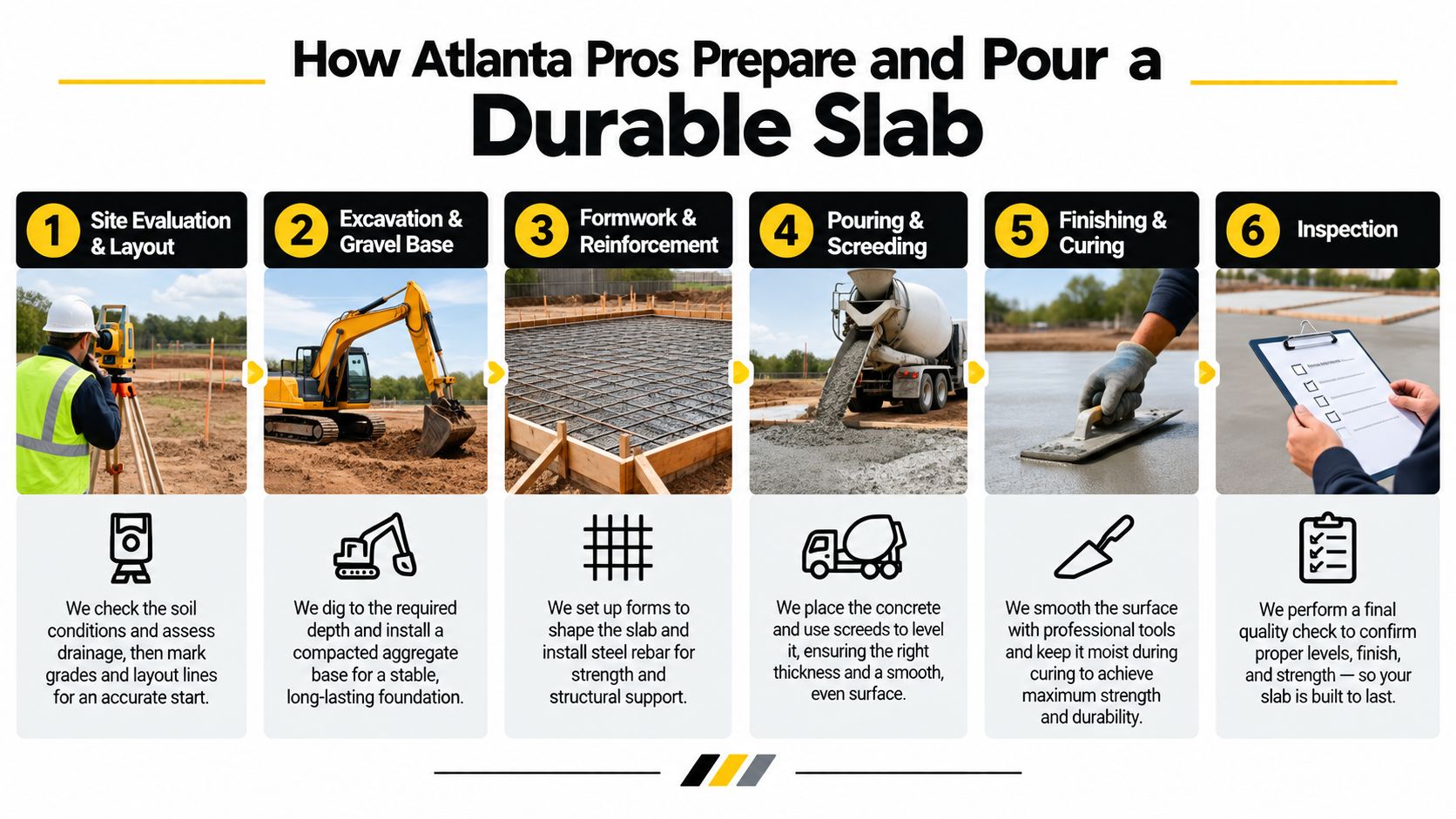
How Atlanta Pros Prepare and Pour a Durable Slab
Durability starts before the concrete truck arrives. A good crew treats the slab as a system, with the ground, aggregate, steel, concrete, joints, edges, slope, and curing plan all working together.
Site evaluation and base preparation
The first decision is elevation. The crew marks the finished height and checks how water will move away from the house, garage, driveway, or walkway. A slab that looks level to the eye may still need a controlled slope so rain doesn't collect against walls or at the low edge.
Excavation removes weak topsoil and unsuitable material. The crew then places aggregate in a way that can be compacted properly, rather than spreading a thin layer over soft ground. Base correction and compaction are among the most important defenses against settlement. If the soil shifts below the slab, thicker concrete alone won't solve the underlying problem.
Forms must be straight, braced, and set to the correct elevation. Reinforcement belongs in the slab at the intended position, not lying on the soil where it contributes little. The choice between wire mesh and rebar depends on the vehicle loads, dimensions, subgrade, and project requirements.
Placement, screeding, and finishing
During placement, the crew distributes concrete evenly and avoids adding unnecessary water. A wetter mix may seem easier to move, but excess water can increase bleeding and leave a weaker surface. The ACI guide for concrete floor and slab construction.pdf) recommends using the lowest practicable water content and timing finishing around the loss of bleed water.
Screeding establishes the plane. Bull floating or other finishing work then corrects the surface before the final texture is applied. Broom texture is common outdoors because it adds traction. A smooth trowel surface may suit an interior garage, but it can be slippery when wet.
Control joints give shrinkage cracking a planned location. For a 4-inch slab, common control-joint spacing is 8 to 12 feet, according to the joint and maintenance guidance summarized by Polyguard. The actual layout should respond to the slab's shape, corners, openings, and transitions rather than follow a careless grid.
Watch the pour-day process video with one question in mind: does the crew appear to be controlling the concrete, or reacting to it? Good workmanship shows up in prepared forms, accessible tools, steady screeding, clean edges, deliberate joint planning, and patience before final finishing.
Curing is part of installation
Finishing isn't the end of the job. The main curing goal is moisture retention, which allows cement hydration to continue. Finishing while bleed water remains on the surface, or overwatering the slab early, can create surface weakness and defects.
Water curing requires runoff control, and curing water should stay within 20 °F, or 7 °C, of the concrete temperature to reduce thermal shock, as stated in the ACI guidance cited above. A professional crew should be able to explain its curing method before the pour, not improvise after the surface begins drying.
Costs Timeline and Permits for Atlanta Slab Projects
A driveway can look straightforward from the street and still require demolition, excavation, drainage correction, reinforcement, and careful access planning. Atlanta pricing follows those site conditions, not just the slab's visible area. A replacement on firm, well-drained ground costs differently from a widening project over soft soil or an area that holds stormwater.
For planning, standard residential slabs are commonly estimated at $6 to $12 per square foot installed. Decorative or stamped work can reach $15 to $30 per square foot, according to published concrete slab cost ranges. A slab-on-grade foundation is commonly listed at about $5 to $14 per square foot installed. Treat these as planning ranges. A contractor still needs to inspect the site before pricing the work.
Atlanta Concrete Slab Cost and Thickness Guide
| Slab Type and Use | Cost Per Sq Ft and Thickness |
|---|---|
| Standard residential slab, patios, walks, and typical flatwork | $6 to $12 per sq. ft. installed, thickness selected for use |
| Slab-on-grade residential foundation | $5 to $14 per sq. ft. installed |
| Decorative or stamped slab | $15 to $30 per sq. ft. installed, with finish and base conditions affecting the total |
| Passenger-car driveway | Commonly 4 inches where use and soil support are suitable |
| SUV or light-truck driveway | Commonly 5 to 6 inches, depending on loads and site conditions |
The written estimate should identify access, demolition, excavation, base correction, reinforcement, drainage, edge restraints, joints, and finish. Those items often explain why two square-foot prices differ. Paying for proper soil correction and water control before placing concrete can prevent settlement repairs later. Stamping a slab over a weak base only makes an expensive failure more noticeable.
One 2026 industry estimate places slab pricing roughly 15% to 20% higher than in 2022, citing material costs, labor shortages, and demand in its 2026 concrete flatwork trends coverage. Compare written scopes rather than choosing the lowest surface price. Confirm whether the bid includes hauling, forming, joint layout, edge work, curing, and cleanup.
Timeline and approvals
The schedule generally covers consultation, measurements, estimating, material coordination, site preparation, forming, reinforcement, placement, finishing, curing, and cleanup. Rain, restricted access, demolition, drainage repairs, and municipal requirements can extend the work. Concrete reaches a commonly cited full-cure milestone at about 28 days, so the contractor should state separately when the slab can be walked on, parked on, and sealed.
Driveway widenings, extensions, aprons, sidewalks, and work near public rights of way may require local approval. HOA rules may control driveway width, visible finishes, drainage changes, or street connections. Ask who will research permits and whether the estimate includes city or county coordination, utility markings, and HOA communication. A clear answer before demolition prevents delays after the crew has already mobilized.
Choosing Finishes Thickness and Reinforcement That Last
A driveway should be designed around the vehicles it carries, the soil beneath it, and the water moving across the property. Finish comes after those decisions. A beautiful surface poured on a poorly compacted base will still crack or settle.
Thickness for actual vehicle use
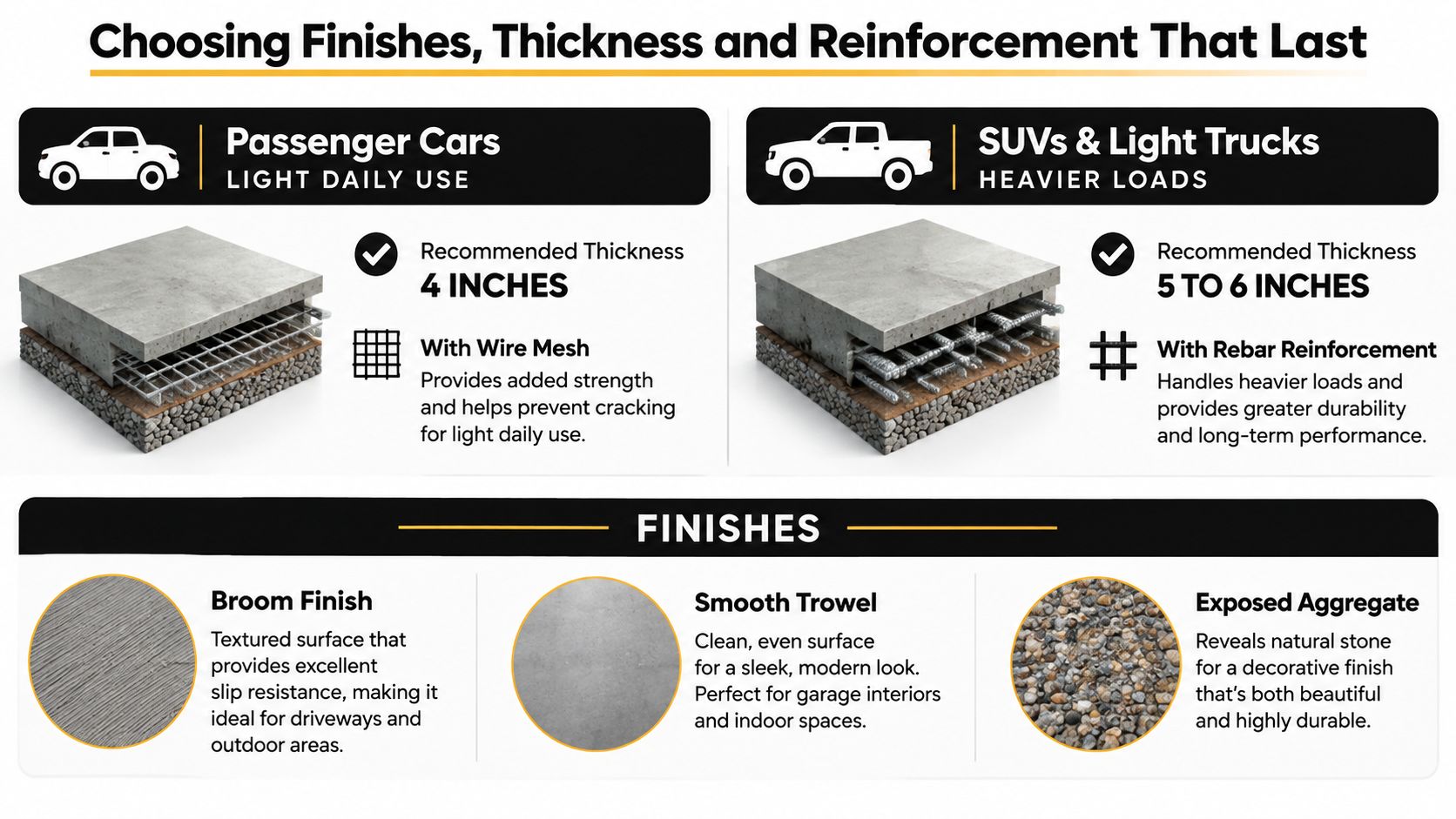
Residential concrete driveways are commonly specified at 4 to 6 inches thick. Guidance from SlabCalc's driveway guide cites 4 inches for passenger cars, while 5 to 6 inches is recommended for SUVs and light trucks. Heavier use pushes the recommendation toward 6 inches or more.
A short driveway serving one passenger car may be appropriate for a 4-inch design when the base is stable and drainage is controlled. A family driveway used by SUVs, delivery vehicles, trailers, or light trucks deserves a more durable design. A widening project also needs attention at the tie-in. If the new strip sits on weaker soil than the original driveway, the joint can become the first place settlement appears.
Reinforcement has a specific job
Rebar doesn't prevent every crack, and it can't compensate for poor excavation. Its role is to help carry tensile stresses and hold cracked concrete together when the design, placement, and support are appropriate. Wire mesh may suit lighter residential use, while rebar is often selected for heavier loads, larger areas, or demanding site conditions.
The steel must be supported at the proper elevation during the pour. Reinforcement left on the ground doesn't perform as intended. Ask to see the reinforcement plan and ask how the crew will keep it positioned while concrete is placed.
Finish choices and maintenance tradeoffs
A broom finish is practical for Atlanta driveways, sidewalks, and sloped approaches because texture improves traction. Exposed aggregate adds visual character and can suit a front walk or patio, but the surface still needs sound joints and curing.
Stamped concrete can reproduce the look of stone, brick, or tile. It delivers stronger visual impact, yet the pattern and color may demand more careful cleaning and resealing. Integral color can create a consistent tone, while polished concrete fits garages and interiors better than exposed outdoor driveways.
For a contemporary interior project, Atlanta Concrete Solutions also provides residential polished concrete. That finish should be judged by lighting, slip exposure, maintenance expectations, and intended use, not by appearance alone.
The finish is the visible decision. The base, joints, drainage, and curing determine whether that decision keeps looking good.
How to Choose the Right Concrete Contractor Near You
The right contractor answers technical questions without hiding behind a low square-foot price. Start with local experience, then test whether the estimate explains the work that protects the slab after the crew leaves.
Ask each bidder to address:
- Local site knowledge: Can the contractor explain how Atlanta-area drainage, grades, and changing soil conditions affect your project?
- Crew responsibility: Will trained employees perform the work, or will unknown subcontractors handle excavation and finishing?
- Insurance and credentials: Can the company provide current licensing information where required and proof of liability coverage?
- Written scope: Does the proposal identify demolition, excavation, aggregate, compaction, reinforcement, thickness, finish, joints, curing, cleanup, and exclusions?
- Relevant examples: Can you inspect recent driveway replacements, extensions, aprons, patios, stamped surfaces, or foundation slabs?
- Aftercare: What does the contractor recommend for curing, sealing, joint inspection, and crack-related concerns?
Red flags in a low bid
A vague phrase such as “prepare and pour” doesn't tell you whether the crew will remove weak soil or compact a proper aggregate base. No joint layout is another warning sign, especially on a broad driveway or irregular patio. A quote that ignores downspout discharge, standing water, or the slab-to-wall edge may leave you paying for the same problem later.
Atlanta Concrete Solutions states that it manages residential, commercial, and industrial concrete and masonry work through an in-house team, serving communities including Alpharetta, Marietta, Johns Creek, Duluth, and greater Atlanta. Its stated services include driveway replacement, decorative concrete, polished concrete, poured slabs and foundations, sidewalks, and masonry repair, with free quotes and financing options available.
A clear online presence can also reveal whether a contractor explains scope and workmanship consistently. For a broader look at how service companies communicate their value and build trust with prospective clients, review these marketing strategies for contractors that work.
Questions worth asking before signing
Ask who controls water during curing, how the crew will protect adjacent surfaces, where joints will go, and what happens if soft soil appears during excavation. Request a payment schedule tied to defined work stages rather than unclear promises. The contractor should also explain access, concrete delivery, weather delays, and the point at which the slab can carry foot and vehicle traffic.
Protecting Your New Slab With Proper Curing and Care
A driveway can look finished while its concrete is still gaining strength. The first week deserves close attention, and the first month sets the slab's long-term performance. ACI guidance identifies continuous moist curing for at least 7 days under normal conditions as an important quality benchmark. Wet coverings or membrane curing must stay effective without interruption. The ACI slab construction guidance also identifies insufficient curing as a common cause of slab defects.
A standard driveway is commonly treated as fully cured after about 28 days. Until then, follow the contractor's written instructions for foot traffic, vehicles, and stored loads. Keep irrigation and downspout discharge off the slab, protect exposed edges, and prevent uncontrolled water from washing across fresh concrete.
Sealing and inspection rhythm
Sealer type determines how often the surface needs attention. Topical acrylic sealers commonly last about 1 to 3 years, while penetrating silane or siloxane products are often described in the 5 to 10-year range, according to driveway sealer lifespan guidance from Hardshore Exteriors. That guidance places penetrating sealer application at 28 days at the earliest and surface sealer application at 90 days. Confirm the product instructions and the slab's curing condition before applying anything.
Use a straightforward inspection routine:
- After heavy rain: Check edges, control joints, downspout outlets, and low areas where water collects.
- After winter conditions: Look for opened joints, surface scaling, or movement where the slab meets a wall.
- During regular cleaning: Remove leaves, soil, and other materials that hold moisture against the concrete.
- Before resealing: Clean the slab, confirm it is dry, and match the product to the finish and exposure.
- When movement appears: Correct drainage and joint gaps before cosmetic patching conceals the cause.
A wide slab-to-wall gap may require backer rod before sealant. Inspect that joint each year and after severe weather, then reseal when the sealant pulls away or cracks. For damaged edges, failed joints, and related deterioration, Atlanta Concrete Solutions lists residential concrete and masonry repair among its services.
Well-installed and maintained concrete driveways are commonly described as lasting 25 to 30 years. Sealing and maintenance may add 10 or more years by limiting water and salt damage. The practical priority is clear: manage drainage, joints, edges, and curing before small defects become settlement or cracking.
Atlanta Concrete Solutions provides site consultation, excavation, base preparation, driveway replacement, decorative concrete, poured slabs, foundations, and repair throughout the Atlanta metro area. Request a free quote through Atlanta Concrete Solutions and ask for a written scope covering drainage, thickness, reinforcement, joints, curing, and aftercare.