
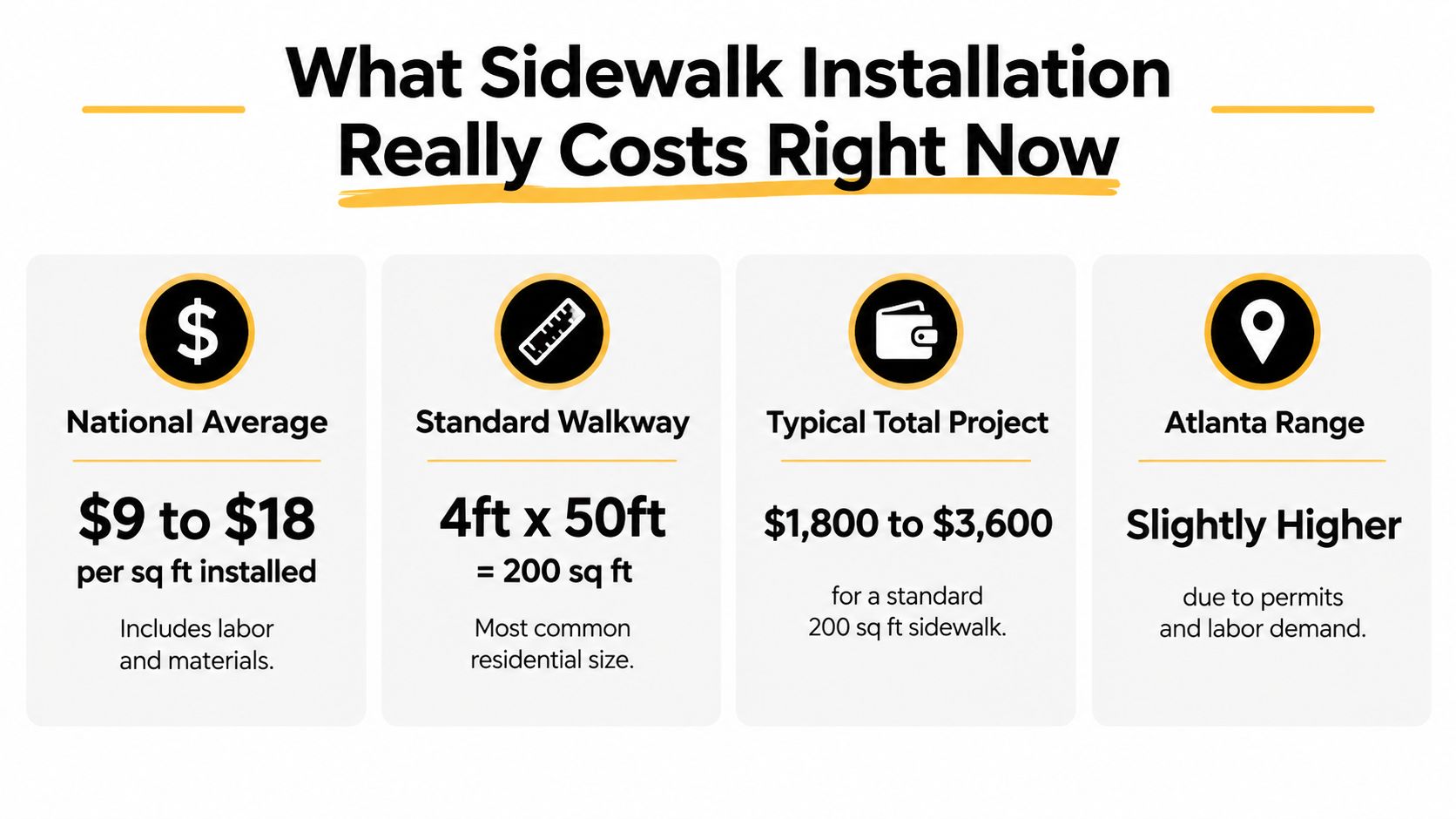
A 2026 national sidewalk installation cost benchmark places installed work at about $7 to $17 per square foot, with a typical project total of $1,400 to $3,400. A standard 4-foot-wide, 50-foot-long residential walk covers about 200 square feet, while Atlanta projects generally cluster near the middle of that range unless decorative finishes, replacement work, permits, or vehicle-rated sections change the scope.
You may be looking at a cracked path beside your Atlanta driveway, comparing a contractor's estimate with an online calculator and wondering why two bids for what appears to be the same sidewalk are far apart. The concrete itself is only one part of the quote. Excavation, forms, drainage, reinforcement, curb cuts, access, inspections, and local labor requirements can move the final number more than the basic material choice.
A useful estimate starts with the area, then adds the construction details that make the sidewalk pedestrian-only, decorative, replacement-grade, or strong enough for occasional vehicle loading. The sections below show how to read those details before you approve a proposal.
What Sidewalk Installation Really Costs Right Now
An Atlanta homeowner might receive one quote for a straight front-walk installation and another for a path that crosses a driveway apron. Both may be described as “concrete sidewalk,” but they aren't the same construction assignment. The first may use a standard pedestrian slab, while the second can require a thicker section, reinforcement, more careful grading, and coordination with the curb.
The national installed benchmark is about $7 to $17 per square foot, including labor, forming, pouring, finishing, and cleanup, according to HomeGuide's concrete sidewalk cost benchmark. That source places a typical total project at $1,400 to $3,400 for an average sidewalk job. For the familiar 4-foot by 50-foot walk, the math is straightforward: 4 × 50 equals roughly 200 square feet.
What a normal bid should tell you
A quote near the middle of the installed range may be reasonable for a standard Atlanta residential walkway with accessible soil, ordinary forming, and a basic finish. A much lower figure deserves questions about demolition, base preparation, reinforcement, disposal, or whether the number covers labor and cleanup.
A much higher figure isn't automatically excessive. Custom or higher-end designs can exceed $20 per square foot, more than 40% above the common upper range, as the HomeGuide benchmark explains. Decorative patterns, difficult access, extensive removal, drainage corrections, and vehicle crossings can all create legitimate increases.
For project planning, software can help organize dimensions and scope before contractors price the work. Exayard concrete estimating software is one resource for structuring quantities and comparing estimate components, but it shouldn't replace an on-site review when grades, roots, utilities, or public right-of-way details affect construction.
Practical rule: Treat the per-square-foot number as a starting point, not the whole explanation. The scope behind the rate matters more than the rate by itself.
How Per Square Foot Pricing Works for Sidewalks
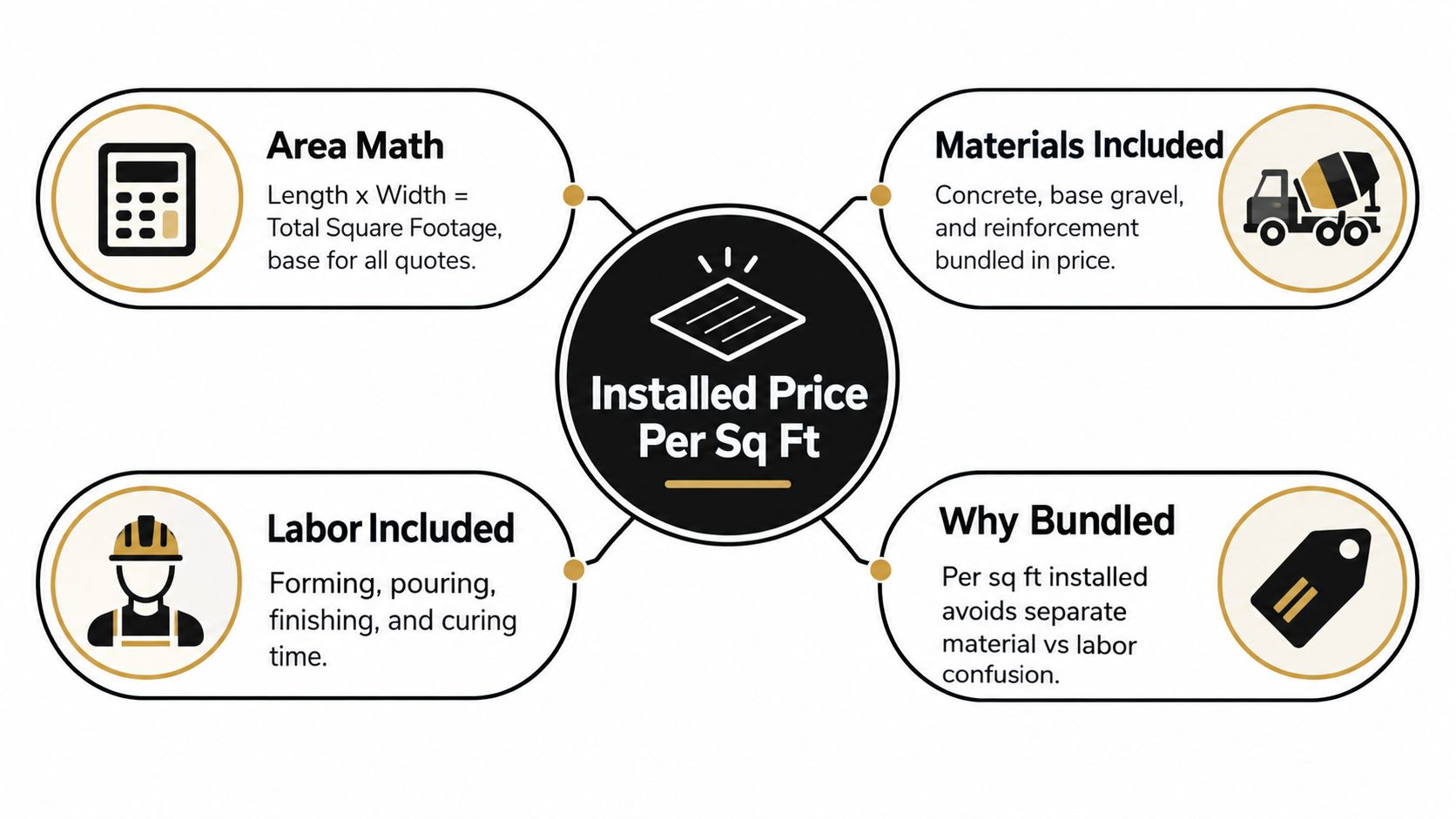
Per-square-foot pricing becomes useful once you know what the contractor has included. Start with the footprint. Measure the walkway's length and average width, then multiply those dimensions to find the surface area.
For example, a 4-foot-wide path running 50 feet covers about 200 square feet. If the proposal uses an installed rate of $10 per square foot, the simple area calculation produces a $2,000 planning figure. A rate of $15 per square foot produces a $3,000 planning figure. Those examples are arithmetic illustrations based on the verified 200-square-foot example, not promises of what an Atlanta contractor will charge.
Why installed pricing is bundled
The concrete truck is visible on pour day, but much of the work happens before and after the truck arrives. An installed rate commonly accounts for several connected tasks:
- Area calculation: Length multiplied by width establishes the quantity being priced.
- Materials: The concrete mix, base aggregate, and specified reinforcement form the physical package.
- Site preparation: The crew excavates, grades, levels, and compacts the area before placing concrete.
- Forming and finishing: Workers install edge forms, place the slab, strike it level, texture the surface, tool the joints, and clean the site.
A materials-only comparison can mislead you because two contractors may use similar concrete but assign very different amounts of labor to preparation and finishing. One site may be open and level. Another may require hand excavation through narrow side access, removal of an old slab, or careful work around landscaping.
How dimensions change the total
Width affects the budget just as directly as length. A short, wide walk can contain more concrete than a long, narrow one, while curves and jogs increase forming work even when the surface area changes only modestly. Ask the estimator to show the measured length, width, and total square footage on the proposal.
The same check applies to partial work. If only a driveway crossing needs a stronger design, that segment should appear as a separate area or line item rather than being blended invisibly into the entire walkway rate. Clear area math helps you identify exactly where the higher specification applies.
Material Choices and Finishes That Change Your Price
A standard poured-concrete walkway with a broom texture is usually the practical baseline. It provides a familiar walking surface and keeps the design simple. Price changes when you select a decorative finish, specify additional reinforcement, or increase slab thickness for a demanding load.
Georgia cost data illustrates the effect of structural specification. A Georgia concrete cost report lists $6.05 per square foot for a 4-inch reinforced slab and $9.08 per square foot for a 6-inch reinforced slab, with repair listed at $5.50 per square foot. These figures aren't a complete Atlanta sidewalk bid, but they show how thickness and reinforcement can alter the concrete portion of a project.
| Material and Finish | Installed Cost per Sq Ft | Best For |
|---|---|---|
| Standard poured concrete with broom finish | Usually within the standard installed range | Straight residential pedestrian walks |
| 4-inch reinforced slab | Georgia example of $6.05 per sq. ft. | Reinforced pedestrian applications where specified |
| 6-inch reinforced slab | Georgia example of $9.08 per sq. ft. | Vehicle crossings and heavier loading |
| Decorative or stamped concrete | Can move above the standard range | Curb appeal and coordinated outdoor design |
Match the upgrade to the use
A basic broom finish often makes sense for a side path, garden connection, or front walk where traction and serviceability matter more than ornament. Stamped concrete can coordinate the walkway with a decorative driveway or patio, but the design introduces more forming, coloring, texturing, and finishing decisions.
For homeowners considering a patterned surface, residential stamped concrete in Atlanta provides a relevant local reference point for the design conversation. Ask whether the quoted price includes color, sealer, joint layout, edge treatment, and any restoration needed around the work area.
Don't pay for strength where you don't need it
Reinforcement and added thickness have a purpose, but they shouldn't be spread across every square foot without explanation. A pedestrian path and a driveway apron experience different loads. If only the crossing requires a heavier section, ask the contractor to identify that transition on the plan and price it separately.
The better question isn't “What is the cheapest finish?” It's “Which specification fits how this surface will be used?” Spending on a durable structure at a vehicle crossing can protect the project, while spending on decorative treatment for a hidden side path may deliver little practical value.
Labor Site Prep and Structural Details Behind the Quote
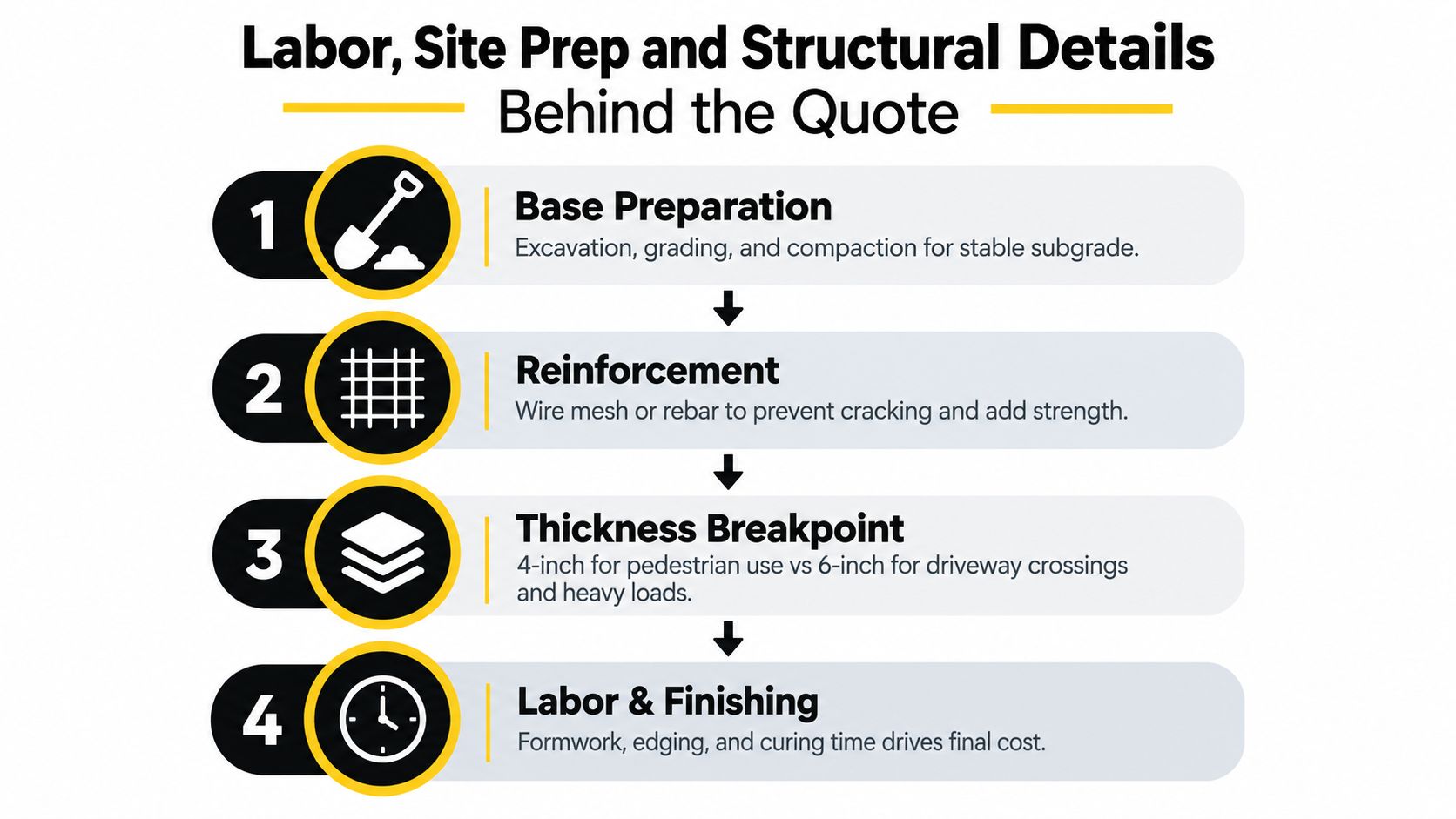
The surface you see at completion hides the work that determines whether the sidewalk stays level and drains properly. Crews may need to remove unsuitable soil, establish a stable subgrade, place and compact aggregate, build forms, and set the slope before concrete arrives.
A standard sidewalk pricing guide places poured-concrete sidewalk installation at about $8 to $18 per square foot. The lower end generally corresponds to straightforward residential work on decent soils, while the upper end can reflect thicker sections, compacted aggregate base, reinforcement, accessibility details, and higher labor rates.
The thickness breakpoint
A 4-inch slab is a common pedestrian baseline. Where a sidewalk crosses a driveway or may receive vehicle loading, the design commonly increases to 6 inches and usually includes rebar. The same source says those transition zones can add $2.50 to $4.00 per square foot.
That breakpoint explains why a driveway apron or curb cut can cost more than a garden walk of identical width. The contractor isn't charging only for extra concrete. The crew is building a section intended to tolerate a different load, often with more careful reinforcement and preparation.
Drainage belongs in the structural discussion too. A concrete driveway and sidewalk guideline.pdf?hsLang=en) specifies a drainage slope of at least 1/8 inch per foot, along with a minimum 4-inch driveway thickness and an increase to 5 inches where delivery vehicles are expected. Local Atlanta requirements may differ, so use those values as an example of the type of technical detail a contractor should document, not as a substitute for local specifications.
Finishing and curing are part of the job
A good bid should account for edging, joint tooling, texturing, cleanup, and curing procedures. The same guideline says curing must begin within 30 minutes after texturing and continue for at least three days, which shows why labor doesn't end when the crew leaves the pour area.
The following video can help homeowners recognize the sequence of preparation, placement, and finishing before discussing a bid with a contractor.
Atlanta Permits Codes and Local Factors to Budget For
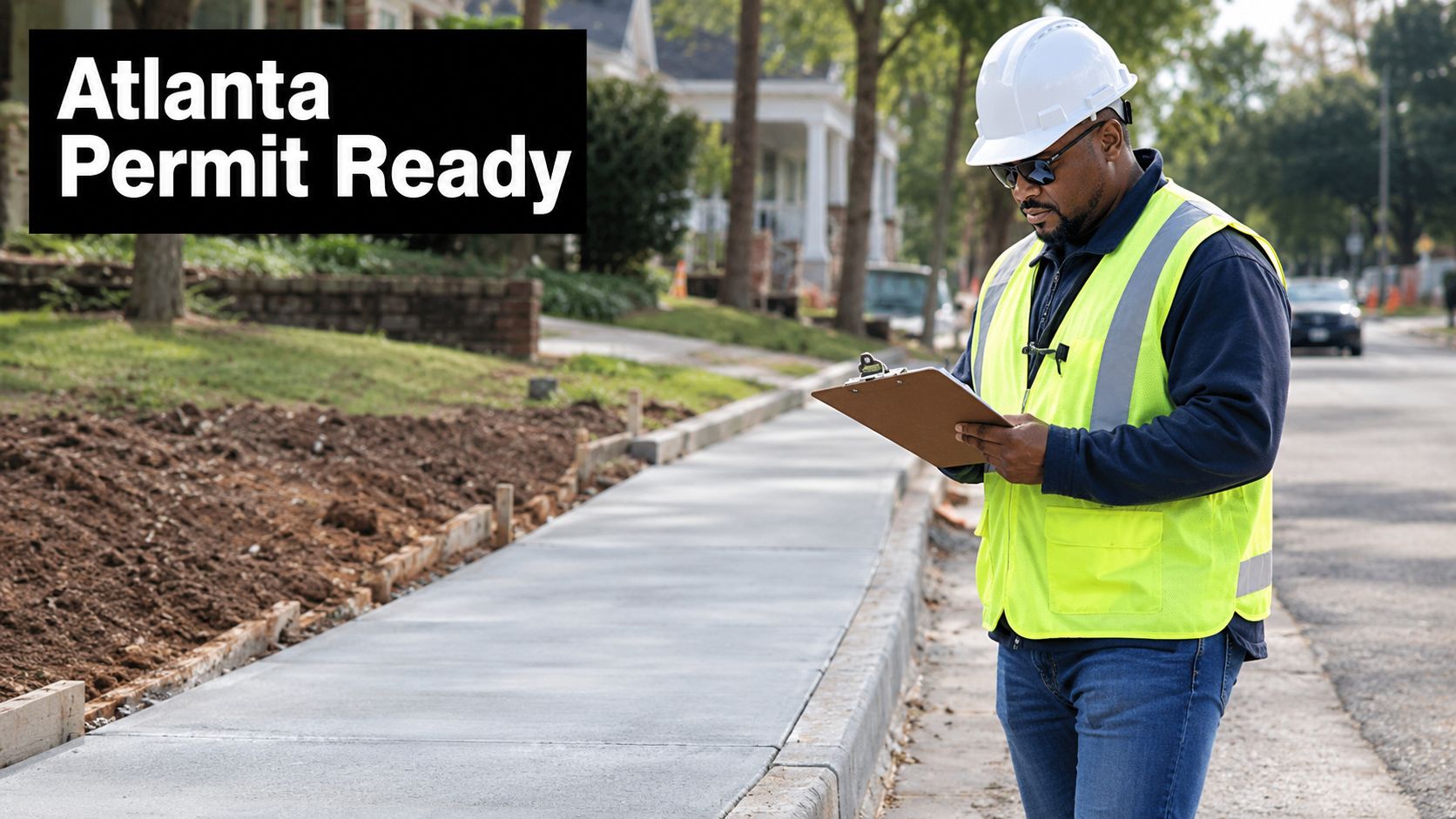
Atlanta sidewalk work becomes more complicated when the path occupies or touches a public right-of-way. The city or jurisdiction may require permits, inspections, accessibility details, or specific construction standards. A contractor who prices only the concrete and crew time may leave those obligations outside the initial number.
The local compliance question is one reason a standard installed range can stretch from $8 to $18 per square foot. A 2026 sidewalk installation cost analysis connects the higher end with thicker sections, compacted base, rebar or mesh, ADA detectable warnings, and prevailing-wage labor. The same source identifies a 46% spread across states, with typical projects ranging from $2,520 to $3,670, depending on labor rates, code requirements, and permit fees.
Questions to ask before signing
Don't assume that “permit included” means every approval and inspection has been identified. Ask the estimator to clarify:
- Jurisdiction: Which city, county, or transportation authority controls the sidewalk location?
- Right-of-way work: Does the proposal include applications, traffic protection, inspections, and restoration?
- Accessibility details: Are detectable warnings, slopes, transitions, and curb-cut requirements part of the design?
- Labor rules: Does municipal or prevailing-wage work apply to this location?
- Responsibility: Who pays if an inspector requires a change before final approval?
A contractor serving Atlanta may need to coordinate more than a residential crew working entirely inside a private lot. That coordination adds administrative time and can affect scheduling, crew requirements, and restoration.
Read compliance as part of construction
The distinction matters because a sidewalk can look finished while still failing a required detail. Rework costs more than planning the correct slope, transition, or warning surface from the beginning.
For a local contractor familiar with concrete installation and related site requirements, Atlanta concrete services can provide a starting point for discussing the scope. Still, every buyer should request written confirmation of which permits and inspections the estimate covers.
Smart Ways to Save on Your Sidewalk Project
The safest savings come from reducing uncertainty and unnecessary complexity, not from removing the base preparation that protects the slab. Start by defining the route before requesting bids. A straight, efficiently formed path is easier to measure and build than one with avoidable curves, decorative borders, and frequent changes in direction.
Use a value-focused checklist
- Choose the finish deliberately: A standard broom texture may be enough for a functional walkway. Reserve decorative treatment for areas where appearance has a clear design purpose.
- Bundle related work: If a driveway replacement, apron correction, or walkway installation is already planned, ask contractors whether coordinating access and mobilization can simplify the overall project.
- Keep the layout efficient: Fewer unnecessary corners reduce formwork and make the square-foot calculation easier to verify.
- Prepare for access: Clear furniture, plan for gate access, and identify irrigation lines or features before the crew arrives.
- Separate demolition: If an existing sidewalk must be removed, make sure breaking, hauling, and disposal appear as distinct scope items so you can compare bids fairly.
Timing can also affect practicality. A contractor who can complete connected work during one mobilization may avoid repeating site setup, protection, and cleanup. The exact savings depend on the site and the contractor's schedule, so ask for a bundled price rather than assuming one exists.
Don't cut the wrong line item
A cheaper bid that omits compaction, reinforcement at a vehicle crossing, proper joints, or curing support can create a false economy. A driveway-apron maintenance guide says a properly installed concrete apron can last 30 to 50 years or more, while poor installation or maintenance can shorten service life to 10 to 15 years (maintenance and service-life guidance).
Sealing also needs a schedule rather than an immediate application. That guidance says initial sealing should wait at least 28 days after installation, with resealing commonly performed every 3 to 5 years. Follow the product and contractor recommendations for the actual finish and local conditions.
Spend on the structure first. Decorative upgrades can wait, but a weak base or poorly designed crossing is expensive to correct later.
Planning Your Atlanta Sidewalk Estimate With Confidence
A reliable sidewalk estimate answers three questions in order. How much area is being built? What surface and structural specification does that area require? Which Atlanta permits, inspections, and site conditions affect the work?
Start by comparing the measured square footage, not just the bottom-line total. Confirm whether the proposal includes excavation, base material, forms, concrete, reinforcement, finish, joints, cleanup, disposal, and restoration. If the sidewalk crosses a driveway, make sure the heavier section is identified rather than averaged into a vague description.
A bid-reading checklist
- Verify dimensions: Check the listed length, width, and total area against your site.
- Mark transitions: Identify driveway aprons, curb cuts, loading areas, and any place vehicles may cross.
- Confirm thickness: Ask where the slab is 4 inches and where it becomes thicker.
- Ask about reinforcement: Confirm whether the plan uses rebar, mesh, or another specified system.
- Review drainage: Make sure the finished grade directs water away from structures and doesn't create a trip or ponding issue.
- Separate compliance costs: Look for permits, inspections, accessibility details, and public-right-of-way requirements.
- Plan maintenance: Ask when the surface can be used, when sealing is appropriate, and what care the selected finish needs.
Atlanta driveway pricing provides a useful reminder that local scope can move a quote substantially. A neutral Atlanta guide places a standard 520-square-foot concrete driveway at about $5,338 to $7,223, while another local breakdown gives a broader installed range of $9.71 to $18.22 per square foot for a two-car driveway, reflecting differences in finish, site conditions, and scope (Atlanta driveway cost data). A sidewalk estimate should receive the same level of detail.
For a contractor option that handles concrete installation, replacement, and related residential work, review Atlanta Concrete Solutions services and request a written, line-item quote. Compare that proposal with other bids using the same dimensions, thicknesses, reinforcement plan, finish, permit responsibilities, and cleanup terms.
Atlanta Concrete Solutions offers sidewalk installation, repair, replacement, driveway, apron, and decorative concrete services for Atlanta-area properties. Visit Atlanta Concrete Solutions to discuss your site conditions, request a detailed quote, and plan a sidewalk built around the way your property is used.