
Choosing a stamped pattern first is backward. The best driveway replacement ideas start with the apron, drainage, base, and vehicle loads, then consider the finish. Color cannot fix soft support, water flowing toward the garage, or an approach that needs right-of-way approval.
For Concrete Driveway Replacement Atlanta projects, evaluate Piedmont clay, sloping lots, and heavy summer storms before decorative upgrades. Clay needs assessment, not an assumption that water will soak away. Establish finished elevations, investigate failed areas, and decide where runoff will discharge before ordering concrete.
Discuss traction, surface texture, and cleaning early. A finish should suit how the driveway will be used and maintained, as well as its appearance.
The options below range from broom-finished concrete to reinforced truck entrances. Neighborhood examples are planning scenarios, not claims about completed customer projects. For costs and construction schedules, request written, property-specific quotes. A credible price should account for demolition, access, soil correction, drainage, permits, and the specified slab, not just the visible finish.
1. Standard Broom-Finish Plain Concrete Driveway
Broom-finished concrete is the baseline worth pricing first. It gives tires and shoes a textured surface without adding decorative coloring, stamping, or complicated maintenance.
For a Johns Creek homeowner replacing a cracked driveway, the sensible starting point is a plain slab with properly prepared support, deliberate joint placement, and a consistent broom texture. Fiber reinforcement may be appropriate, but it doesn't excuse weak subgrade preparation or replace a structural reinforcement design.
The infographic shows the construction details to discuss, rather than specifications to accept automatically.
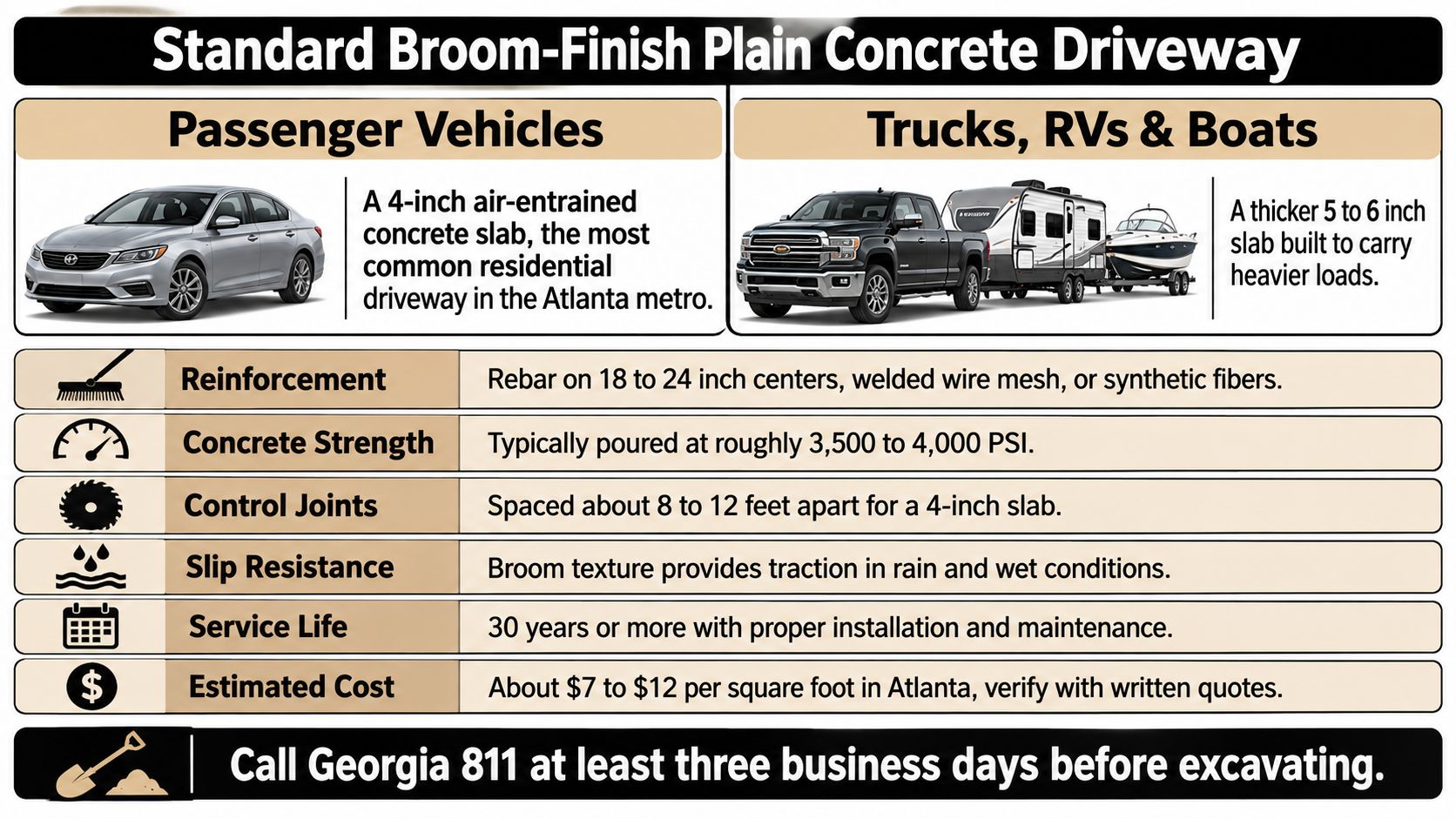
Specify the Work Beneath the Finish
- Base preparation: Ask how the crew will remove soft material and compact replacement aggregate in lifts.
- Concrete mix: Have the proposal identify strength, exposure requirements, and any air entrainment or fiber additives.
- Opening schedule: Get separate written releases for pedestrian access, passenger vehicles, and heavier traffic.
For How Long Before You Can Drive on New Concrete?, don't substitute a familiar calendar rule for the installer's release. Weather, mixture, curing, and vehicle loading affect that decision.
Also arrange utility locating through Georgia 811 before excavation. A plain finish keeps the decorative scope simple, but the underground work still needs the same care as an expensive installation.
2. Stamped Concrete Driveway
A stamped driveway works best when the house already has a clear material palette. An ashlar slate pattern in charcoal and tan could complement a Duluth home with stone accents, while a restrained herringbone border could suit an Alpharetta entrance.
The crew presses patterned mats into fresh concrete and uses integral color, surface color products, or both. It's still a concrete slab underneath, so it needs the same drainage, base preparation, curing, and joints as plain concrete.
The trade-off is appearance versus upkeep. Stamping can create a coordinated entrance without installing individual paving units, but a glossy sealer can become troublesome on a shaded slope. Repairs can also be difficult to blend into the original pattern and color.
Practical rule: Approve a physical sample outdoors, and evaluate texture when wet, not just color when dry.
For Stamped Concrete Driveway Atlanta planning, compare residential stamped concrete options with a plain slab plus decorative borders. Keeping ornament at the edges can simplify the main driving surface and make joints less visually intrusive.
The installation process is easier to assess when you can see the stamping sequence.
Ask the contractor to identify the sealer and maintenance requirements before accepting the finish. Don't assume every stamped surface needs the same recoating schedule.
3. Exposed Aggregate Concrete Driveway
Exposed aggregate gives texture without an imitation pattern. The finisher removes surface cement paste to reveal selected stone, producing a driveway with visible mineral color and a more pronounced feel underfoot.
On a sloping Roswell approach, a small, rounded aggregate could provide a textured walking surface without the harshness of larger, angular stone. For a Cobb County property with a stone retaining wall, a compatible river-rock blend could connect the driveway visually to the landscaping.
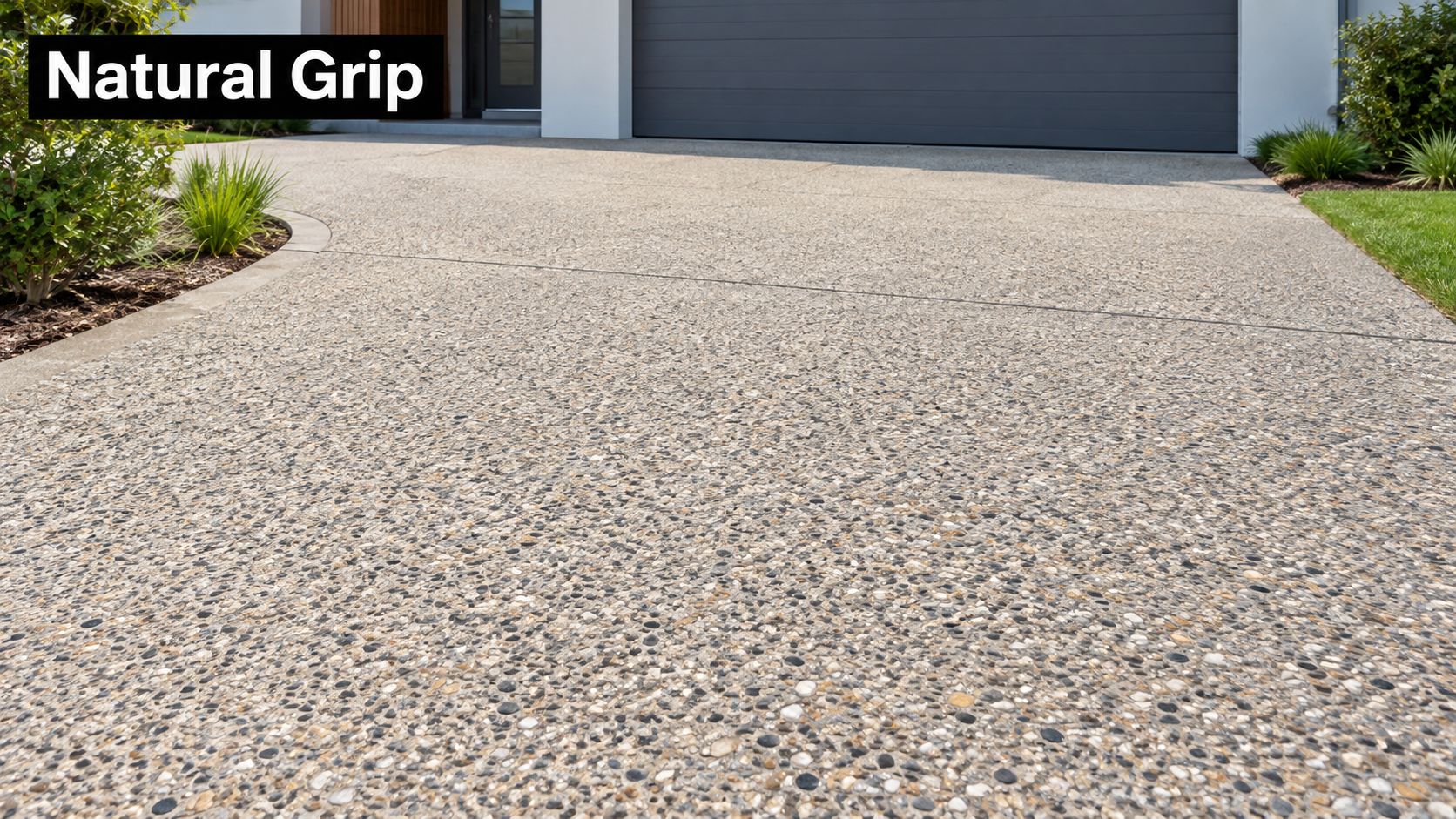
Judge the Sample Underfoot
Ask for a cured sample showing the proposed stone and depth of exposure. A photograph won't tell you whether the surface feels comfortable between the garage, mailbox, and front door.
- Finishing timing: The crew must expose the stone without loosening it or leaving patches of cement film.
- Walking comfort: Smaller aggregate generally suits frequently walked areas better than aggressively exposed large stone.
- Appearance: Expect natural variation rather than the uniformity of a manufactured tile.
The main limitation is repair matching. A replacement panel may differ in aggregate distribution, paste color, and exposure even when the contractor uses the same materials.
Choose exposed aggregate because you like its texture and natural variation. Don't choose it expecting the finish to compensate for poor drainage or hide structural cracking.
4. Integral Color and Acid-Stained Concrete Driveway
Integral color and acid stain aren't interchangeable. Integral pigment colors the concrete mixture, while acid stain reacts with the hardened surface to create mottled tones. Neither should be confused with an opaque paint coating.
A Milton home with a modern façade could use charcoal integral color and restrained saw-cut geometry. A Sandy Springs property with warm brick might suit a brown-and-tan stain, provided the owner accepts variation rather than expecting a flat, perfectly uniform shade.
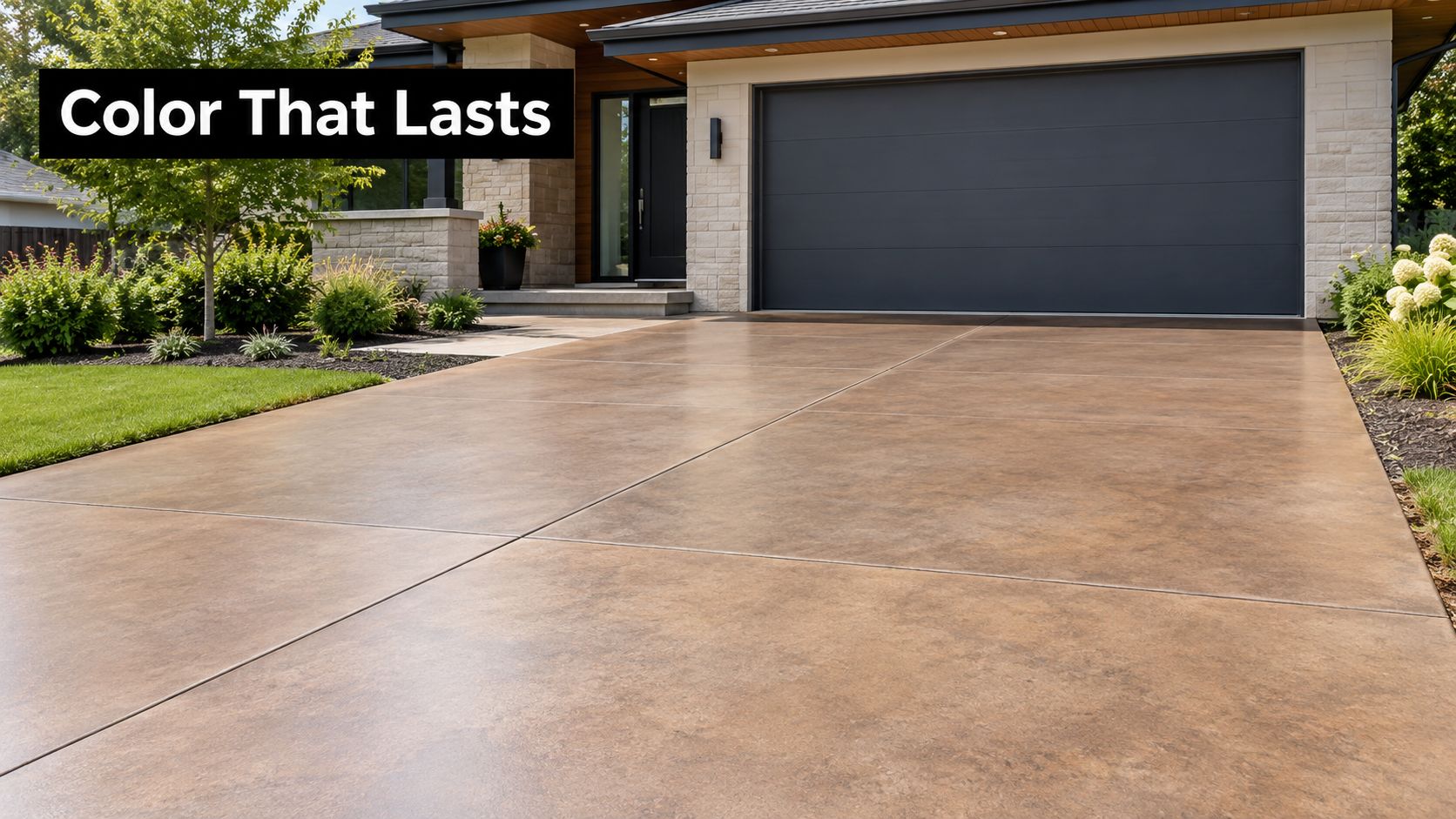
Separate Color From Protection
The color system establishes appearance. The compatible sealer, surface texture, and maintenance plan determine how the finished surface behaves under vehicles and wet shoes.
Request a sample using the proposed concrete and finishing method. For acid stain, a discreet test patch is particularly useful because the existing surface condition affects the reaction.
- Keep records: Retain pigment names, batch information, stain products, and sealer details.
- Avoid automatic gloss: Choose the sheen and traction characteristics for the driveway's slope and shade.
- Expect repair differences: Through-color concrete can still show patches, and stained repairs may react differently.
For Concrete Driveway Sealing Atlanta, compatibility matters more than choosing a product just because its label says it's suitable for concrete. Mixing incompatible coating systems can create a maintenance problem that the original color treatment never had.
5. Driveway Apron Replacement
The apron isn't merely another driveway panel. It connects private access to public infrastructure, where sidewalk elevations, curb geometry, drainage, and permitting can control the design.
Within the City of Atlanta, the Department of Transportation's permit guidance states that disturbance within the public right-of-way requires a permit and specifically identifies driveway apron installation or repair. Don't assume that rule establishes the process in Decatur, Dunwoody, or another municipality. Confirm the actual jurisdiction.
A Decatur homeowner dealing with a heaved sidewalk crossing should resolve pedestrian access and approach elevations before selecting a decorative finish. For a Dunwoody property, the permit-approved apron detail should guide the connection to the private driveway.
Define Responsibility Before Demolition
- Permit ownership: Identify who submits drawings, obtains approval, and schedules inspections.
- Boundary verification: Establish the right-of-way limits instead of guessing from the lawn edge.
- Restoration scope: Include affected sidewalk, curb, gutter, landscaping, and street-edge work in the quote.
For Concrete Driveway Apron Atlanta projects, compare targeted concrete and masonry repair services with complete replacement when the surrounding concrete remains sound.
Coordinate the apron and driveway design together, even if the work requires separate approvals. A neat joint alignment won't help if the finished approach scrapes vehicle undercarriages or interrupts gutter flow.
6. Driveway Widening with Matching Concrete
An addition can solve parking problems without removing serviceable pavement. Matching the old concrete perfectly is usually the wrong promise, however. Weathering, aggregate, finishing, and curing can make the new strip visibly different.
For a Smyrna household adding parking beside an existing driveway, a deliberate border may look better than an attempted invisible match. A Lawrenceville property adding access toward a side-entry garage needs enough turning room, not just extra pavement beside the current slab.
The Driveway Widening Atlanta decision also changes how much rainfall runs off the property. The EPA's stormwater guidance identifies driveways as impervious surfaces and recognizes permeable pavement as a practice that can slow, detain, or filter stormwater.
Treat the widening as a new pavement section with its own support and drainage requirements, not as a concrete strip poured onto the lawn.
Before committing, check local width restrictions, setbacks, and impervious-area requirements. Then have the contractor establish the junction between old and new concrete and determine whether a joint or engineered connection suits the conditions.
A drainage-friendly edge or permeable parking bay may help, but it still needs a designed base and an outlet strategy. On Piedmont clay, an open-looking surface alone doesn't establish that water can infiltrate safely.
7. Driveway Extension to Garage, RV Pad, or Side Yard
An extension needs a destination and a loading plan. Reaching a detached garage is different from supporting an RV, boat trailer, or workshop delivery vehicle.
For a Woodstock property adding an RV pad, the contractor needs the vehicle's loaded weight and support-point arrangement. For a Peachtree City home extending toward a detached garage, turning geometry and a practical turnaround may matter as much as the parking surface itself.
Design the Panels Before the Pour
Near-square panels help manage shrinkage cracking. Portland Cement Association jointing guidance warns that panels with a length-to-width ratio greater than 1.5:1 are more likely to crack randomly and recommends contraction or construction joint depths of at least one-quarter of the slab thickness.
Those details matter on long, narrow extensions, where an attractive unbroken strip can create an unsuitable panel layout.
- Check underground constraints: Locate utilities, septic components, and drainage lines before setting the route.
- Confirm legal access: Review setbacks, easements, and parking restrictions.
- Resolve discharge: Keep runoff away from neighboring property and vulnerable foundations.
For Driveway Extension Atlanta, don't automatically specify a passenger-car slab beneath an RV. Have the designer address wheel loads, jacks, edges, reinforcement, and soil support together.
Also consider future use. Installing the right access width and turning area during replacement is more practical than discovering afterward that the trailer can't reach its pad.
8. Drainage-Optimized Driveway Design
Water needs a continuous route to an acceptable outlet. A channel drain at the garage is useful only if its pipe can carry collected water somewhere appropriate.
A Johns Creek driveway sloping toward the garage might need an intercepted surface flow path and a channel drain. A Stone Mountain property may instead need regrading and an uphill interceptor to keep yard runoff from reaching the driveway.
For How to Fix Drainage Problems on an Atlanta Driveway, distinguish surface collection from subsurface drainage. A French drain doesn't automatically collect fast-moving sheet flow, and a trench grate doesn't correct a saturated base beneath the slab.
Test Before Choosing Permeable Pavement
The EPA's permeable pavement guidance explains that performance depends on the aggregate system, subgrade conditions, drainage design, and protection from sediment. On clay sites, require infiltration testing and a cross-section showing the storage layer and any underdrain.
- Measure elevations: Use a laser or level to establish slopes and outlet feasibility.
- Separate water sources: Redirect roof runoff where appropriate instead of adding it to a driveway bottleneck.
- Provide access: Keep drains, cleanouts, and outlets reachable for maintenance.
An unexplained wet area may involve a buried utility problem rather than rainfall alone. Information about sewer pipe replacement for homeowners can help distinguish a plumbing investigation from surface drainage work.
Don't pour over an unresolved water problem. Establish its source first.
9. Concrete Driveway Sealing and Protective Coatings
Sealing is a preservation option, not structural replacement. It belongs on this list because sound concrete with surface wear may not need demolition at all.
A Marietta homeowner with stable panels and staining could benefit from cleaning and an appropriate protective treatment. A Roswell HOA managing shared driveways needs a compatible maintenance specification, not repeated coats of whichever product is available.
The Portland Cement Association's concrete applications guidance emphasizes proper curing and identifies water, moisture-retaining coverings, and curing compounds as methods for limiting moisture loss. A decorative sealer shouldn't be assumed to perform the same job as the specified curing system.
The drainage detail shown below illustrates another prerequisite: protective treatments can't correct water collecting at the garage.
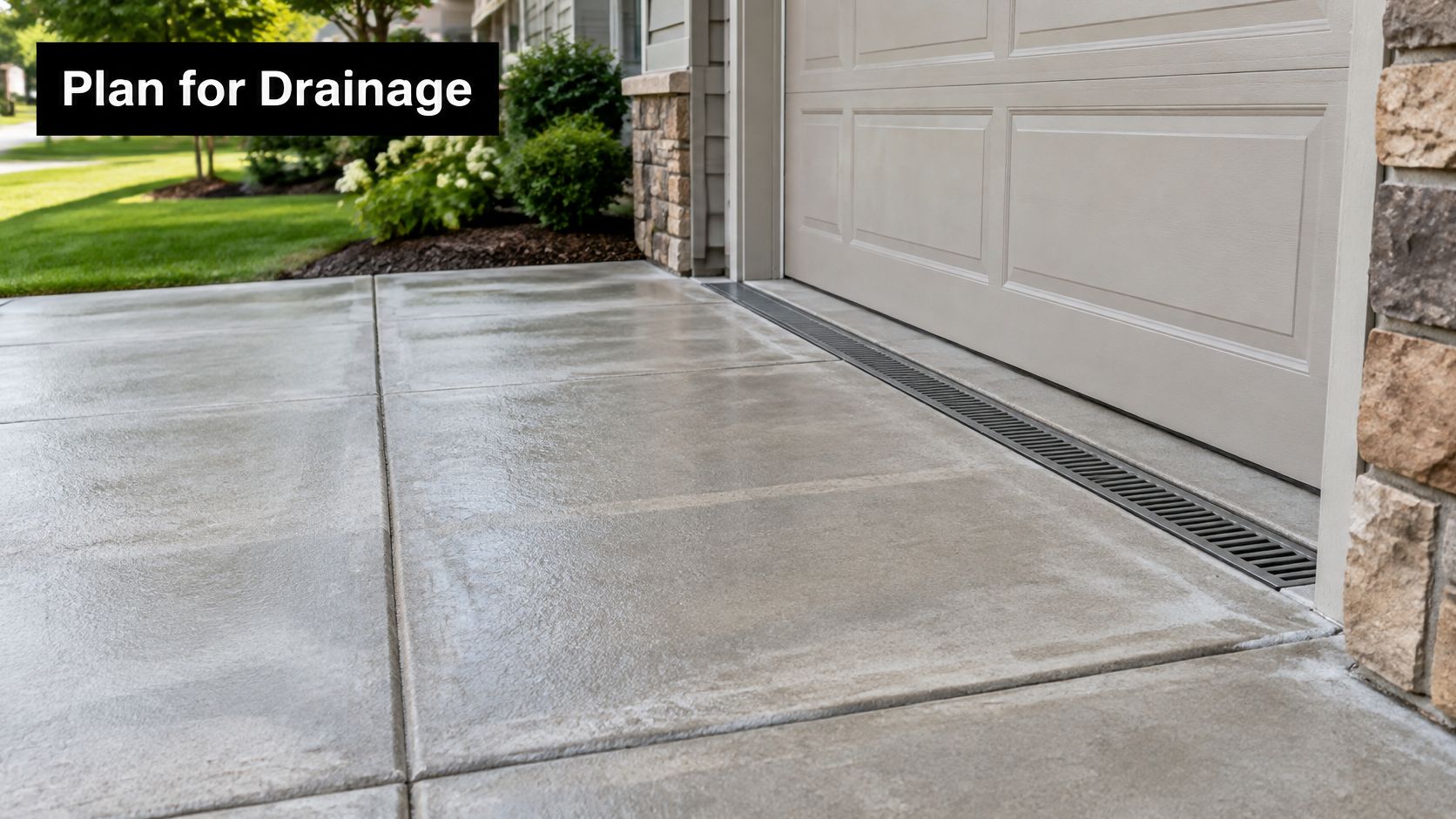
Match the Treatment to the Surface
Penetrating sealers and film-forming sealers have different purposes. Choose according to the concrete condition, existing treatments, stain resistance requirements, appearance, and traction.
- Prepare thoroughly: Remove contaminants and investigate existing coating adhesion.
- Test compatibility: Apply a small sample before treating the whole driveway.
- Watch conditions: Follow product limits for moisture, temperature, and weather exposure.
A useful Concrete Driveway Maintenance Guide should identify the actual products installed. For Concrete Driveway Repair vs Replacement, uneven movement, widespread deterioration, and failed support deserve investigation before anyone recommends a cosmetic coating.
10. Heavy-Duty Reinforced Driveway for Trucks and Commercial Traffic
A driveway serving work trucks isn't just a residential slab with extra steel. The design must address actual axle loads, turning movements, braking, soil support, and vulnerable edges.
A Norcross contractor planning daily truck access should provide vehicle information before pricing. A Duluth townhome community should identify refuse and delivery vehicles when specifying its shared service entrance, even if residents mostly drive passenger cars.
For Best Concrete Thickness for a Residential Driveway, start with expected loading rather than a universal detail. The Georgia Department of Transportation miscellaneous-concrete specification requires a compacted and wetted subgrade for the work it covers, reinforcing the importance of support rather than finish alone.
Reinforcement Doesn't Replace Design
For Do You Need Rebar in a Concrete Driveway?, the answer depends on the designed section and loading. Reinforcement can help control crack movement, but it doesn't make unsuitable soil, inadequate thickness, or poorly located joints acceptable.
Load-first recommendation: Give the designer the heaviest expected vehicle, not just the vehicle that parks there most often.
Discuss commercial driveway concrete when trucks, equipment, or repeated service traffic determine performance. Ask whether the project needs a subgrade assessment, engineered reinforcement, thicker edges, or additional turning space.
Also specify curing protection and opening requirements. Heavy vehicles shouldn't enter merely because the surface looks dry or the finishing crew has left.
Cost, Thickness, and Best Use for Each Driveway Replacement Idea
Finish is the last choice, not the first. In Atlanta, the apron, drainage, base, and expected vehicle loads determine what the replacement needs before color or texture enters the decision. Piedmont clay and heavy summer storms make soil support and water flow especially important; public-facing apron work may also require right-of-way approval.
The table gives typical thicknesses and the main cost drivers, not installed price quotes. Demolition, base and soil correction, drainage, permits, reinforcement, and decorative finish can change the scope. Get those items specified separately before comparing bids.
| Item | Main Cost Drivers | Typical Thickness | Best For |
|---|---|---|---|
| Standard Broom-Finish Plain Concrete Driveway | Demolition, base preparation, soil correction, and drainage | 4 in.; 5–6 in. for heavy vehicles | Homeowners seeking a durable surface with minimal upkeep |
| Stamped Concrete Driveway | Demolition, base preparation, and decorative stamping | Typically 4 in. | Homeowners and HOAs seeking a paver look in concrete |
| Exposed Aggregate Concrete Driveway | Aggregate finish, base preparation, and drainage | 4 in. | Homeowners wanting a natural look and added traction |
| Integral Color and Acid-Stained Concrete Driveway | Color or stain work, surface preparation, and sealing | 4 in. | Property owners wanting custom color without coating maintenance |
| Driveway Apron Replacement | Demolition, right-of-way permits, base correction, and street tie-in | Typically 6 in. or more | Homeowners addressing a cracked or heaved street apron |
| Driveway Widening with Matching Concrete | Excavation, base work, drainage, and matching the existing slab | Match the existing slab design | Homeowners needing more parking or access without full replacement |
| Driveway Extension to Garage, RV Pad, or Side Yard | Excavation, base preparation, drainage, and reinforcement for heavier vehicles | 4–6 in.; thicker for heavy vehicles | Homeowners with RVs, boats, trailers, or detached garages |
| Drainage-Optimized Driveway Design | Regrading, drainage work, demolition, and base correction | Set by the slab design and loading | Properties with standing water, steep grades, or drainage-related cracking |
| Concrete Driveway Sealing and Protective Coatings | Surface preparation, product choice, and application | Not applicable | Driveway owners seeking to protect the surface and maintain its appearance |
| Heavy-Duty Reinforced Driveway for Trucks and Commercial Traffic | Thicker slab, reinforcement, base preparation, and soil correction | 5–6 in. or more | Contractors, RV owners, commercial properties, and HOAs with heavy vehicle traffic |
A 4-inch residential slab is a common starting point, not a substitute for checking support and loading. Heavy vehicles call for a thicker section, while poor drainage or weak soil may require correcting the base before any finish is applied. Stamped, exposed-aggregate, and colored surfaces add finish work, but they do not replace sound preparation.
Match the Replacement to Your Soil, Traffic, and Budget
The finish should be the last decision. Settle the base, grade, apron approval, and vehicle loads first. Atlanta's clay soils and heavy summer storms make support and drainage part of the replacement scope, while right-of-way work may require approval. Once those conditions are addressed, choose a finish that suits the property and the maintenance it requires.
For How Much Does a Concrete Driveway Cost in Atlanta? and Concrete Driveway Replacement Cost Atlanta 2026, installed prices depend on measured quantities, site access, soil conditions, and drainage. Written local quotes are the reliable basis for a price on your property. Ask bidders to price demolition, disposal, excavation, soil correction, aggregate, drainage, concrete, reinforcement, permits, and decorative work as separate line items.
Compare the Whole Replacement Scope
Have each bidder specify slab thickness, base depth, concrete mixture, reinforcement, joint layout, curing method, and sealing. Also clarify who handles utility locating, public access, inspections, landscaping restoration, and weather-related schedule changes. A low total may reflect work left out of the proposal, so compare the same scope line by line.
For Concrete Driveway vs Asphalt in Atlanta, weigh maintenance and intended performance alongside installation price. The Federal Highway Administration's pavement guidance uses minimum performance periods of 25 years for reconstructed flexible pavements and 35 years for reconstructed rigid pavements. These are roadway planning benchmarks, not driveway warranties.
For How Long Does a Concrete Driveway Last in Atlanta?, assess how the design addresses site preparation, drainage, joints, and curing. For Concrete Driveway Cracks: When Should You Replace It?, distinguish stable shrinkage cracks from displacement, continuing settlement, or deterioration linked to failed support. If the support is the problem, surface repair alone may not resolve it.
Budget for Maintenance and Access
Assess sealing periodically, then base treatment on the installed product and surface condition rather than recoating automatically. HOAs and shared-property managers can use the same reserve-planning approach described in budgeting for condominium repair projects: define responsibilities, document the work scope, and plan for access disruption before construction begins.
Atlanta Concrete Solutions offers free quotes, financing options, and consultations in Alpharetta, Marietta, Johns Creek, Duluth, and nearby communities. Compare a basic replacement with drainage corrections or decorative options before committing. Choose the scope that addresses the cause of failure and fits the driveway's daily use.
Atlanta Concrete Solutions provides driveway replacement, decorative concrete, and residential and commercial concrete services. Visit Atlanta Concrete Solutions to request a consultation and written proposal covering the apron, drainage, base preparation, vehicle loads, and finish.