
You've got a cracked driveway, a contractor who can start immediately, and another whose estimate is higher but includes several lines you don't recognize. Both promise a good job. The problem is that once the concrete is placed, you can't easily inspect the preparation underneath it.
Learning how to choose a concrete contractor means checking what you're buying before comparing what you'll pay. For Atlanta homeowners and commercial buyers, the strongest proposal isn't necessarily the cheapest. It's the one that defines the work, assigns responsibility, and leaves the fewest expensive questions unanswered.
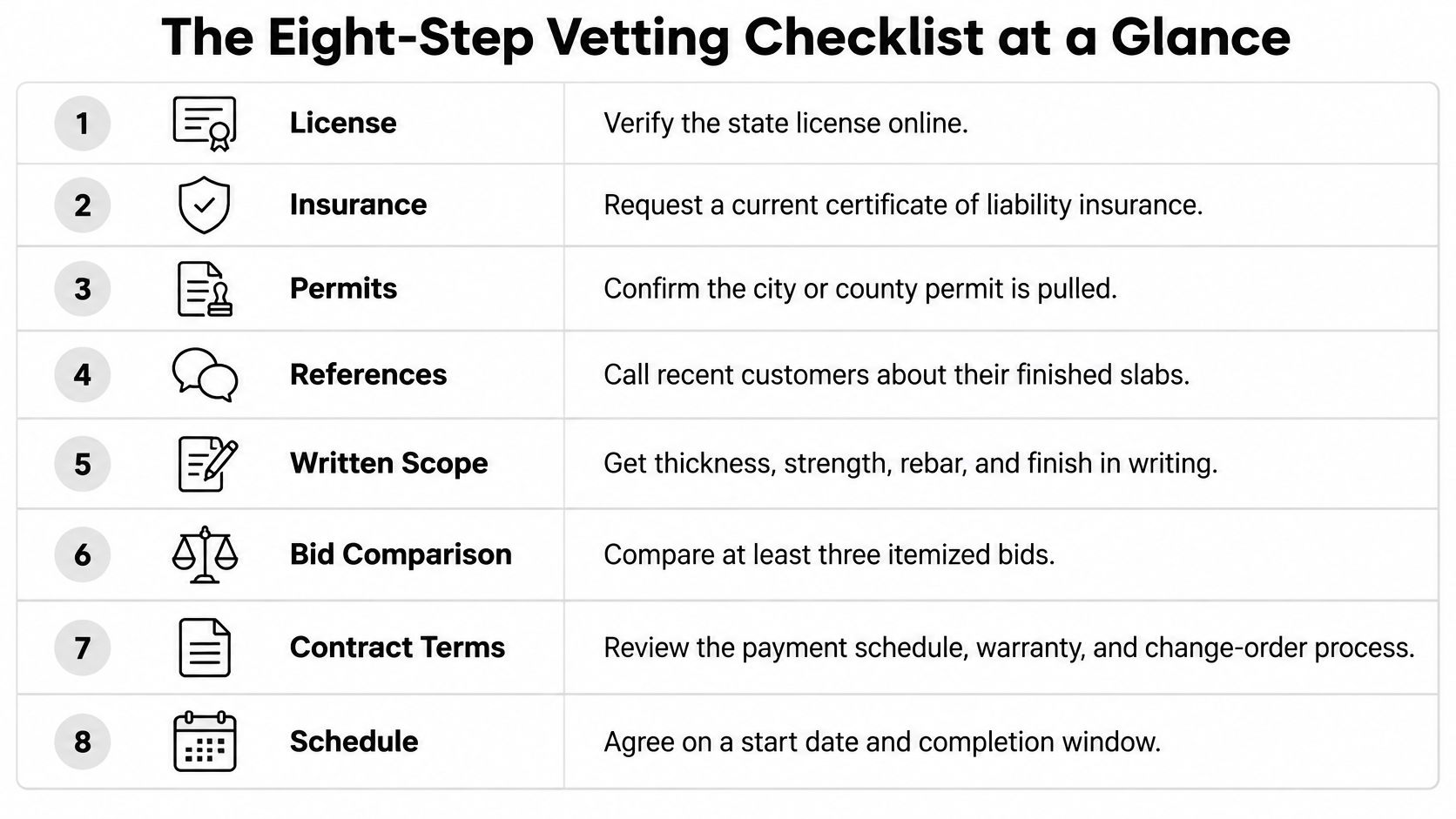
The Eight-Step Vetting Checklist at a Glance
| Step | What to Verify | Where to Verify | Red Flag |
|---|---|---|---|
| 1. License | Active state license where required, correct class, legal name matching the proposal | Georgia Secretary of State licensing lookup | Truck displays a license number with no matching record |
| 2. Insurance | Current general liability and workers' compensation certificates | Insurer-issued certificates, confirmed by phone | Expired certificate or different insured company |
| 3. Permits | Required permit issued for the address and inspections arranged | City or county permit office | Contractor dismisses permits without checking |
| 4. References | Three comparable references, including projects two or more years old | Phone calls and an authorized drive-by | Only friends or family offered |
| 5. Written scope | Identical, itemized requirements for every bidder | Bid review sheet and site visit | Undefined lump-sum allowances |
| 6. Bid comparison | Completeness assessed before price | Side-by-side comparison | Missing base, drainage, or testing |
| 7. Contract terms | Milestone payments, changes, warranty, exclusions | Contract read-through | Full payment demanded before work |
| 8. Schedule | Start, completion window, weather allowance, curing restrictions | Written schedule attached to contract | No completion window or curing plan |
Use the checklist as a screening tool, not a points contest.
Credentials Before Price
License lookups and permit-portal checks can begin with a brief online search. Insurance confirmation and references need phone calls. Scope development and scheduling require documents and, preferably, a site visit.
An unresolved credential failure removes a bidder from consideration. First establish which licensing and permitting requirements apply to your particular work. A contractor who won't meet those requirements isn't an option, however attractive the price.
For a useful general comparison framework, HomeProBadge explains how to compare contractor bids with confidence. Apply that discipline to the preparation and drainage details specific to concrete.
Hypothetical example: Two bids cover the same 600-square-foot driveway. The cheaper proposal pours over soil without a specified compacted gravel base and omits apron drainage. The higher proposal includes both. Those contractors haven't priced the same project.
The credential checks establish eligibility. References establish confidence. The written scope, contract, and schedule determine which eligible contractor offers the more dependable agreement.
Verifying Licenses, Insurance, Permits and Locates
Before a deposit is discussed, verify that the business named on the proposal matches its credentials and insurance. A clean paper trail helps prevent disputes over who was hired, what work is authorized, and who is responsible if something goes wrong.
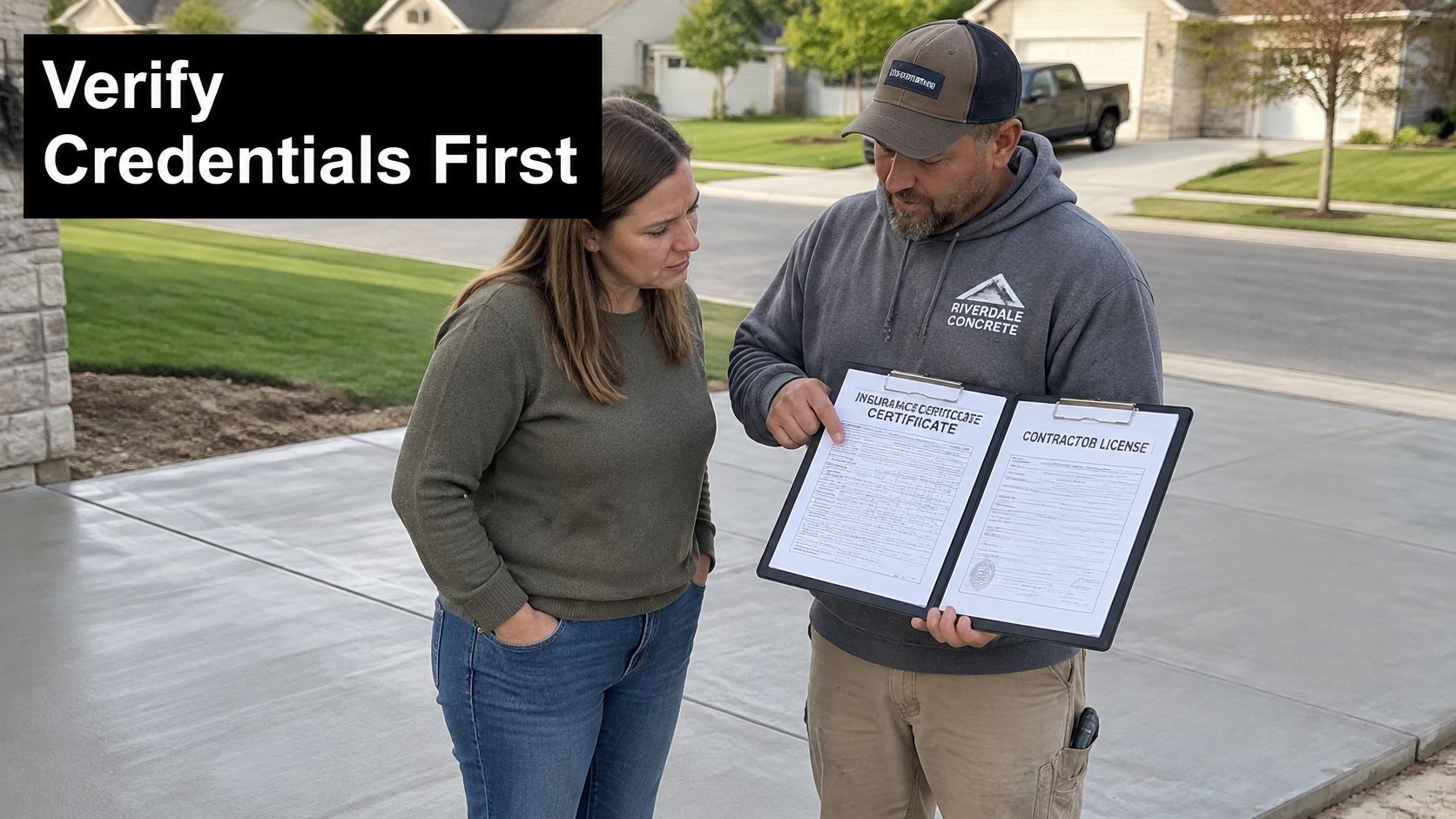
Match the Business to the Paperwork
Licensing depends on the work. Confirm which requirements apply to your project before accepting a claim that a state credential is or is not needed. Where a license is required, check its status, classification, and legal entity through the Georgia Secretary of State licensing lookup.
Ask the insurance representative to confirm general liability and workers' compensation coverage. Check coverage dates, relevant limits, and certificate-holder status where appropriate. Clarify whether crew members are employees or subcontractors, and confirm subcontractor coverage with the issuing insurer by phone.
| Credential | Valid Version Looks Like | Where to Check | Warning Sign |
|---|---|---|---|
| State contractor license | Active, appropriate class where required, matching contract entity | Georgia Secretary of State licensing lookup | No matching record or unexplained business name |
| General liability insurance | Current certificate, appropriate limits, owner identified when requested | Issuing insurer | Expired coverage or another insured entity |
| Workers' compensation | Applicable crew coverage or documented, verified exemption | Issuing insurer and appropriate authority | Unexplained gaps in crew coverage |
| Local business registration | Applicable registration matching the proposal | City or county business license office | Different entity without explanation |
| Driveway or flatwork permit | Required permit for the address, inspections arranged | City or county permit portal | Unsupported claim that permits aren't needed |
| HOA and utility locates | Applicable HOA approval and completed utility-locate process | HOA and Georgia 811 | Excavation before utilities are marked |
Check the authority for the actual project location, not just the contractor's mailing address. Ask the City of Atlanta, Alpharetta, Marietta, or Johns Creek, as applicable, about permits and any separate sidewalk or right-of-way approvals. Confirm HOA approval before changing the footprint or finish. Arrange Georgia 811 locates before digging, and make sure the markings are complete before excavation starts.
A contractor's company history can help you understand its operating approach, but it does not replace checking credentials. Review the contractor background and operating approach, then verify the submitted documents independently.
Ask Who Owns Site Safety
Ask who supervises excavation, identifies hazards, controls equipment, and protects workers and occupants. These questions are appropriate for any concrete job, particularly when work involves digging, heavy equipment, or an occupied property. Ask for a clear name and responsibility, not just a general assurance that the crew follows safety rules.
For commercial work, request applicable bonding evidence and prequalification documents, and identify the person responsible for site safety. Keep those items with the proposal and contract so the project's scope and accountability are clear before work begins.
Questions to Ask and References to Check
| Question | Strong Answer | Weak Answer |
|---|---|---|
| Who supervises the crew on site? | Named foreman with comparable project experience | Vague reassurance about good workers |
| How many similar driveways have you poured in the last year? | Specific count supported by records or photographs | Large, unsupported claim |
| Do you self-perform or use subcontractors? | Clear responsibility for placement, finishing, and joint cutting | Subcontractors identified only when work begins |
| What strength and mix will you specify? | Written PSI requirement and mix specification | An undefined standard mix |
| Who handles testing and finisher certification? | Named qualified personnel and applicable testing plan | No answer or reliance solely on habit |
| What happens if the base or slab fails? | Written investigation, repair, and warranty responsibilities | Claim that concrete cannot fail |
Listen for names, documents, and responsibilities. A convincing answer explains who does the work and how the owner can verify it. A polished sales answer that never reaches those details isn't enough.
Subcontracting itself isn't a reason to reject a contractor. Unclear supervision is. You need to know who directs the crew and who remains responsible if a subcontractor's work doesn't meet the contract.
Check Work That Has Seen Use
In Clever's survey of 1,000 homeowners reported by CNBC, 25% ranked reputation as the most important hiring factor, compared with 23% for experience and 19% for cost. Reputation becomes useful evidence when you investigate how the contractor handled actual problems, not just whether customers liked the salesperson.
Request three comparable references, including work at least two years old. Ask permission before visiting, and use the project portfolio to identify the types of work you want to discuss.
- Schedule accuracy: Did the contractor explain delays and provide revised dates?
- Changes: Were extras documented and approved before the work?
- Cleanup: Were demolition debris, forms, and surrounding damage addressed?
- Follow-through: Did the contractor respond when the customer raised a concern?
- Repeat business: Would the customer hire the same firm again?
A drive-by after rain can reveal standing water at the apron. Look for surface scaling and cracking patterns around joints, but don't diagnose workmanship from the curb alone. Ask what happened, whether the contractor investigated, and how the issue was resolved.
Reference rule: If a contractor can't provide three relevant references within a week, treat that as information about its track record or organization, not merely a scheduling inconvenience.
Comparing Bids on Scope Instead of Price
Send the same written scope to three contractors, mark every item stated, missing, or allowance, and resolve the gaps before comparing totals.
| Line Item | What the Bid Must State | Cost of Omission |
|---|---|---|
| Demolition and disposal | Removal boundaries, haul-off method, disposal responsibility | Extra charges after demolition |
| Subgrade and base | Soil assessment, compaction method, base material and depth | Settlement risk and corrective work |
| Drainage and grading | Slope direction, low points, drains or swales | Ponding and water beneath the slab |
| Concrete strength and mix | Written PSI requirement and mix specification | Unverifiable material requirements |
| Thickness | Thickness in inches and locations of thicker sections | Inadequate capacity for intended loads |
| Reinforcement | Type, size, spacing, and placement requirements | Undocumented substitutions |
| Control joints | Layout, depth, and installation timing | Disputes over uncontrolled cracking |
| Finish, curing and sealer | Finish, curing method, applicable sealer product | Unclear surface protection |
| Warranty and exclusions | Duration, covered defects, excluded causes | Coverage disputes |
| Permits and testing | Responsible party, fees, inspections, test arrangements | Later charges and compliance gaps |
Specify Performance, Not Just Dimensions
A residential driveway commonly starts with a discussion of roughly four inches, with five to six inches considered where trucks turn or park. Those aren't universal design instructions. Have the contractor justify the section for the actual loads, ground conditions, and applicable requirements.
Ask which ASTM, ACI, local-code, or project specifications govern the work. The NIST publication on Portland-cement standards provides background on material standardization; your proposal needs the applicable present-day requirements, not merely an assurance that the contractor uses quality concrete.
For significant structural or commercial work, the Bureau of Reclamation's concrete quality-control guidance supports requesting a testing plan, qualified personnel, and applicable ACI credentials. Review the relevant concrete service categories so bidders are pricing the same application.
Price the Missing Work
Hypothetical comparison: Bid A is $7,200, specifying a 4-inch slab, 6 inches of compacted gravel, and an apron drain. Bid B is $6,100, with an undefined base and no drainage item. Adding hypothetical allowances of $1,200 for base work and $900 for drainage makes Bid B $8,200. These are illustrative figures, not Atlanta market prices.
Drainage deserves its own assessment. Georgia DOT's driveway requirements call for relevant side-drain systems connected to the State Highway System to accommodate the 25-year storm, subject to the stated upstream-system exception. Don't apply that requirement indiscriminately to every residential driveway.
FHWA drainage guidance also explains why water beneath pavement can contribute to deterioration. Replacing a surface without correcting its underlying drainage problem can leave the cause untouched.
For low-carbon proposals, request the mix design and an environmental product declaration, where available. The Concrete Products discussion of LCA and EPD purchasing decisions reinforces the value of measurable documentation. Compare strength, curing needs, availability, service life, and total material volume, not environmental adjectives.
Contract Terms, Payment and Timelines
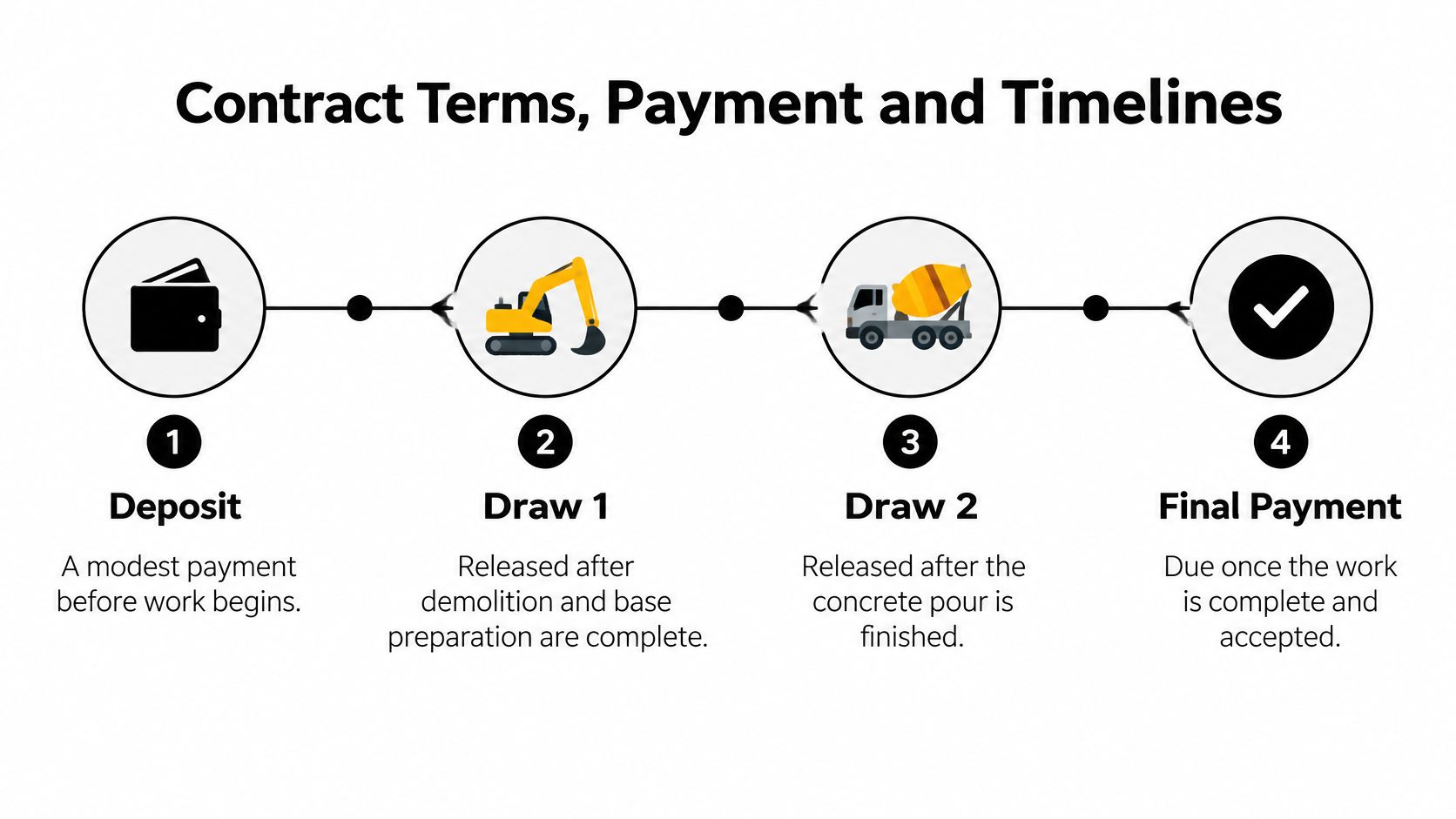
A low bid can become the expensive choice if the contract leaves payment triggers, extra work, or completion criteria open to argument. Tie each payment to work the buyer can inspect, and set a clear final payment process after the walkthrough. Judge a proposed deposit by what it covers, what costs the contractor must pay before work begins, and whether the remaining balance is tied to verifiable milestones. The amount and schedule should be written into the proposal, not left as “modest” or agreed verbally. No extra work should proceed without written authorization, except under an emergency procedure defined in the contract.
Set unit prices for foreseeable discoveries, such as unsuitable soil or additional base depth. Require dated photographs before concealed work is covered. A regional study of contractor payment disputes in Goa identifies delayed payment, underpayment, and disagreements about work and scope changes. It is not evidence of Atlanta pricing, but it highlights why acceptance criteria and payment terms should be clear to both parties.
Use milestones that match work you can inspect.
Protect Payment and Access
For commercial work, ask counsel or the project administrator to review conditional lien waivers with progress payments and the appropriate final unconditional waiver after payment clears. Confirm how supplier and subcontractor waivers will be collected. Paying the prime contractor alone may not resolve downstream obligations.
| Milestone | Contract Should State |
|---|---|
| Permits and utility locates | Required approvals, completion of locates, and responsibility for delays |
| Demolition and excavation | Haul-off method, disposal responsibility, and unit price for unsuitable soil |
| Base, forms and pour | Specified materials, finish, joint layout, and weather-related hold conditions |
| Initial cure and protection | Curing method, specified cure duration, and protection responsibilities |
| Foot traffic and vehicles | Written return-to-service criteria and who authorizes access |
| Strength acceptance | Acceptance test age, required test results, and acceptance criteria |
| Warranty | Written term, covered workmanship defects, exclusions, and claim procedure |
Don't accept a schedule that promises a date without stating what can delay the work, such as approvals, locates, site conditions, or weather. For strength acceptance, the proposal should identify when testing occurs and what result qualifies. That gives you something concrete to compare across bids.
Put Curing and Warranty Obligations in Writing
Atlanta heat, sun, and wind affect the placement plan. FHWA curing guidance describes ways to limit moisture loss and curing methods suited to different applications. Put the selected method, the person responsible for applying it, the specified cure duration, and the protection plan in the contract.
A finished-looking surface is not permission to park on it. Get the vehicle-return instruction in writing.
Write the warranty term into the proposal rather than relying on a general promise. Define covered workmanship defects and how cracking or scaling claims will be evaluated. Discuss exclusions for de-icing salts, heavy equipment, or owner-controlled drainage. If correcting drainage is part of the contracted work, don't accept a broad exclusion that removes responsibility for that work.
Sign Only After the Checklist Passes
You're ready to sign, but the contractor still has not explained who handles a drainage change. Pause and get the answer in writing. One unresolved concern calls for a question, two call for a second opinion, and failure to meet an applicable credential requirement ends consideration. This is a practical decision rule, not a scoring system.
Walk away if the contractor refuses a documented payment trail, pressures you to sign before you finish checking credentials, offers a discount only if you accept an unplanned job immediately, or will not put the agreement in writing. Verbal promises leave room for disputes over materials, responsibilities, and what the price covers.
Compare qualified bidders by scope completeness, follow-through, and workable terms. A longer proposal is not better if it avoids measurable commitments. The lowest bid can cost more when omitted work turns into change orders or disagreements.
Before signing a driveway proposal, have the contractor explain any footprint change and how it affects grading and drainage. Ask whether the existing slab should be repaired or replaced, and what evidence supports that recommendation. For a decorative finish, confirm the agreed appearance, acceptance criteria, and maintenance responsibilities. In Atlanta, also verify any required HOA approval, city or county permits, and Georgia 811 utility locates; the contractor should clarify who arranges each item. The proposal should address heat-related curing and protection as part of the work.
Check that payment milestones, change-order procedures, schedule, and warranty match the itemized scope. For commercial work, confirm any required bonding and the process for collecting lien waivers. A contractor should explain when waivers are provided and how they correspond to payments, so you can document that subcontractors and suppliers have been paid.
Send shortlisted contractors the same project requirements, then request licensing details, insurance certificates, and references. Compare complete scopes and written commitments, not opening prices.
Atlanta Concrete Solutions offers driveway replacement, decorative concrete, slabs, foundations, and masonry services for residential and commercial projects across greater Atlanta. Visit Atlanta Concrete Solutions to request an on-site assessment and an itemized estimate.