
A standard driveway needs 4 inches of concrete for passenger cars and light SUVs, 5 inches for heavier vehicles or multi-car households, and 6 to 8 inches for commercial or heavy-duty use. But thickness alone doesn't determine whether a driveway survives, especially on Atlanta's red clay.
A thick slab poured over soft, wet, poorly compacted soil can fail sooner than a thinner slab built on a properly prepared base. The question isn't only how thick should a driveway be. It's how the entire driveway system, including subgrade, stone base, reinforcement, joints, drainage, and edges, is designed for the way you use the property.
Why Thickness Is Only Half the Story
The 4-inch rule is the standard starting point for residential concrete driveways. Industry guidance describes a 4-inch slab as the minimum for passenger cars and light SUVs when the base is properly compacted, while heavier use commonly calls for 5 inches or more. The Michigan concrete driveway and sidewalk guidelines.pdf?hsLang=en) also explain the practical trade-off: moving from 4 inches to 5 inches can increase load-carrying capacity by nearly 50% while adding roughly 20% to material cost.
That sounds like thickness is the whole decision. It isn't. Concrete driveways usually crack because the slab bends over weak or moving support, not because the concrete lacks compressive strength. A 4-inch slab on a compacted granular base can perform better than a careless 6-inch pour placed directly over unstable soil.
The ground underneath decides a lot
Atlanta's red clay creates a particular problem. It can hold water, soften when saturated, and move as moisture conditions change. If the contractor leaves topsoil, organic material, loose fill, or wet clay beneath the driveway, the slab can settle unevenly. Concrete doesn't forgive those weak spots.
The base needs to distribute wheel loads and provide consistent support. Drainage needs to keep water from collecting beside or beneath the slab. Reinforcement needs to control cracks, and joints need to give shrinkage a planned place to occur.
Practical rule: Pay for proper excavation, compaction, stone, drainage, and reinforcement before paying for unnecessary concrete thickness.
Thickness is one setting in a larger system
The right design balances several decisions:
- Slab thickness: Match it to the heaviest regular vehicle and the driveway's traffic pattern.
- Base preparation: Remove unstable material and compact a granular base evenly.
- Reinforcement: Use mesh or rebar where it can control cracking and support bending.
- Joint layout: Place control and isolation joints where the slab needs relief.
- Edge treatment: Strengthen unsupported edges, aprons, turning areas, and transitions.
For Atlanta homeowners, the strongest answer is usually targeted design, not pouring extra concrete everywhere.
Standard Residential Driveway Thickness by Use
Most residential driveways fit into three practical thickness tiers. The correct choice depends on what parks there regularly, what crosses the driveway occasionally, and whether the base is stable and well drained. A contractor should also account for slopes, turning zones, apron loads, and soil conditions before finalizing the section.
The three residential tiers
A 4-inch slab is the baseline for a single-car driveway serving a sedan, crossover, or light SUV. It works when the subgrade is stable, the granular base is compacted, and the driveway isn't routinely used by loaded trucks or trailers.
A 5-inch slab is my preferred residential upgrade for many Atlanta homes. Choose it for a household with multiple vehicles, a mid-size pickup, delivery traffic, or occasional heavier loads. The extra inch costs more in material, but the added structural capacity provides useful protection at wheel paths and edges.
A 6-inch slab makes sense for an RV pad, a steep approach, a driveway that regularly receives work vehicles, or a site where heavy construction equipment will cross during the build. It shouldn't be used as a substitute for correcting poor soil.
| Use Case | Slab Thickness | Typical Vehicles | Notes |
|---|---|---|---|
| Single-car residential driveway | 4 inches | Sedan, compact SUV, light SUV | Requires a properly compacted and drained base |
| Multi-vehicle household | 5 inches | SUVs, pickups, family vehicles | Better choice for repeated parking and occasional heavier loads |
| Home with work truck or delivery use | 5 inches | Pickup, loaded van, delivery vehicle | Reinforcement and edge detailing become more important |
| RV pad or steep residential driveway | 6 inches | RV, trailer, heavier work vehicle | Confirm soil, drainage, turning, and apron conditions |
| Commercial or heavy-duty use | 6 to 8 inches | Heavy equipment, repeated truck traffic | Requires a project-specific pavement design |
The residential driveway concrete guidance from Atlanta Concrete Solutions is a useful starting point for comparing residential applications.
Concrete mix strength matters, but stronger concrete won't rescue a weak base. A residential driveway should be designed as a complete assembly, with the slab, base, reinforcement, joints, and drainage working together.
How Load and Vehicle Type Drive the Numbers
Concrete driveways fail in bending, not ordinary compression. A tire places a concentrated load on the surface, and the slab transfers that force across the base. When the support underneath is inconsistent, the slab flexes. Repeated flexing creates fatigue, especially along edges, wheel paths, and areas where vehicles turn.
The practical residential rule is straightforward. A 4-inch slab is suited to passenger vehicles on a sound base. A 5-inch slab is the better choice when pickups, SUVs, loaded vans, or multiple vehicles regularly use the driveway. A 6-inch design provides additional room for RVs, trailers, and heavier service conditions.
Why one extra inch matters
The concrete-industry reference cited earlier notes that increasing slab thickness from 4 inches to 5 inches can raise load-carrying capacity by nearly 50%, while material cost rises by roughly 20%. That is a favorable trade for a homeowner who expects heavier use, because the added thickness addresses bending capacity rather than merely adding bulk.
Straight rolling loads are easier on concrete than turning loads. A vehicle that pivots near the garage or street apron pushes sideways against the surface. Those tires shear the concrete and stress the edges, so a driveway with a sedan in the field can still need stronger detailing at the turn.
Use the heaviest regular vehicle as the baseline
Don't design for the car you drive most often if a heavier vehicle uses the driveway every week. A household sedan plus a weekend pickup deserves the 5-inch recommendation. A trailer that sits in one parking bay creates a different stress pattern from a vehicle that repeatedly turns across the full driveway.
The technical driveway thickness guidance-1.pdf?hsLang=en) supports the practical move to 5 inches where light trucks, delivery vehicles, or occasional heavier loads are expected. For commercial traffic, guidance commonly moves beyond residential sections because axle weight and repeated passes matter more than a single occasional visit.
Commercial and Heavy-Duty Driveway Specs
Commercial driveways don't follow the residential 4-inch baseline because they experience heavier axle loads and more repetitions. A delivery apron that receives a truck occasionally has a different job from a route used by a commercial fleet every day. Design needs to account for both the weight and the frequency.
A 6-inch section can suit lighter heavy-duty conditions, such as an occasional box truck, dumpster pad, or residential RV area, when the base and reinforcement are designed correctly. An 8-inch section is more appropriate for repeated heavy loads, commercial vehicle storage, heavy equipment, or a driveway functioning as a regular truck route. Commercial driveway guidance places heavier-duty sections commonly around 6 to 8 inches or more, depending on traffic class.
Compare the whole pavement section
| Application | Thickness | Concrete PSI | Typical Reinforcement |
|---|---|---|---|
| Standard residential traffic | 4 inches | Residential mix specified for the project | Wire mesh or fiber reinforcement |
| Heavy residential traffic | 5 to 6 inches | Higher-strength mix may be considered | Rebar or engineered reinforcement |
| Light commercial apron | 6 inches | Often a stronger mix than residential work | Rebar grid with thickened edges |
| Repeated truck or equipment traffic | 8 inches | Project-specific higher-strength concrete | Engineered rebar design |
| Fire-truck access lane | Code-driven | Confirm with jurisdiction and engineer | Code and project specifications |
Some contractors can increase concrete strength, often from 4,000 to 5,000 PSI, as part of a heavier-duty design. That may be more economical than adding concrete across the entire surface, but strength alone doesn't replace adequate thickness, base support, or reinforcement.
The commercial driveway concrete services page provides a relevant reference point for property owners planning truck aprons, service areas, or larger concrete access surfaces.
Fire-truck lanes and public access areas may be governed by code rather than homeowner preference. If a driveway serves emergency access, a commercial use, or a public connection, verify the required section before ordering concrete.
Subgrade Preparation That Makes Thickness Work
The slab is only as dependable as the soil beneath it. For an Atlanta driveway, the first serious question is whether the contractor is removing unstable material and building a consistent base, not whether the crew is offering an attractive finish.
A proper sequence starts with excavation. Remove topsoil, roots, organic matter, soft fill, and visibly unstable soil until the crew reaches dependable material. Then place a granular base, compact it in controlled lifts, and verify the finished grade before forming the slab.
Build the foundation in clear stages
A practical residential base commonly includes 4 to 6 inches of compacted granular material, such as crusher run or #57 stone. The Concrete Network driveway thickness guidance emphasizes that performance depends on the compacted base, traffic type, local code, and site conditions, not just the concrete depth.
Compaction matters because loose stone can settle after the pour. Where Atlanta clay is particularly aggressive or wet, separation fabric can help keep the granular base from mixing into the soil. The crew should also establish drainage so surface water moves away from the slab rather than collecting at its edges.
Why red clay changes the decision
Atlanta's red clay can carry a driveway well when it stays supported and properly managed. Saturated clay is a different matter. It softens, moves, and can leave the slab bridging weak areas. Pouring a thicker slab over that condition spends money on concrete without fixing the cause of movement.
A perfect finish cannot compensate for a soft base.
Homeowners should ask how the contractor will verify compaction. A common technical target is 95% modified Proctor density, but the contractor should explain how that standard applies to the actual site and material. If you're adding a basketball goal near the driveway, these basketball hoop installation tips can also help you plan the post location without interfering with slab edges, drainage, or vehicle clearance.
Reinforcement, Joints, and Smart Edge Thickening
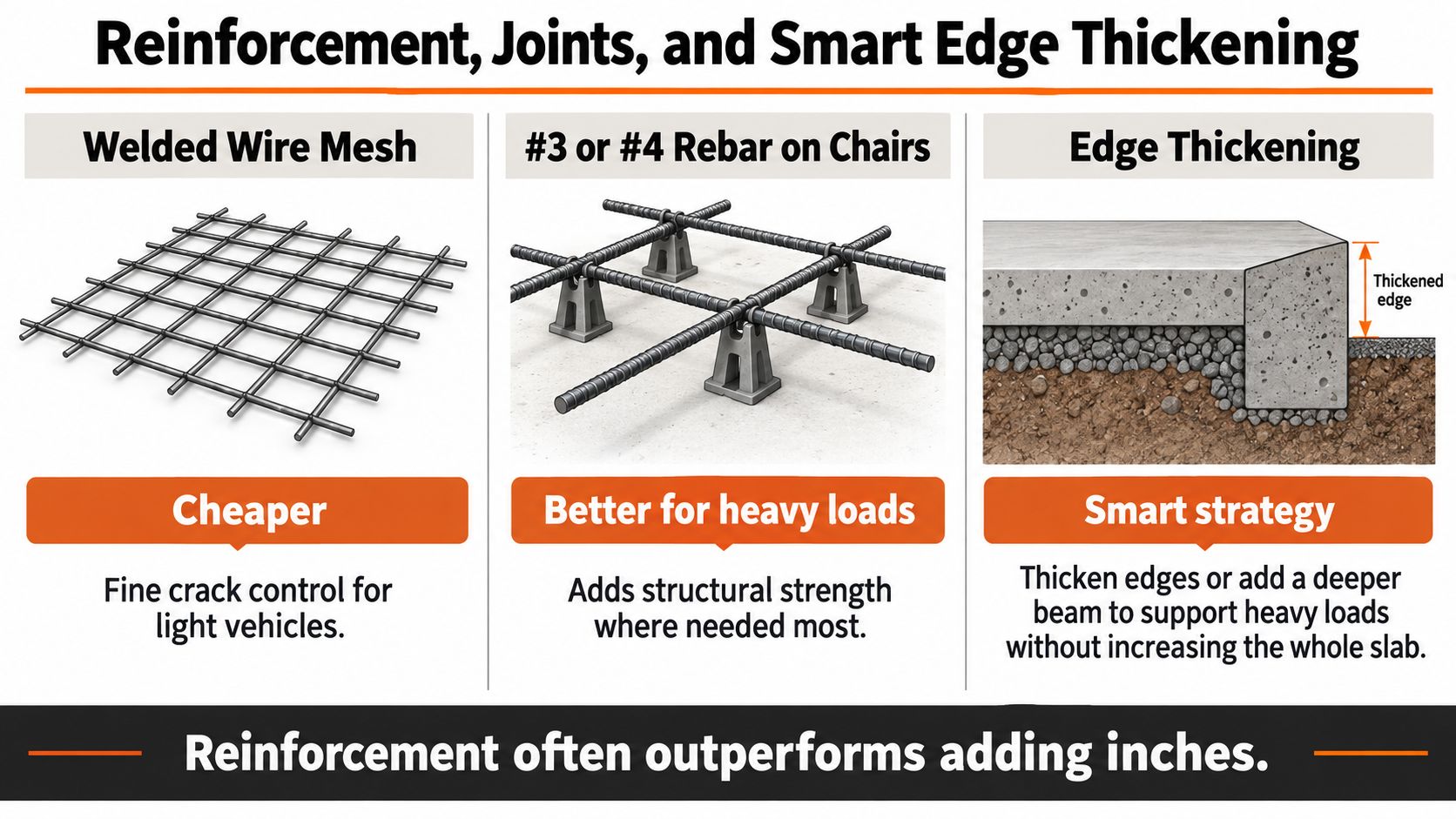
Reinforcement controls how a driveway behaves after cracking begins. It doesn't make concrete immune to cracks, but it can limit crack widening and help the slab hold together across small separations. Placement matters, too. Steel sitting on the ground contributes little if it isn't supported at the correct elevation inside the slab.
Welded wire mesh is a practical option for lighter 4- to 5-inch residential driveways when the goal is fine crack control. Rebar on chairs is the stronger choice for heavier loads, turning zones, and slabs at 5 inches or more. One reinforcement guide describes wire mesh as suitable for 4- to 5-inch driveways and favors rebar once the slab reaches 5 inches or more, while another recommends a rebar grid at roughly 12-inch spacing for reinforced driveway slabs. Review the driveway reinforcement recommendations with the contractor rather than accepting a generic steel promise.
Joints need a plan
Control joints create intentional planes of weakness so shrinkage cracks form in predictable locations. A practical layout uses joints every 8 to 10 feet for 4-inch slabs and every 10 to 12 feet for 5- to 6-inch slabs. Isolation joints should separate the driveway from the garage floor, sidewalk, foundation, or other rigid structures.
Joint layout becomes especially important on wide driveways, irregular shapes, and areas with inside corners. A crew that cuts joints late or places them randomly is leaving the slab's natural movement uncontrolled.
Thicken the places that take the abuse
Many driveway recommendations miss the point. Targeted thickening at edges, aprons, turning radii, and steep slopes often delivers more durability per dollar than making the entire driveway thicker.
A common detail is a thickened edge approximately 12 inches deep by 12 inches wide, shaped as a deeper beam along unsupported sides. The apron where the driveway meets the street deserves special attention because vehicles turn and cross the edge there. The curve into the garage and any wheel path beside an open lawn can also benefit from deeper concrete or additional rebar.
Smart design: Keep the field at its appropriate thickness, then reinforce the stress points that actually punish the slab.
This approach is particularly useful on Atlanta clay. Unsupported edges can move when surrounding soil dries or becomes saturated, while a stronger edge detail resists the wheel tracking that causes edge cracks.
Atlanta Climate, Code, and Site Considerations
Atlanta doesn't have the prolonged freeze-thaw exposure found in colder regions, but occasional hard freezes still matter when moisture is trapped beneath an under-reinforced slab. The bigger local concern is usually moisture movement through red clay. Clay swells when wet and shrinks during dry periods, so drainage and base preparation deserve as much attention as slab thickness.
Grade the driveway so water leaves the surface and doesn't pond against the edges. Avoid placing concrete directly on saturated clay. The contractor should inspect the approach, sidewalk crossing, curb connection, and right-of-way before building forms.
Confirm local requirements before the pour
Cobb, Fulton, DeKalb, and Gwinnett counties can apply different requirements to driveway aprons, sidewalk crossings, curb cuts, and work in the public right-of-way. New driveways, widenings, and curb modifications may require permits. Georgia 811 utility locates are also essential before excavation.
| Factor | What to Verify | Typical Atlanta Requirement |
|---|---|---|
| Right-of-way work | Whether the apron or curb connection enters public property | Confirm with the governing city or county |
| Sidewalk crossing | Slope, width, drainage, and accessibility details | Verify applicable local and accessibility rules |
| Driveway widening | Permit needs and curb-cut limits | Obtain jurisdiction-specific approval before work |
| Drainage | Positive flow away from structures and slab edges | Confirm grading during forming |
| Utilities | Underground lines before excavation | Contact Georgia 811 before digging |
| Fire or service access | Required structural section and access width | Verify code or engineering requirements |
The Atlanta concrete services overview can help homeowners identify the scope of work, but local authorities control permitting and right-of-way requirements.
Ask the contractor who pulls the permit, who coordinates utility locates, and who checks the final grade. Don't wait until the concrete truck is scheduled. A code issue discovered after the pour is expensive and disruptive.
Putting It Together and Hiring the Right Pro
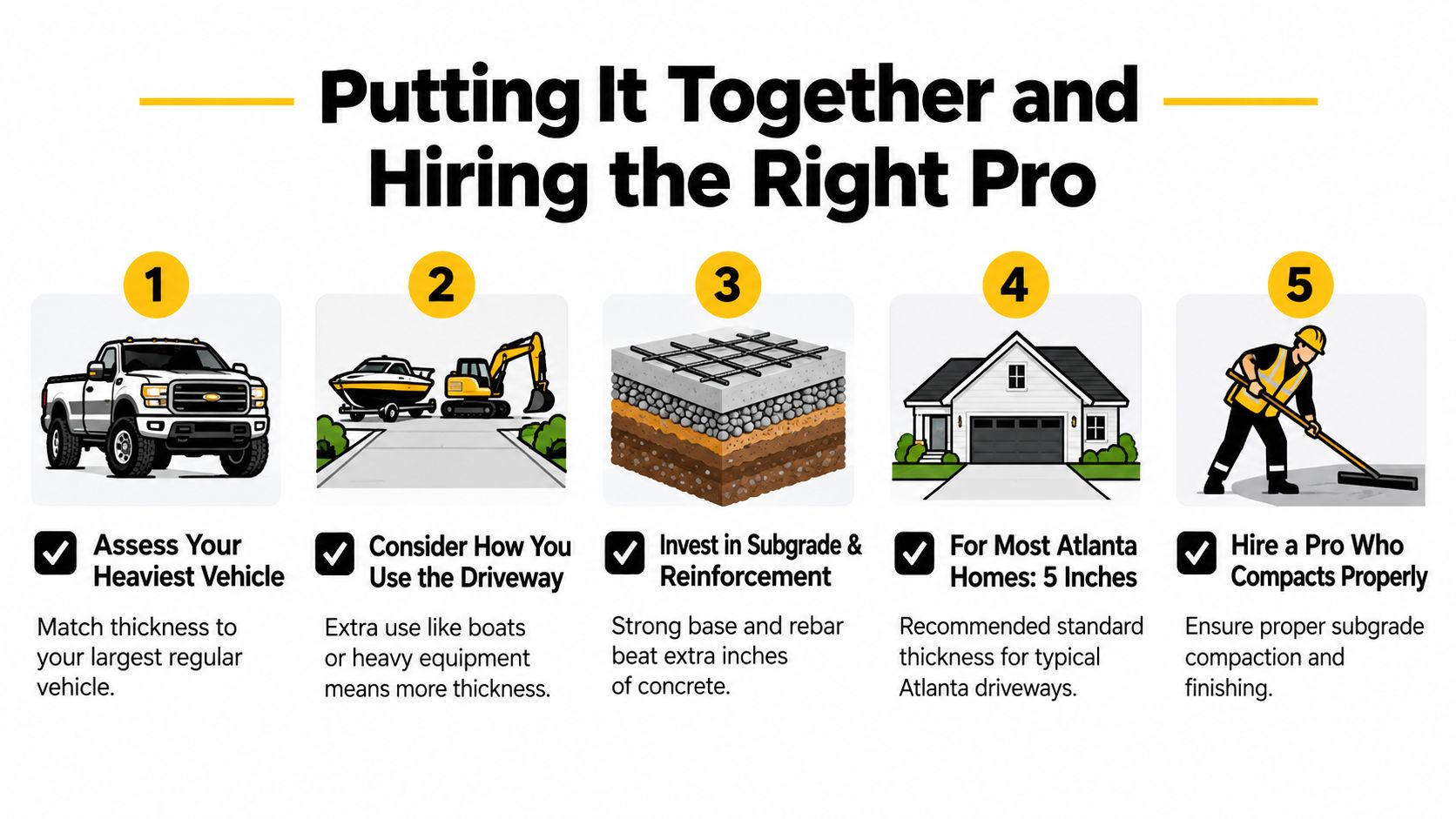
For most Atlanta homes, I'd start with a 5-inch slab, a 6-inch edge, a 4-inch compacted granite base, and reinforcement selected for the actual vehicle load. That combination gives a typical residential driveway a stronger system than a thicker, unreinforced slab poured over raw clay.
Your decision path should be simple:
- Identify the heaviest regular vehicle. Passenger cars and light SUVs point toward 4 inches. Pickups, delivery vehicles, and multi-car households generally justify 5 inches.
- Map the stress points. Mark the street apron, garage turn, steep sections, trailer parking, and unsupported edges.
- Specify the base in writing. Ask for excavation details, granular material, compaction method, and drainage grade.
- Choose reinforcement deliberately. Confirm whether the proposal uses mesh, fiber, rebar, chairs, or thickened-edge details.
- Verify code and workmanship. Get written information about joints, permits, insurance, references, and warranty coverage.
Get at least three written bids. Each bid should state the slab thickness, base depth, reinforcement, joint pattern, concrete mix, drainage plan, and edge treatment. If a proposal says only “new concrete driveway” without those details, you can't compare it fairly.
For heavy hardscape work around the driveway, including retaining walls, outdoor grades, or connected construction, Pool & Landscaping of Vistancia LLC offers an example of why site coordination matters across concrete and landscaping scopes. The driveway contractor still needs Atlanta-specific knowledge of clay, permitting, and drainage.
Atlanta Concrete Solutions can evaluate your driveway use, red-clay subgrade, drainage, thickness, reinforcement, and apron details before concrete is ordered. Visit Atlanta Concrete Solutions to request a project consultation and written quote that reflects how your driveway will be used.