
Most stamped concrete resealing advice is too casual. It treats the job like paint maintenance. Wash it, let it dry, roll on another coat, done. That shortcut is exactly why so many Atlanta driveways end up with white haze, peeling in the tire paths, or a gummy finish that never seems to harden out.
On real stamped concrete, resealing is a coating-system job. The old sealer matters. The weather matters. The texture matters. A driveway that looks dry on top can still hold moisture down in the grout lines and low spots, and the wrong new sealer can react badly with what's already there. If you want to know how to reseal stamped concrete the right way, start by thinking less about shine and more about compatibility, dryness, and film thickness.
That same mindset applies across exterior concrete work in Atlanta. Whether you're maintaining a stamped surface or planning a full Concrete Driveway Replacement Atlanta project, the long-term result usually comes down to prep, drainage, and matching the system to the slab. It's also why related topics keep coming up for homeowners, including How Much Does a Concrete Driveway Cost in Atlanta?, Concrete Driveway Replacement Cost Atlanta 2026, How Long Does a Concrete Driveway Last in Atlanta?, Concrete Driveway vs Asphalt in Atlanta, Best Concrete Thickness for a Residential Driveway, Do You Need Rebar in a Concrete Driveway?, Concrete Driveway Cracks: When Should You Replace It?, Concrete Driveway Repair vs Replacement, How to Fix Drainage Problems on an Atlanta Driveway, Concrete Driveway Apron Atlanta, Driveway Widening Atlanta, Driveway Extension Atlanta, Stamped Concrete Driveway Atlanta, Concrete Driveway Sealing Atlanta, How Long Before You Can Drive on New Concrete?, and a full Concrete Driveway Maintenance Guide. Those decisions connect. Maintenance only works when the base slab, drainage, and coating are all working together. This guide always includes information and examples from the field perspective that homeowners need.
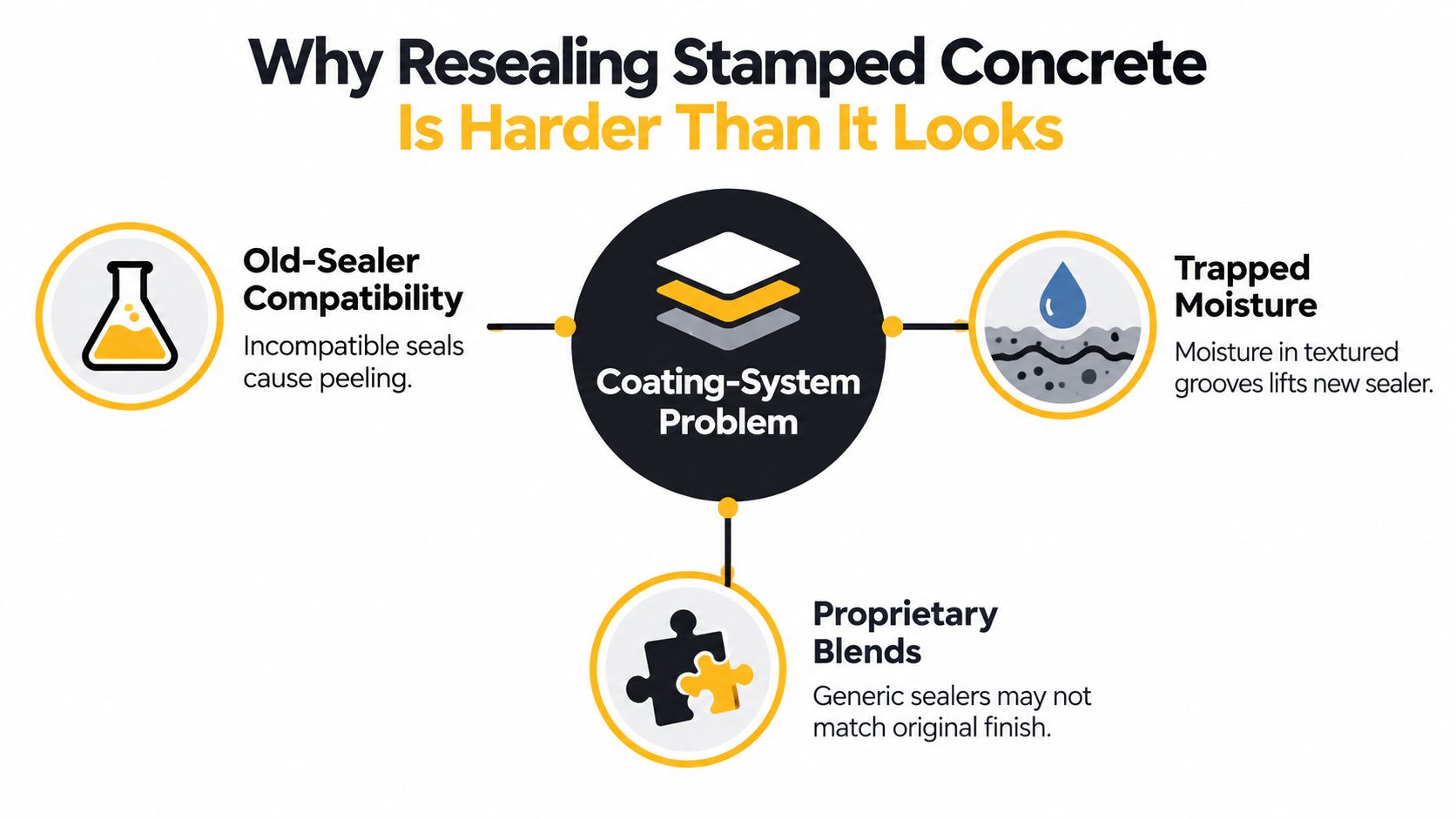
Why Resealing Stamped Concrete Is Harder Than It Looks
The most popular bad advice is simple. “Just clean it and roll on another coat.”
That works on very few stamped concrete driveways. On most of them, it creates new problems because the fresh sealer isn't going onto bare concrete. It's going onto an existing film with its own wear pattern, chemistry, and weak spots. If that base layer is failing, the new coat usually fails with it.
The old sealer controls the job
A lot of homeowners focus on the new product label. The bigger question is what's already on the slab. Industry guidance points out a major compatibility issue that many how-to articles skip. Putting a solvent-based acrylic over a water-based acrylic can trigger chemical attack and coating failure, so the safer move is to identify the original resin family first, and if the old film is flaking or discolored, removal may be necessary before resealing (resealing compatibility guidance for stamped concrete).
That's why “whatever is on sale” is a risky plan. On decorative concrete, generic substitutions can get expensive fast.
Practical rule: If the existing sealer is loose, chalky, cloudy, or peeling, adding another coat usually hides the problem for a very short time and then makes cleanup harder later.
Texture holds moisture longer than people think
Stamped surfaces aren't flat garage floors. They have low pockets, faux joints, and texture ridges that keep water around longer after washing or rain. If that moisture gets trapped under a new film, you can end up with cloudiness, tackiness, or peeling.
A driveway can look dry and still not be ready.
Thick coats are the shortcut that ruins the finish
Homeowners often assume more sealer means more protection. It usually means the opposite. Heavy coats are where whitening, flaking, and hot-tire pickup start. Resealing works best when the film stays thin and even, not heavy and glossy at all costs.
If you keep those three realities in view, the rest of the job gets clearer. Match the chemistry, manage the moisture, and don't over-apply.
When Your Stamped Concrete Actually Needs Resealing
Stamped concrete doesn't need resealing just because the calendar says so. It needs resealing when the protective film is wearing out.
Industry guidance generally lands around a 1 to 3 year maintenance cycle, and many sources describe 2 to 3 years as the standard interval for exterior residential stamped concrete. One trade source notes that sealer life can range from 6 months to 5-plus years, while saying the average for a typical acrylic sealer on exterior residential stamped concrete is about 2.5 years. A government maintenance manual for stamped concrete sidewalks also describes resealing as a biennial cycle, or once every two years (resealing interval guidance from Concrete Decor).
That gives you a range, not a schedule you should follow blindly.
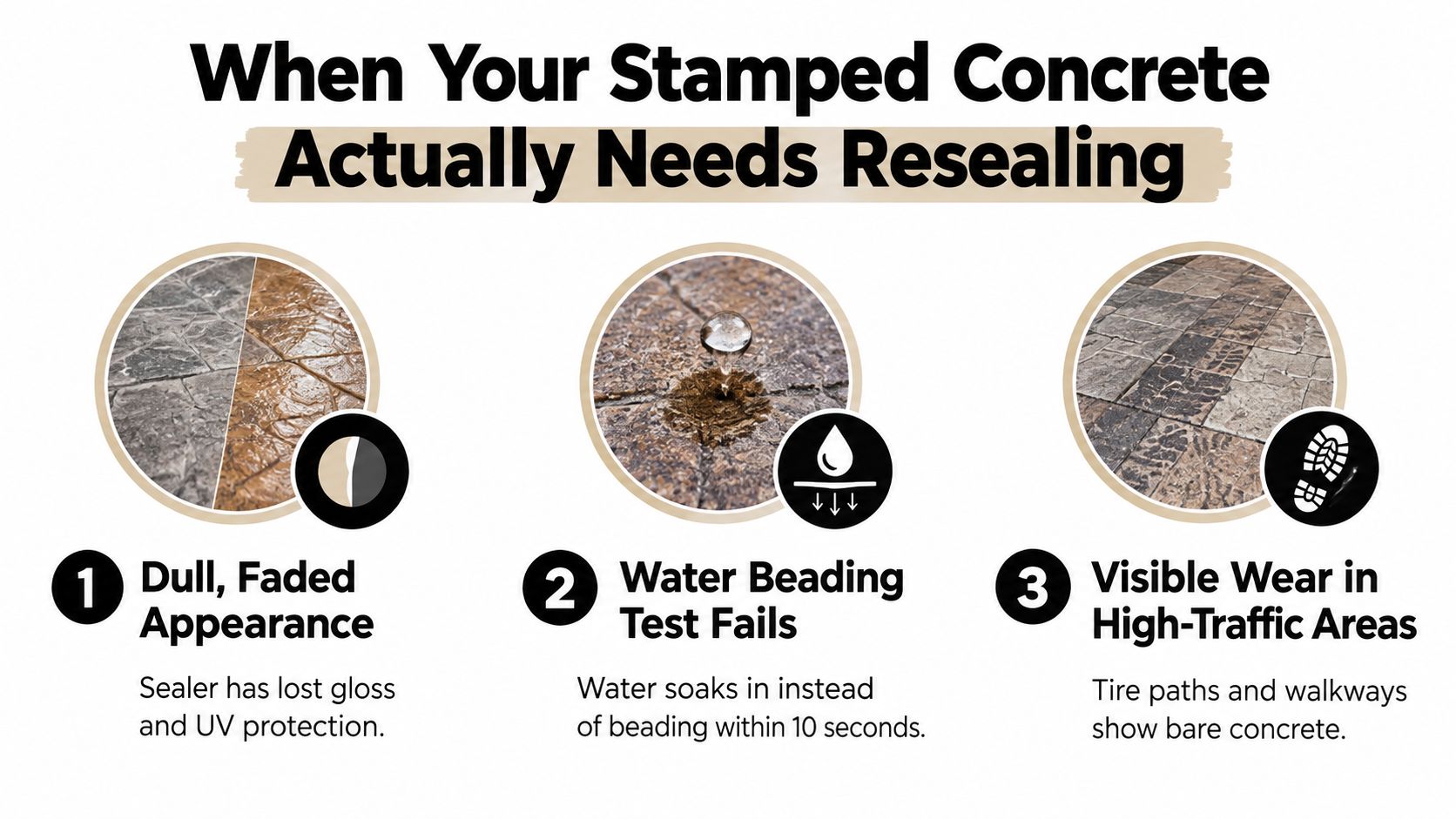
What to look for in the field
A driveway that still beads water and still has a stable film may not need anything yet, even if the gloss has softened a bit. Slight sheen loss is mostly cosmetic.
These signs matter more:
- Water stops beading: Water should sit up on the surface. If it starts soaking in instead, the protective layer is fading.
- Traffic lanes go flat first: Tire paths and the route from the car door to the front walk often wear before the rest of the slab.
- Color looks tired: On stamped concrete, fading often shows up as less depth in the release color and less contrast in the pattern.
Use a small test area first
Before committing to a full reseal, clean a small section and rinse it well. Then check how water behaves there. That tells you more than guessing from a distance.
If the slab also has cracks, surface wear, or broader decorative damage, maintenance may not be the only issue. In those cases, it helps to compare the condition against actual residential concrete and masonry repair options before assuming a simple reseal is the whole answer.
A shiny driveway isn't always a protected driveway. Water behavior tells the truth faster than gloss does.
Cleaning and Drying the Surface Before Resealing
Prep is where most reseal jobs are won or lost. Not during application. Before it.
Stamped concrete traps grit in the low texture, and that grit acts like sandpaper under a fresh film. Oil spots are another problem. If you seal over them, they often telegraph right back through the finish or interfere with bonding in that area.
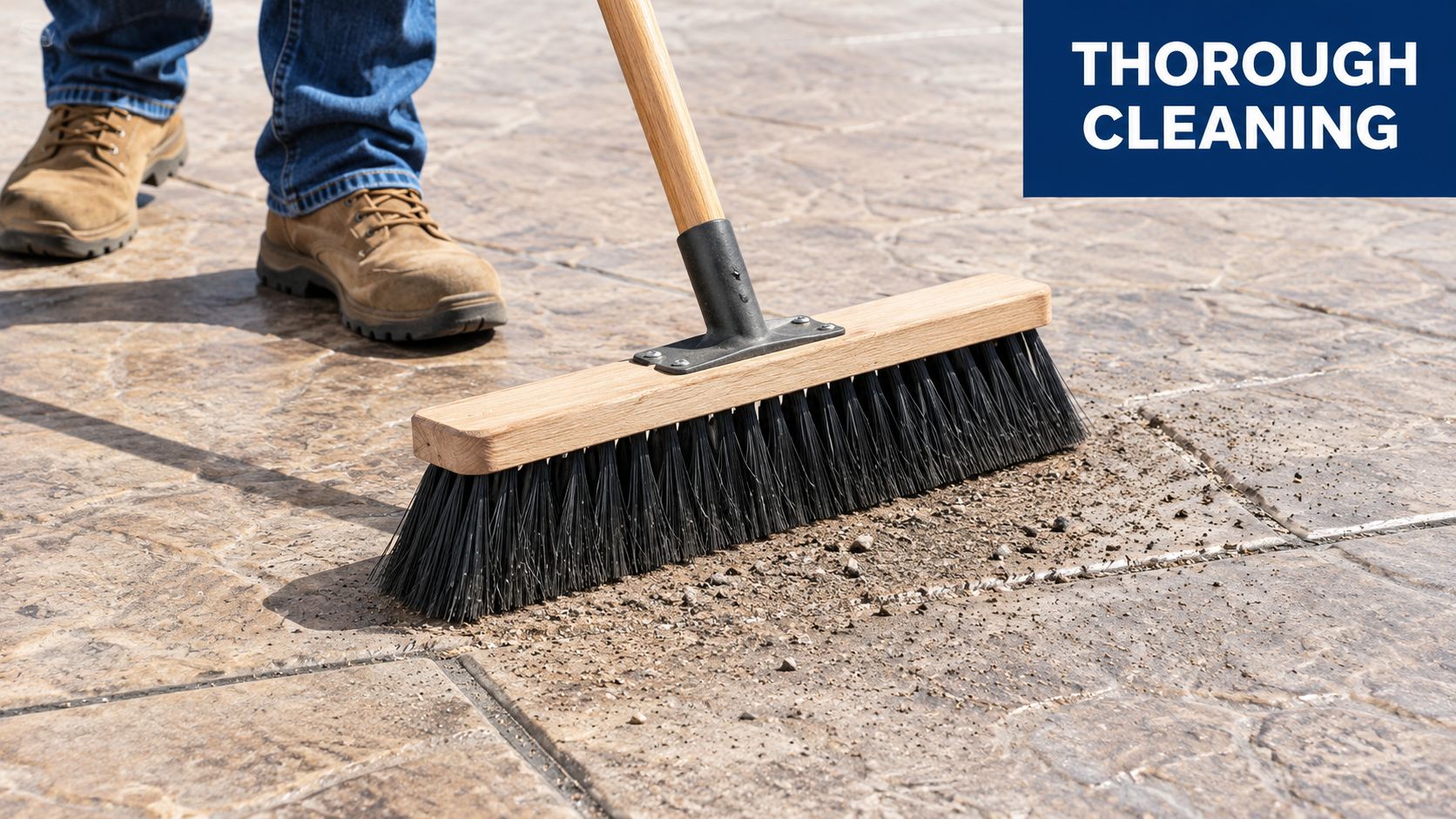
Clean in the right order
Start dry, not wet.
- Sweep first: Use a stiff push broom to pull loose grit out of the pattern before you introduce water.
- Treat stains separately: Hit oil or greasy spots with a degreaser that's appropriate for concrete.
- Wash with a concrete cleaner: A pH-neutral cleaner is the safer choice for routine prep because it won't leave the slab fighting harsh residue.
- Scrub the texture: A stiff-bristle brush or rotary scrubber does a better job in stamped impressions than a quick rinse ever will.
- Rinse thoroughly: Soap residue under sealer can create adhesion and appearance issues.
Contractors in different markets handle decorative surfaces much the same way. If you want a useful comparison point outside Atlanta, this overview from a trusted concrete paver contractor Austin is a good reminder that textured exterior hardscapes demand more careful prep than flat slabs.
Drying is the step people rush
The slab has to be fully dry, not just surface-dry. Recent sealing guidance for stamped concrete stresses waiting for bone-dry conditions with no rain in the forecast for at least 24 hours, and notes that some recommendations call for 24 hours minimum while others suggest 48 to 72 hours or longer when humidity is high (stamped concrete sealing and drying guidance).
Atlanta weather makes this trickier than people expect. Humid air slows drying, shaded areas stay damp longer, and stamped grooves can hold rinse water well after the high spots look ready.
What actually works on Atlanta driveways
Use a simple field check before sealing:
- Inspect shaded edges: They dry last.
- Check joints and low spots: That's where moisture hides.
- Wait after overnight dew: Morning dryness can be misleading.
- Don't seal because the weekend is ending: That's how you buy yourself peeling.
If you're choosing between sealing today on a maybe-dry slab or waiting another day, wait another day.
Choosing the Right Sealer for Your Existing Surface
Sealer choice starts with identification, not preference. The finish you want matters, but compatibility with the existing coating matters more. That's the point a lot of stamped concrete guides miss.
If you know what's on the surface now, the decision gets easier. If you don't, be conservative. Unknown coatings are where reseal jobs get unpredictable.
Sealer Type Comparison for Stamped Concrete Resealing
| Property | Solvent-Based Acrylic | Water-Based Acrylic |
|---|---|---|
| Color enhancement | Usually deepens color more noticeably | Usually more restrained and natural-looking |
| Odor during application | Stronger | Lower |
| Recoat risk over incompatible old film | Higher if the old coating chemistry is wrong | Often more forgiving, but still not foolproof |
| Traffic performance feel | Common choice where a richer film look is wanted | Common choice where easier application is a priority |
| Finish style | Often selected for higher-gloss looks | Often selected for lower-sheen looks |
Finish matters on driveways
High-gloss sealers make pattern and color pop. They also show scuffs, tire marks, and uneven wear faster. On a driveway, that trade-off matters. Satin or matte finishes usually hide real-world use better.
For homeowners comparing decorative surface options in general, this gallery of decorative concrete services is useful because it shows how finish choice changes the look of stamped work without pretending every surface should have the same sheen.
A practical way to decide
Use these filters in order:
- Known existing sealer: Match the resin family if the current film is sound.
- Unknown existing sealer: Test first in a small inconspicuous area rather than guessing across the whole driveway.
- Failed existing sealer: Strip the bad material before thinking about sheen level.
- Driveway use: If the slab sees daily cars and turning tires, don't choose gloss just because it looks dramatic on day one.
A helpful outside reference on appearance trade-offs is this breakdown of Painters North Shore advice on concrete finish types. It's not Atlanta-specific, but it's a good reminder that surface finish is both a visual and maintenance decision.
If you can't identify the old sealer, don't assume the new one will “melt in” and behave. Sometimes it will. Sometimes it won't.
One practical option in the Atlanta market is Atlanta Concrete Solutions' sealing service for decorative concrete. The useful part isn't branding. It's that a contractor who already works with stamped surfaces can inspect the existing film, check whether removal is needed, and choose a reseal approach based on the slab instead of a one-size-fits-all product pitch.
Applying the Sealer Without Ruining the Finish
Application is where a good prep job can still get wasted. The method matters, and on stamped concrete the cleanest results usually come from spray and back-roll, not from trying to muscle everything on with one heavy roller pass.
Industry guidance from the ASCC Decorative Concrete Council identifies spray-and-back-roll as the preferred method for textured stamped surfaces because it creates a more uniform film across ridges and valleys. That same guidance supports a second thin coat only after the first has flashed and is no longer tacky, and a practical benchmark from Concrete Decor is to target at least 400 square feet per gallon when resealing to avoid over-application and the whitening or blushing failures that show up when acrylic or solvent sealers go on too heavy (ASCC stamped concrete sealing best practices).
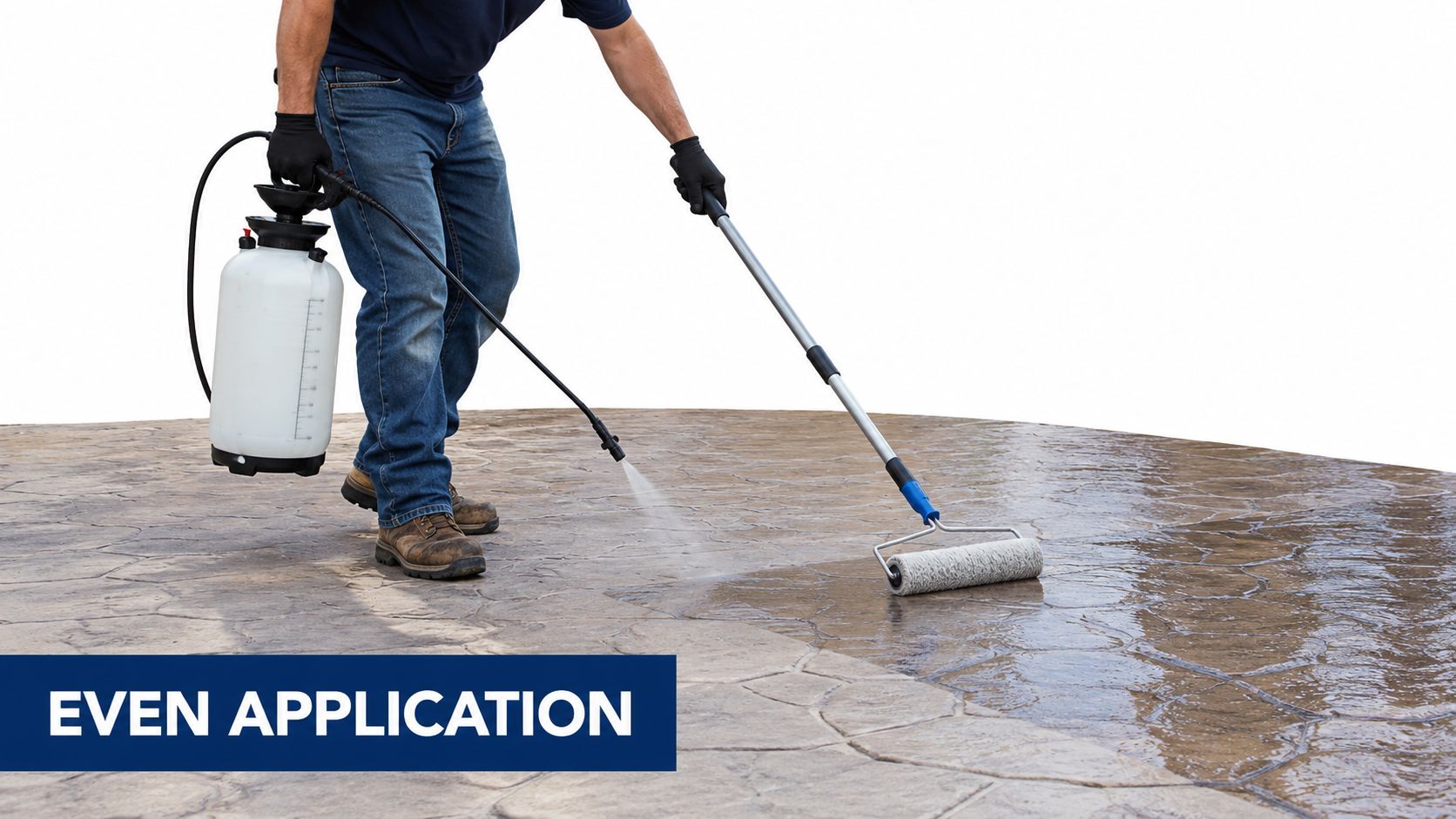
The method that works
A simple setup is usually enough:
- Pump sprayer: Lays down an even wet film without overloading the high spots.
- Lambswool or lint-free roller: Pushes material into the low texture and evens out puddles.
- Painter's tape and masking: Protects garage doors, stone, siding, and brick.
- Spiked attention to edges: Borders and aprons are where lap lines show first.
Here's the sequence:
- Cut in first. Handle edges, borders, and detail areas before broad spraying.
- Spray a thin pass. Don't chase a wet-look shine immediately.
- Back-roll right away. Even out the film while it's still workable.
- Keep a wet edge. That's how you avoid lap marks and patchy sheen.
- Let the first coat flash. If it's still tacky, it's too soon for the second coat.
- Apply the second coat only if needed, and keep it thin.
What ruins the finish
Most failures come from one of these:
- Too much sealer in one pass
- Applying in direct hot sun
- Stopping and restarting in random sections
- Letting material puddle in low stamped joints
- Trying to “fix” a tacky area by adding more product
The driveway doesn't need a thick shell. It needs an even sacrificial film.
This walkthrough gives a visual sense of the process and why control matters more than speed.
Thin wins
On stamped concrete, more product doesn't equal more durability. Thin coats preserve the texture, reduce trapped solvent risk, and wear more predictably. That's especially important on Atlanta driveways where turning tires and summer heat can punish a heavy film quickly.
Drying Times and When You Can Walk or Drive on It
Cure time gets oversimplified all the time. People want one answer. There isn't one.
Sealer labels give a starting point, but site conditions can change the timeline. Humidity, slab temperature, overnight dew, shade, and coat thickness all affect when the surface is ready for use. A driveway that feels dry to the touch can still be soft under tire load.
The practical baseline
For stamped concrete that's been resealed, a practical field guideline is to wait about 7 days before driving a personal vehicle on the surface, while heavy vehicles such as RVs, trucks, or construction equipment should wait 28 days (guidance on driving after sealing stamped concrete).
That's the safer answer for real driveways, especially if the finish got two thin coats and the weather isn't ideal.
What slows cure in Atlanta
A few things regularly stretch the timeline:
- Humidity: Moist air slows evaporation and cure.
- Night dew: A slab can re-wet at the surface before the film is fully set.
- Shade: Areas beside homes, retaining walls, and tree cover cure slower.
- Thicker application: Heavy spots stay softer longer than the rest of the driveway.
If you're unsure, stay off it longer. Tire twist is the stress test, not gentle straight-line rolling.
Fresh sealer usually gets damaged first where drivers turn the wheel while the car is barely moving. That twisting load finds soft spots fast.
A better habit than guessing
Before returning a driveway to service, check an inconspicuous area with a clean white cloth and your shoe sole. If the surface still feels tacky, smears, or grabs dust easily, it isn't ready for vehicle traffic.
For walk-on use, homeowners often focus too much on “can I step on it” and not enough on “can the film handle pressure without marking.” Those aren't the same question. On decorative concrete, patience is cheaper than repair.
Keeping Your Resealed Surface Looking New
The day after cure is when maintenance starts. A lot of stamped concrete problems don't begin with catastrophic failure. They start with small routine abuse that slowly grinds the film down.
One driveway gets resealed properly, then the homeowner lets dirt and grit build up for weeks. Tires drag that grit through the same turning area every day. The sealer starts looking tired long before the rest of the slab.
Another driveway gets resealed with the wrong chemistry over a weak old coat. It looks fine at first, then small flakes start at the edges and in the tire lanes. By the time the owner notices, the fix is no longer a quick maintenance coat. It's a coating-removal problem.
What regular upkeep should look like
Keep it simple:
- Sweep often: Soft-bristle sweeping removes the abrasive dirt that scuffs fresh film fastest.
- Rinse gently: A garden hose is better than aggressive washing for routine care.
- Clean spills quickly: Use a pH-neutral concrete cleaner instead of harsh acids or strong degreasers unless spot treatment requires it.
- Watch traffic zones first: The wear usually shows up in turning areas, parking spots, and the route to the front door before the rest of the slab.
What not to do
Some maintenance habits shorten sealer life faster than people expect:
- Pressure washing too aggressively
- Letting deicing residue sit
- Ignoring dull spots until the whole driveway fails
- Assuming one reseal means years of no attention
A stamped driveway is easier to maintain when you treat the film as renewable, not permanent. That's also clear in real project examples. Looking through completed concrete project work in Atlanta makes it obvious that decorative surfaces hold up best when owners stay ahead of wear instead of waiting for widespread failure.
The maintenance rhythm that works
Think in inspections, not emergencies. Each spring, look at the high-traffic zones first. If those areas start losing protection before the rest, address the wear early instead of waiting for a full-slab problem.
That approach is what separates a driveway that ages evenly from one that ends up with patchy sheen, peeling in the wheel paths, and a full strip-and-reseal job much sooner than it should have needed.
Atlanta Concrete Solutions handles stamped concrete maintenance, driveway sealing, decorative concrete installation, and full replacement work across the Atlanta area. If your stamped driveway is dull, peeling, or due for a careful reseal, visit Atlanta Concrete Solutions to review services and request the right next step for your surface.