
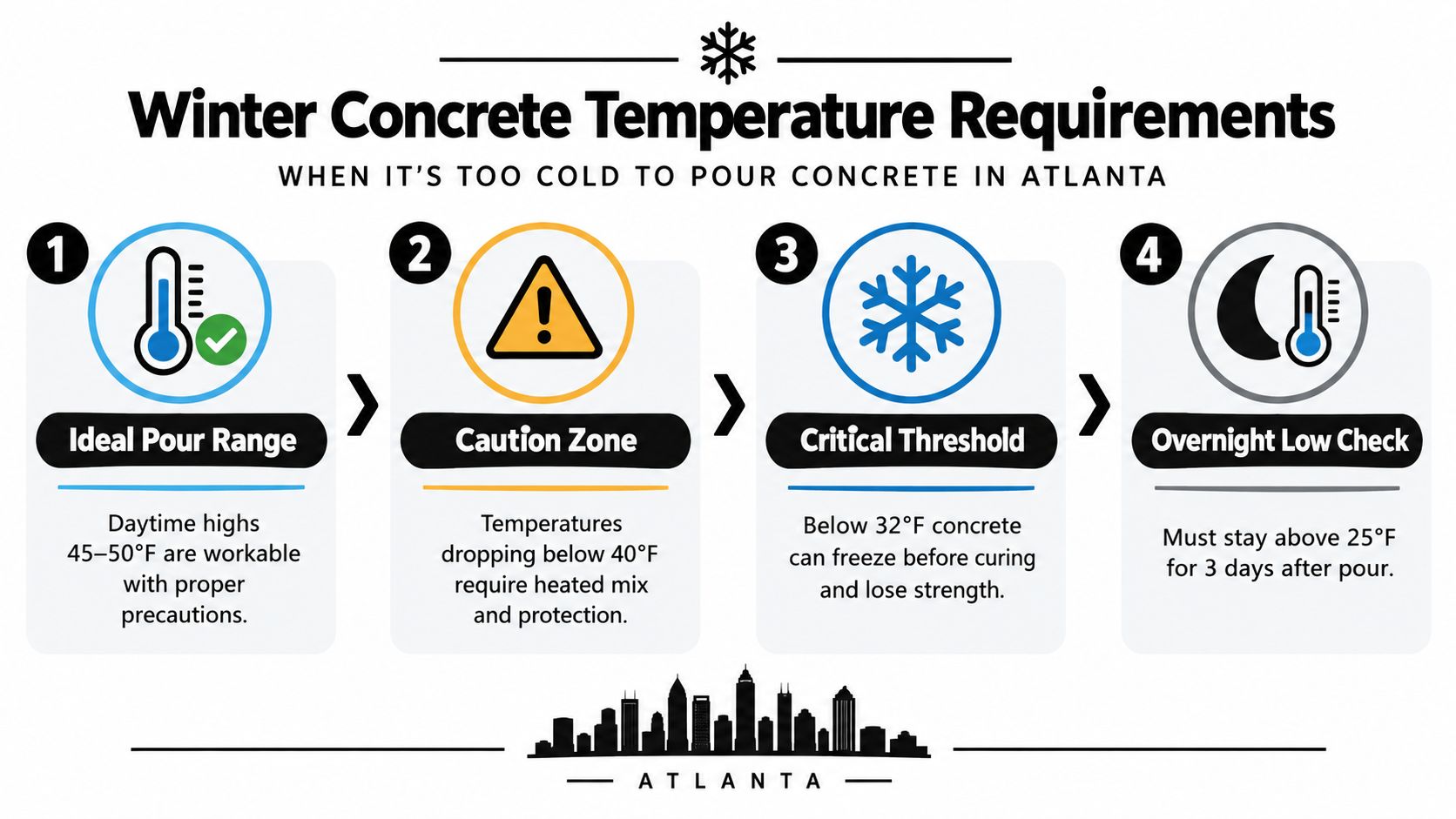
Winter concrete can be poured successfully when air and slab temps stay above 40°F and the concrete is protected from freezing for at least 48 hours after placement. In Atlanta, that means a workable afternoon alone isn't enough, the overnight forecast and the slab's actual temperature must support safe curing.
A common Atlanta driveway job starts with a mild afternoon, a forecast near 45°F or 50°F, and a sharp freeze expected after sunset. Homeowners see the warm daylight and assume the pour is safe. The crew sees the risk, a fresh slab losing heat through its surface and subgrade before it develops enough early strength.
Winter placement isn't automatically a mistake. It becomes a mistake when the contractor treats it like a summer pour, skips ground preparation, uses an unsuitable mix, or removes protection because the surface looks hard. The same planning also applies to Concrete Driveway Replacement Atlanta, stamped driveways, aprons, extensions, sidewalks, and other exterior flatwork.
Winter Concrete Temperature Requirements
Atlanta's winter weather creates short working windows. A sunny afternoon may be suitable for placement while the following night creates freezing conditions, so the pour decision must account for the entire protection period rather than the truck arrival time.
The American Concrete Institute's cold-weather concreting guidance defines cold weather as conditions where air temperature has fallen to, or is expected to fall below, 40°F (4°C) during the protection period. Fresh concrete also needs specific minimum temperatures based on section size:
- Sections under 12 inches: Maintain at least 55°F.
- Sections from 12 to 36 inches: Maintain at least 50°F.
- Sections from 36 to 72 inches: Maintain at least 45°F.
- Sections over 72 inches: Maintain at least 40°F.
A residential driveway is usually a relatively thin section, so it loses heat faster than a massive foundation or retaining wall. That makes insulation, wind protection, and accurate monitoring especially important for flatwork.
The first protection window
Protection from unexpected freezing should continue for at least the first 24 hours after placement in cooler shoulder-season and winter conditions, or until the concrete reaches the required minimum compressive strength, according to the ACI guidance. In residential work, many field guides use 500 psi as the practical early-strength milestone and describe roughly 48 hours under typical conditions, although actual timing may range from 1 to 4 days depending on temperature and mix design. Those benchmarks are summarized in cold-weather placement guidance.
Don't rely on the air thermometer beside the house. A contractor should check concrete temperature at several locations, including corners and exposed edges, because those areas cool faster. Transportation guidance also calls for monitoring at several locations and protecting concrete from freeze-thaw cycles until it reaches about 24 MPa, or approximately 3,500 psi, as described in the ACI cold-weather excerpt.
Practical rule: A workable afternoon doesn't make a winter pour safe unless the slab can stay warm enough through the following nights.
For Atlanta homeowners, the right question isn't just, “Is today above freezing?” Ask whether the mix will arrive warm, whether the ground is thawed, how the slab will be insulated, and who will monitor its temperature after the crew leaves. Contractors familiar with Atlanta concrete installation should be able to explain those controls before scheduling the truck.
Preparing Your Site for Cold Weather Pouring
The slab's first heating system is the concrete itself. Cement hydration produces heat, but frozen soil, ice, wind, and cold forms can pull that heat away before the driveway develops useful strength.
Start with the subgrade. Remove snow, ice, standing water, and frozen soil from every area receiving concrete. A driveway replacement in north Atlanta may have no snow on the surface but still contain frozen or saturated material below the gravel base. That hidden condition matters because thawing soil can settle unevenly beneath a slab, leaving unsupported areas that crack later.
A field-ready preparation check
- Probe the base: Use a steel rod or similar tool to check whether the prepared base is firm and stable rather than frozen near the surface.
- Check drainage: Confirm that water has a path away from the forms. A winter pour should never trap meltwater against the fresh slab or allow runoff to wash across the placement area.
- Inspect forms: Forms must be secure, clean, and free from frost. Cold forms can chill the concrete at the edges, so insulated forms may be appropriate during a hard freeze.
- Clear access routes: The truck path, pump position, and crew walkways should be safe and free from ice before placement begins.
- Protect the site from wind: Temporary windbreaks can reduce rapid surface cooling without touching the finished concrete.
The subgrade must be thawed before placement. Heating only the top surface can create a temperature mismatch, with the concrete near the ground curing more slowly than the exposed surface. That uneven development increases the chance of cracking and settlement when the ground later warms.
Fresh concrete shouldn't be used to thaw a frozen driveway base. Heat the site first, or postpone the placement.
A contractor should also confirm that reinforcement, vapor barriers where specified, drains, sleeves, and utility transitions are ready before the truck arrives. Delays after discharge expose the mix to falling temperatures and can force rushed finishing. For homeowners comparing replacement options, the residential driveway concrete service should include site preparation, not just the visible placement work.
Atlanta's clay-heavy areas and sloped properties require particular attention to runoff. A driveway can be structurally sound yet direct thawing water toward a garage, walkway, or foundation. Set grades and drainage before the pour, because correcting them after the slab hardens is expensive and disruptive.
Concrete Mix Design for Cold Weather Success
A winter mix shouldn't be selected by adding a random accelerator at the jobsite. The ready-mix supplier and contractor need to coordinate cement type, water content, air entrainment, aggregate temperature, placement temperature, and the expected protection plan.
The first priority is controlling water. A lower water-cement ratio supports a denser concrete matrix, while unnecessary added water slows strength development and increases the amount of water that can freeze in the early period. The crew should never add water just to make a stiff winter load easier to finish.
What each adjustment does
| Adjustment | Purpose | Typical Range |
|---|---|---|
| Heated water or aggregate | Raises the mix temperature at placement and offsets heat loss | Set by the ready-mix supplier for site conditions |
| Type III cement | Supports faster early strength development in cold conditions | Selected when schedule and temperature require earlier strength |
| Accelerator | Helps the concrete set and gain early strength sooner | Dosage is determined by the supplier and mix design |
| Air entrainment | Improves resistance to freeze-thaw exposure in exterior flatwork | Specified for the intended exposure and local requirements |
| Water-cement ratio control | Limits excess water and supports strength development | Established by the approved mix design |
The table describes categories of adjustment, not a recipe. Dosage and target values must come from the supplier's approved design and the project's requirements. Chloride-based accelerators can create corrosion concerns where steel reinforcement is present, so the contractor should identify reinforcement and exposure conditions before selecting an admixture.
Type III cement or a non-chloride accelerator can be useful when an Atlanta driveway must be placed during a narrow weather window. The trade-off is cost and heat management. A faster-strength mix still needs insulation, because rapid early hydration doesn't make fresh concrete immune to freezing.
Air entrainment also deserves careful attention. Exterior concrete exposed to freeze-thaw cycling in saturated conditions shouldn't be relied on until it reaches about 3,500 psi, while approximately 4,500 psi is cited where surface defects matter before harsh winter service exposure. The ACI preview on cold-weather concreting_preview.pdf) also warns that freezing within a few hours after placement can reduce ultimate strength by up to 50% of its potential 28-day strength.
Questions for the supplier
Ask whether the proposed mix is designed for exterior flatwork, whether the water or aggregate will be heated, which accelerator is being used, and how the crew will verify air content and concrete temperature. The supplier should also explain how the mix fits the contractor's insulation and strength-release plan.
Warm materials can improve the starting condition, but they don't replace protection. The most reliable winter result comes from matching the mix to the forecast, placing it on a thawed base, and maintaining temperature until the concrete crosses the required early-strength milestone.
Protection Methods and Curing Strategies
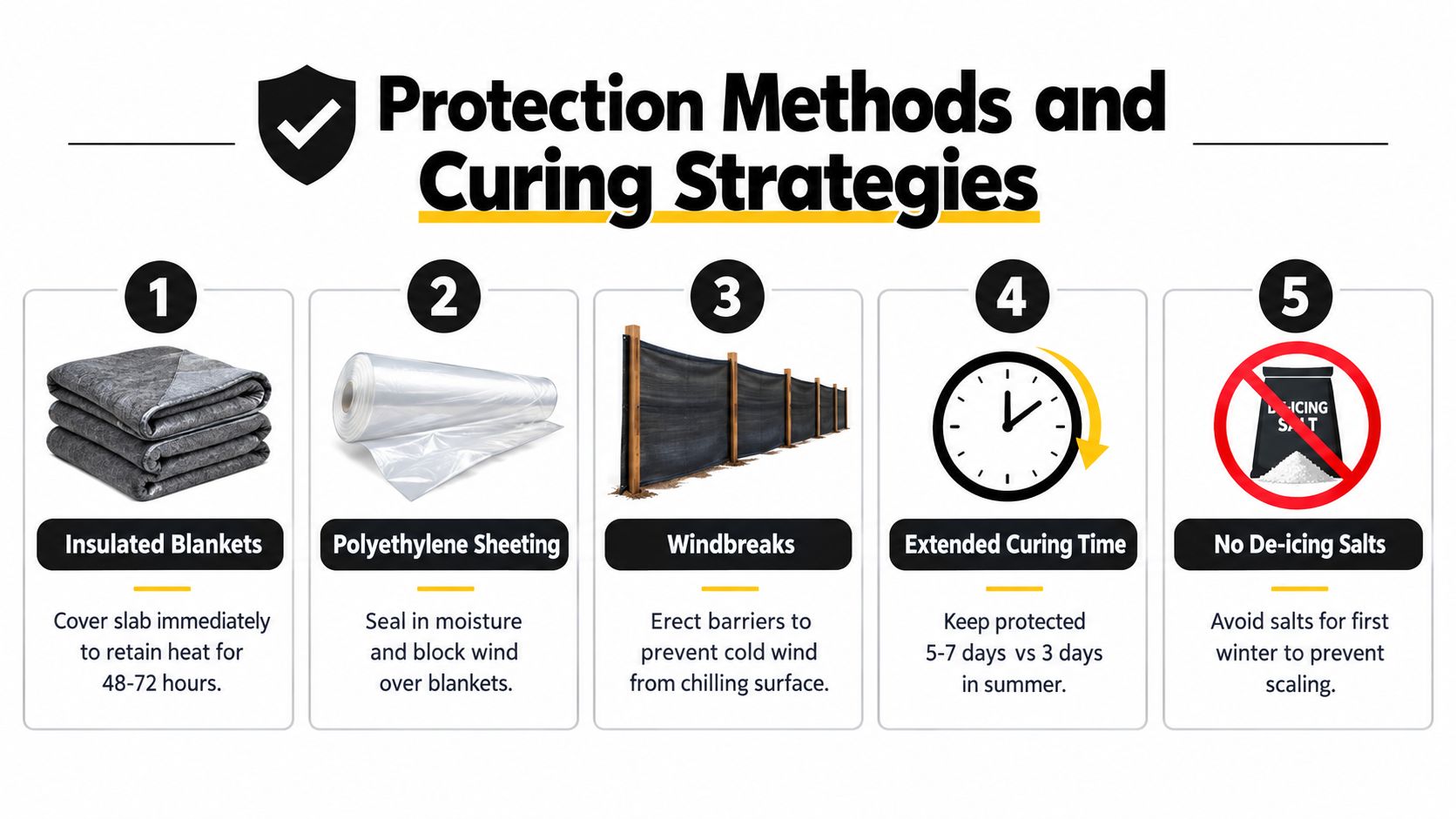
Protection must begin immediately after finishing. Winter blankets, polyethylene sheeting, windbreaks, and controlled heat each have a place, but they don't provide the same level of control.
For a normal Atlanta cold snap, insulated blankets over the slab may be enough when the subgrade is thawed and the concrete arrives warm. The blankets must cover edges and corners, stay dry, and remain secure during wind. Polyethylene sheeting over the blankets helps retain moisture and reduces wind-driven cooling, but plastic shouldn't be placed carelessly against a surface that could be marked before it has hardened.
Match protection to the risk
- Insulated blankets: Practical for ordinary cold conditions when properly secured and monitored.
- Polyethylene sheeting: Useful as a moisture and wind barrier over insulation.
- Windbreaks: Helpful on open lots, exposed corners, and sloped driveways.
- Heated enclosures: More appropriate during severe cold, prolonged freezing, or when the project cannot tolerate temperature loss.
- Hydronic heating: A controlled option for difficult sites, though it requires specialized equipment and careful operation.
Below about 20°F, risk climbs sharply, and heated enclosures or hydronic methods become more appropriate than standard blankets alone, according to cold-weather concrete placement guidance. Heaters must provide even, indirect heat. Direct high heat can dry the surface, create thermal gradients, or produce unsafe exhaust conditions.
A curing compound may help retain moisture, but application timing and temperature limits must match the product instructions. Cold weather also slows finishing and curing, so the crew should avoid sealing a surface that is too cold or wet for the selected material.
Monitor slab temperature beneath the insulation, at exposed corners, and near edges. If temperatures drop unexpectedly, add insulation, strengthen wind protection, and use approved supplemental heat. Don't pull blankets off to inspect repeatedly, since every exposure releases stored heat.
For exterior flatwork, protection may need to continue until the concrete reaches about 70% of design strength. One guide estimates 5 to 7 days for standard Type I cement at 40°F to 50°F, or 3 to 4 days with Type III cement or accelerators, as outlined in cold-weather curing guidance.
The spring alternative avoids freeze risk but can delay access and extend an already inconvenient project. Winter placement can work when the contractor has the equipment, labor, and monitoring plan to protect the slab. It doesn't work when blankets are treated as an afterthought.
The residential poured concrete service should clarify who supplies protection materials, who checks temperatures, and when the driveway may be exposed.
A short video can also help homeowners recognize the practical sequence of protection after placement:
Winter Pour Scheduling Decisions
The best winter pour date is a stable weather window, not merely the warmest afternoon available. Review the expected conditions from placement through the protection period, including daytime temperature, nighttime lows, wind, rain, and the likelihood of frozen ground.
A sensible decision process looks like this:
- Confirm the site: If the base is frozen, icy, saturated, or poorly drained, postpone or prepare the site before ordering concrete.
- Confirm the mix: The supplier should identify the intended placement temperature, cement type, admixtures, and exterior exposure requirements.
- Confirm protection: Blankets, sheeting, windbreaks, sensors, heaters, and labor should be ready before discharge.
- Confirm access: Make sure the household can keep vehicles and foot traffic off the driveway while strength develops.
- Set a release rule: The contractor should explain what temperature or strength milestone allows protection and traffic restrictions to end.
Winter may offer scheduling flexibility or lower labor demand, but protection materials, heated water, accelerators, monitoring, and enclosures can offset any seasonal savings. Compare the complete winter scope with a spring estimate rather than comparing only the concrete price.
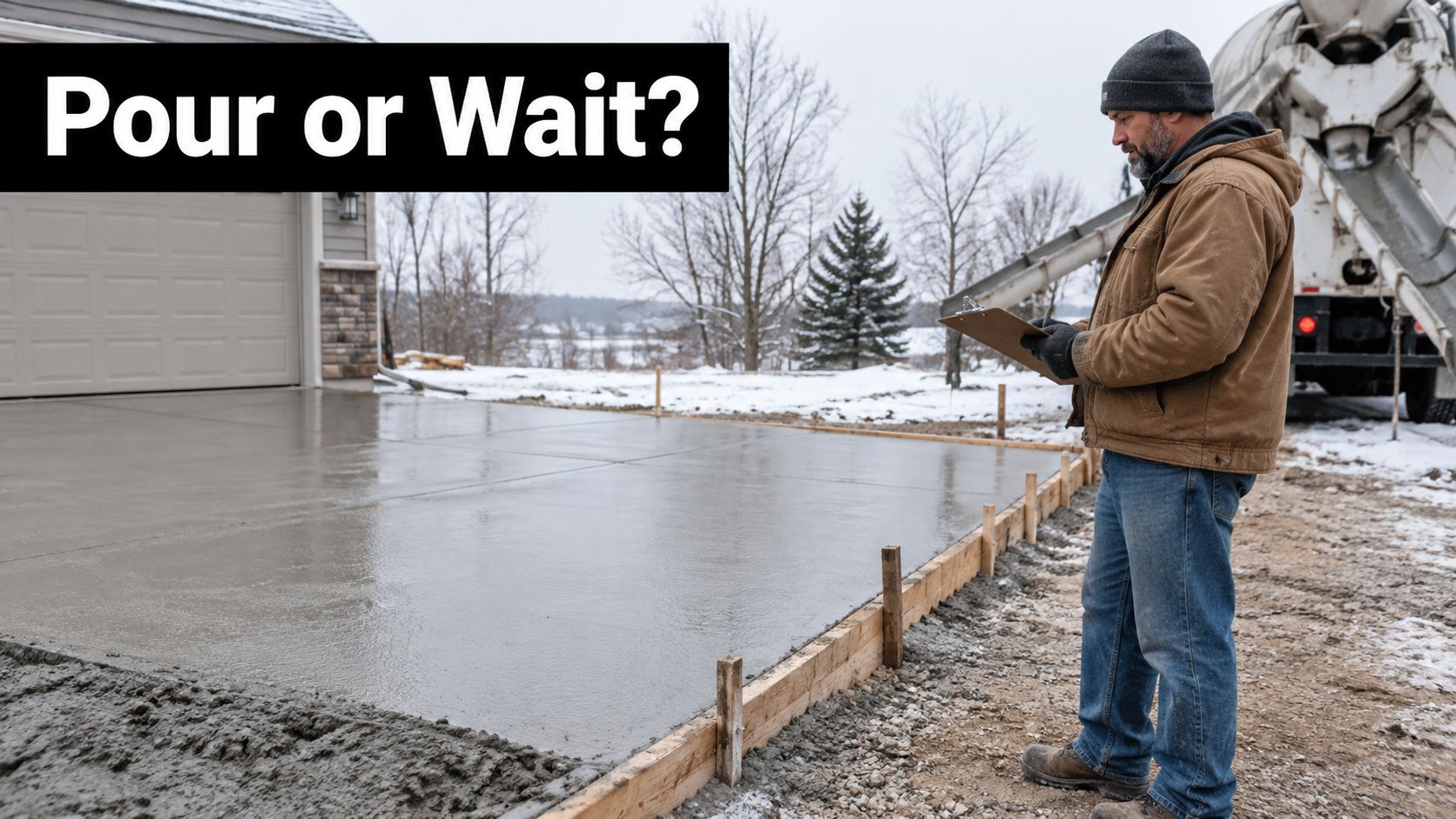
A contractor who can't explain the overnight protection plan hasn't finished planning the pour.
Postpone when freezing weather is expected before the crew can establish protection, when the subgrade can't be thawed, when heavy rain will undermine the base, or when the contractor lacks a way to monitor slab temperature. A mild afternoon followed by several hard freezes can be riskier than a consistently cold but controlled period.
For a driveway replacement, discuss vehicle access before signing. A homeowner may need to park on the street or arrange alternate access while the slab cures. That inconvenience is manageable when planned, but it becomes a serious problem when the crew leaves without clear instructions.
Post-Pour Care and Long-Term Success
The first week requires discipline. Keep vehicles off the new driveway until the contractor releases it for service. A practical guide places light foot traffic at 24 to 48 hours, passenger vehicles at about 7 days, and full design strength at 28 days, as summarized in this concrete curing guide.
Those timeframes aren't permission to ignore the weather. Continue protection through temperature swings, inspect blankets after wind or rain, and keep drainage paths open so melting frost or rain doesn't pond beside the slab. Remove snow with a plastic shovel or broom, and don't drag metal tools across a young surface.
A simple Atlanta maintenance rhythm
- During the protected curing period: Check blanket coverage, edges, corners, and runoff after each cold night.
- During the first winter: Avoid de-icing salts on new concrete because early salt exposure can contribute to scaling.
- As temperatures rise: Remove protection gradually when conditions stabilize, rather than exposing a warm slab suddenly to cold wind.
- After the first seasonal cycle: Look for scaling, surface flaking, edge damage, settlement, and cracks that change width or elevation.
- Before future winters: Clean the surface, address drainage, and apply a compatible sealer only when concrete and weather conditions meet the product requirements.
Cracks deserve diagnosis rather than automatic patching. A narrow shrinkage crack may need monitoring, while displaced panels, pumping, drainage failure, or structural movement can justify replacement. Tree roots create a separate problem, so homeowners dealing with heaving should review practical guidance on fixing root-cracked driveways before repairing the concrete alone.
Call a professional when the slab freezes during its early curing period, develops widespread scaling, settles after thawing, or shows cracks connected to drainage or root movement. Surface appearance can be misleading, and winter damage may become clearer as temperatures cycle.
Atlanta's winter doesn't make driveway work impossible. It rewards contractors who manage the slab's temperature, protect the base, respect early-strength limits, and give the concrete enough time to mature.
Atlanta Concrete Solutions can evaluate your driveway, confirm whether winter placement is practical, and plan the mix, site preparation, protection, and curing steps around Atlanta weather. Visit Atlanta Concrete Solutions to request a project assessment and discuss a durable replacement or decorative concrete upgrade.