
You're seeing white powder on the brick, a stair-step crack near a window, or mortar that crumbles when you touch it with a key. In Atlanta, those signs rarely tell the whole story. The visible defect may be the final result of roof runoff, failed flashing, trapped moisture, soil movement, or a repair material that never belonged on the wall in the first place.
Masonry repair should begin with diagnosis, not a tube of sealant. I've seen too many walls patched twice because nobody traced the water path or checked how the original masonry was built. The right repair restores the wall and removes the condition that caused it.
What Masonry Repair Actually Means in Atlanta Homes
A Buckhead bungalow develops a dusting of white powder across its brick every spring. The owner calls it a cleaning problem. Up close, the deposits appear below a porch roof where flashing has failed, and a downspout discharges against the foundation. The brick is only showing where the water has traveled.
That distinction matters. Masonry repair is not merely filling cracked joints. It includes finding the source of deterioration, identifying the masonry unit, selecting compatible materials, removing failed work, and rebuilding the damaged area without trapping moisture inside the wall. A contractor who quotes a price before walking the wall with a hose and flashlight is selling a patch, not a repair.
Three materials, three different repair problems
Clay brick can lose its fired face through spalling, shed mortar through erosion, or crack when water enters and freezes in vulnerable areas. Older Atlanta neighborhoods often contain soft brick paired with lime-rich mortar. That wall needs a repair material that can accommodate vapor movement and minor expansion, not the hardest mix available.
Natural stone behaves differently depending on the stone. Granite, limestone, and marble accents each have distinct porosity, strength, and weathering patterns. A dense patch that looks acceptable on day one can redirect water into a softer adjacent stone.
Cast or poured concrete commonly develops cracks, surface scaling, exposed reinforcement, and water-related staining. Its repair requires attention to reinforcement, bonding, drainage, and the reason water reached the concrete. Concrete work and brickwork may share a property, but they don't share one universal repair formula. Atlanta Concrete Solutions discusses concrete and masonry services for Atlanta properties, including the need to match the repair to the existing structure.
Start with the wall, not the defect
I look for the entire moisture route. That might mean a redirected downspout saturating the footing, a porch-roof flashing detail allowing rain behind the top course, or a 1920s lime mortar joint finally giving up after decades of weather and seasonal movement.
Preservation guidance treats repointing as a core masonry repair method when mortar joints have eroded about one-third of an inch or more, and recommends removing deteriorated mortar to a uniform depth of two to two and a half times the joint width before installing new mortar. The same guidance stresses matching the original mortar's size, color, texture, profile, and tooling, because the repair must work structurally and visually (historic masonry repointing guidance).
Practical rule: If the contractor can't explain where the water goes, don't approve the mortar color yet.

The Most Common Failure Modes That Drive Repairs
The most useful way to understand masonry failure is by cause. A crack, stain, or loose brick is evidence. It isn't a diagnosis.
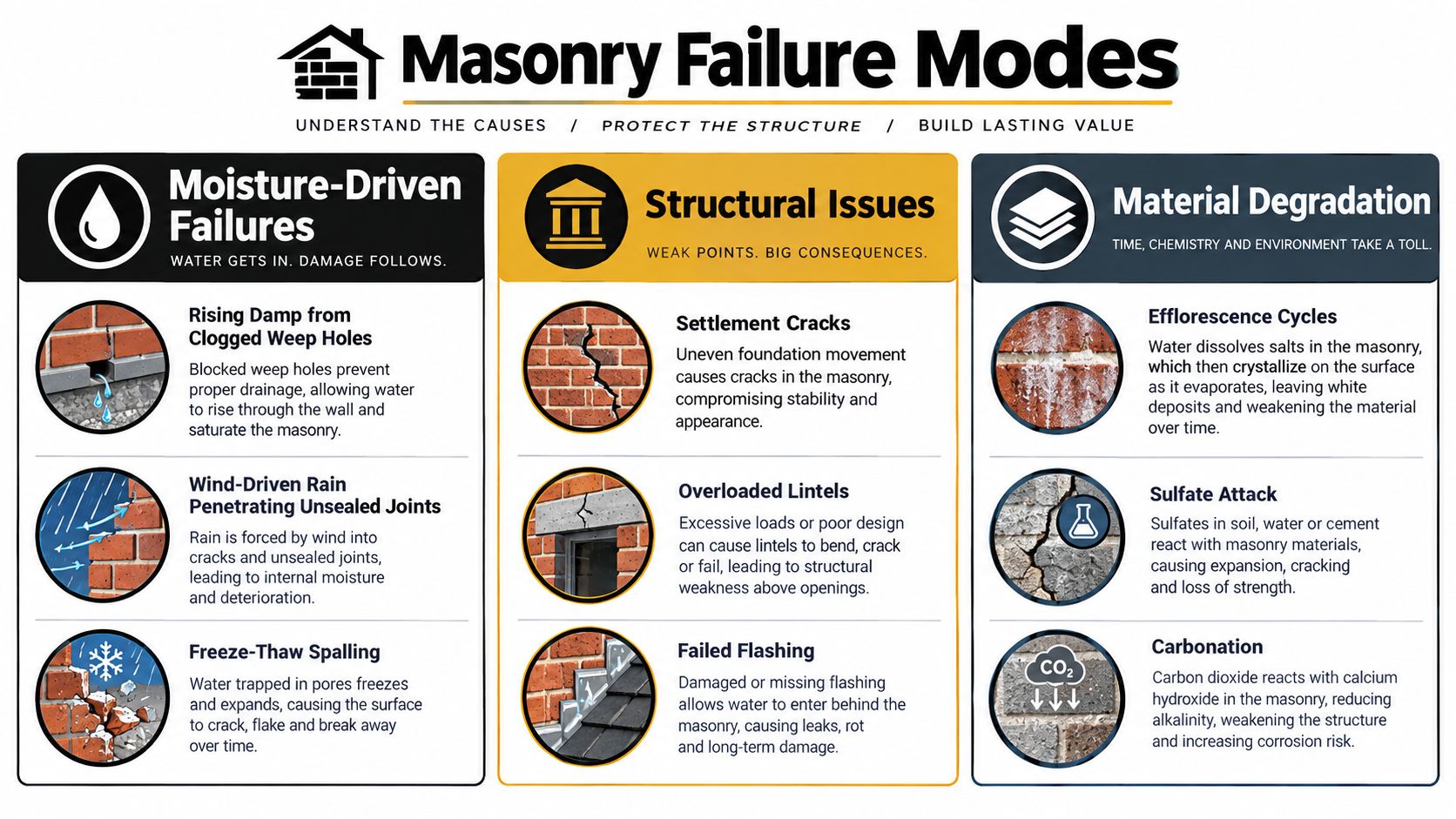
Moisture creates the largest repair workload
Clogged weep holes can hold rising damp inside a veneer. Wind-driven rain can enter through open or poorly bonded joints. Roof runoff can saturate the top courses of brick, while Atlanta's clay-heavy soils keep foundation areas wet after storms.
Efflorescence belongs in this category. Soluble salts reach the surface only when water moves through the masonry, so recurring white deposits point to rain penetration, failed flashing, deteriorated joints, or ground moisture. Cleaning the salts before correcting the water source only resets the clock. Brick maintenance guidance explains why efflorescence requires moisture control before cleaning.
Age weakens the original system
Mortar joints gradually erode. Brick faces spall when water enters and expands during freezing conditions. Limestone and brownstone can soften into a sandy crust as water, salts, and weathering attack the surface.
A building over thirty years old deserves a maintenance mindset rather than a one-time-fix mindset. One industry source estimates that approximately 85% of commercial and residential buildings over thirty years old need some form of masonry maintenance or repair, while properly maintained masonry can last over one hundred years (masonry maintenance and repair overview). Those figures describe a lifecycle reality. Older walls need inspection because mortar erosion and water entry accumulate gradually.
Movement leaves recognizable patterns
Foundation settlement can create stair-step cracks that follow mortar joints. Long window lintels can experience thermal expansion and stress nearby brick. Vibration from busy corridors, including Peachtree Street or the connector, can aggravate an already weak area.
Chemical damage adds another layer. Aggressive cleaning acids can burn mortar, repeated wetting can drive efflorescence cycles, and rusting steel lintels can expand behind brick in a process commonly called rust jacking.
Every failure mode points to a pathway. Water enters, moves, freezes, dissolves, expands, or carries salts. The wall then shows the consequence. For a homeowner deciding whether to patch or investigate, this guide to fixing a cracked brick wall offers useful visual context, but a recurring defect still needs an on-site diagnosis.
Warning Signs That Your Masonry Needs Attention Now
Start your inspection at ground level and walk slowly around the house. Look at the wall straight on, then from an angle. A flashlight held across the surface can reveal shallow bulges, open joints, and changes in texture that disappear in direct sunlight.
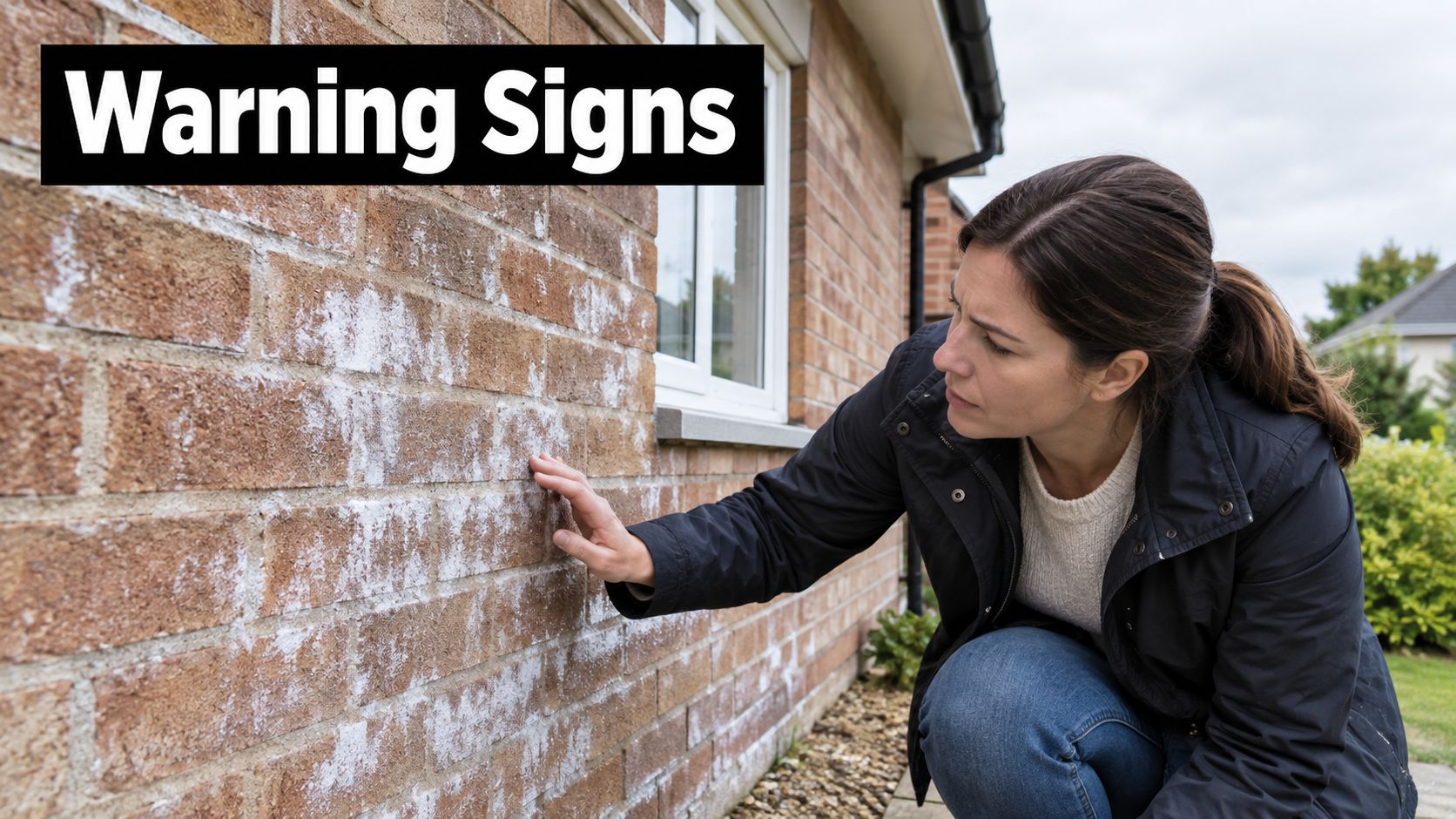
Efflorescence is white, powdery salt on brick or stone. A light deposit that disappears after a dry season may be leftover salt from a past wetting event. Deposits that return in the same location, especially below windows, around chimneys, or near the foundation, suggest active moisture movement.
Hairline shrinkage cracks in a small, non-load-bearing area may remain cosmetic. Stair-step cracks that follow mortar joints deserve professional attention because they can indicate differential settlement or movement in the wall system.
Separate surface symptoms from structural warnings
Use this quick screening list:
- Spalling brick: Flaking or missing fired faces expose the softer body of the brick and allow more water to enter.
- Crumbling mortar: If a house key can scrape material from a joint, the joint has lost meaningful integrity.
- Bulging or bowing: A wall that no longer sits in one plane may have failed ties, movement, or water-related deterioration.
- Rust streaks: Orange or brown bleeding below a lintel often signals corroding steel behind the masonry.
- Interior odors: A musty smell near a masonry fireplace can point to moisture entering through the chimney, flashing, or surrounding wall.
- Sticking doors: A door that suddenly binds on the side of the house next to a brick exterior may reflect movement, though the door itself still needs separate evaluation.
Don't scrape, seal, or paint over a warning sign before finding its source. A surface coating can hide the evidence an inspector needs.
You can perform a limited hose test on a dry day. Spray the wall gently from the bottom upward, avoid forcing water into openings, and watch whether the surface sheds water or darkens in isolated areas. Stop if water appears inside. The test can help identify vulnerable zones, but it can't replace an inspection of flashing, weep holes, drainage, or concealed cavities.
The video below provides additional visual guidance for recognizing brick and masonry defects.
Repair Methods Explained and When Each One Fits
The correct method depends on what failed. Repointing treats joints. Brick replacement treats damaged units. Sealing manages water absorption on suitable masonry, but it doesn't rebuild a failing wall.
Repointing and tuckpointing
Repointing removes deteriorated mortar and installs new mortar in the existing joints. It's the usual choice when the brick or stone remains sound but the bedding material has eroded. The crew should remove loose material to a consistent depth, clean the joint without damaging the masonry edges, dampen appropriately, and compact the replacement mortar in lifts.
Tuckpointing is often used loosely to describe repointing, but traditionally it adds a narrow contrasting line for a crisp, decorative joint. That effect can suit a Druid Hills restoration where appearance matters. It may be unnecessary on a plain 1960s ranch, especially if the existing wall has broad, weathered joints.
Material compatibility controls the outcome. Heritage guidance favors lime-based mortars where they match the existing substrate because they remain vapor permeable and can be removed with less risk to the base material. The repair must make full contact with the masonry unit and bedding mortar. A stronger bond isn't automatically better if the mortar is too dense or rigid (compatible repair mortar research).
Replacement and surface patching
Replace a brick or stone when the unit has lost its face, has deep cracking, or no longer provides a sound weathering surface. Matching requires more than color. Compare size, texture, absorption, edge profile, and the surrounding mortar.
Surface patching fits shallow losses in stone or concrete when the substrate remains stable. It doesn't belong over active movement, loose material, or a wet wall. Before painting or coating, correct the moisture problem. The practical principle is covered well in this resource on repairing water damage before painting.
Sealing has a limited job
A breathable hydrophobic silane-siloxane treatment can reduce water absorption on suitable porous brick or concrete. It won't close a structural crack, repair a failed lintel, replace missing mortar, or stop water entering through a roof detail. Never use sealant to disguise a defect that still moves.
| Method | Best For | Typical Lifespan | When to Avoid |
|---|---|---|---|
| Repointing | Eroded or missing mortar joints | Depends on compatibility and exposure | Active movement or unresolved moisture |
| Tuckpointing | Historic appearance and crisp joint definition | Depends on the underlying repointing work | Decorative work on unstable masonry |
| Brick or stone replacement | Spalled, cracked, or loose units | Depends on matching and installation | When the wall movement remains active |
| Surface patching | Limited losses in sound stone or concrete | Depends on substrate and exposure | Deep cracks, hollow areas, or saturated walls |
| Masonry sealing | Reducing absorption on suitable porous surfaces | Depends on product and exposure | Trapped moisture, open joints, and leaking details |
Mortar labels aren't a substitute for testing. N and S mixes may appear on contractor proposals, but older soft brick often needs a softer, more vapor-open material. Compare the existing joint and unit before choosing a bagged product. For broader repair options, review residential concrete and masonry repair services and ask how the proposed method fits the wall.
What Masonry Repair Costs in Atlanta This Year
Masonry repair pricing varies with access, height, material matching, joint hardness, and the hidden cause of damage. A small repair can cost more per square foot than a large wall because setup, travel, protection, and diagnosis still take time.
The ranges below are practical planning figures for Atlanta in 2026, based on the supplied local estimates. They are not bids, and they don't include every unusual condition.
| Repair Type | Low Estimate | High Estimate | Typical Project |
|---|---|---|---|
| Repointing | $8 per sq. ft. | $15 per sq. ft. | Accessible wall with moderate joint erosion |
| Full brick replacement | $25 per sq. ft. | $45 per sq. ft. | Damaged units requiring labor and material matching |
| Historic tuckpointing | $20 per sq. ft. | $30 per sq. ft. | Facade needing precise cosmetic joint work |
| Small masonry repair | $500 | $1,200 | Minimum-charge work such as a limited chimney or garden wall repair |
The repointing, replacement, tuckpointing, and small-project figures are planning ranges supplied for Atlanta masonry work. Your price can rise when a two-story Buckhead colonial needs scaffolding, when a period home requires mortar-color matching, or when the crew must correct drainage before touching the wall.
Don't accept a quote that lists only “masonry repair.” Ask whether it includes access equipment, removal and disposal, replacement units, mortar testing or matching, flashing work, cleaning, water management, and final inspection. A low number often excludes the work that prevents failure from returning.
Get at least three itemized proposals. Compare the diagnosis and scope, not just the bottom line. Use Atlanta Concrete Solutions project examples as one place to review the type of concrete and masonry work a contractor may document, then ask each bidder to identify the same repair boundaries.
DIY Versus Hiring a Professional Masonry Contractor
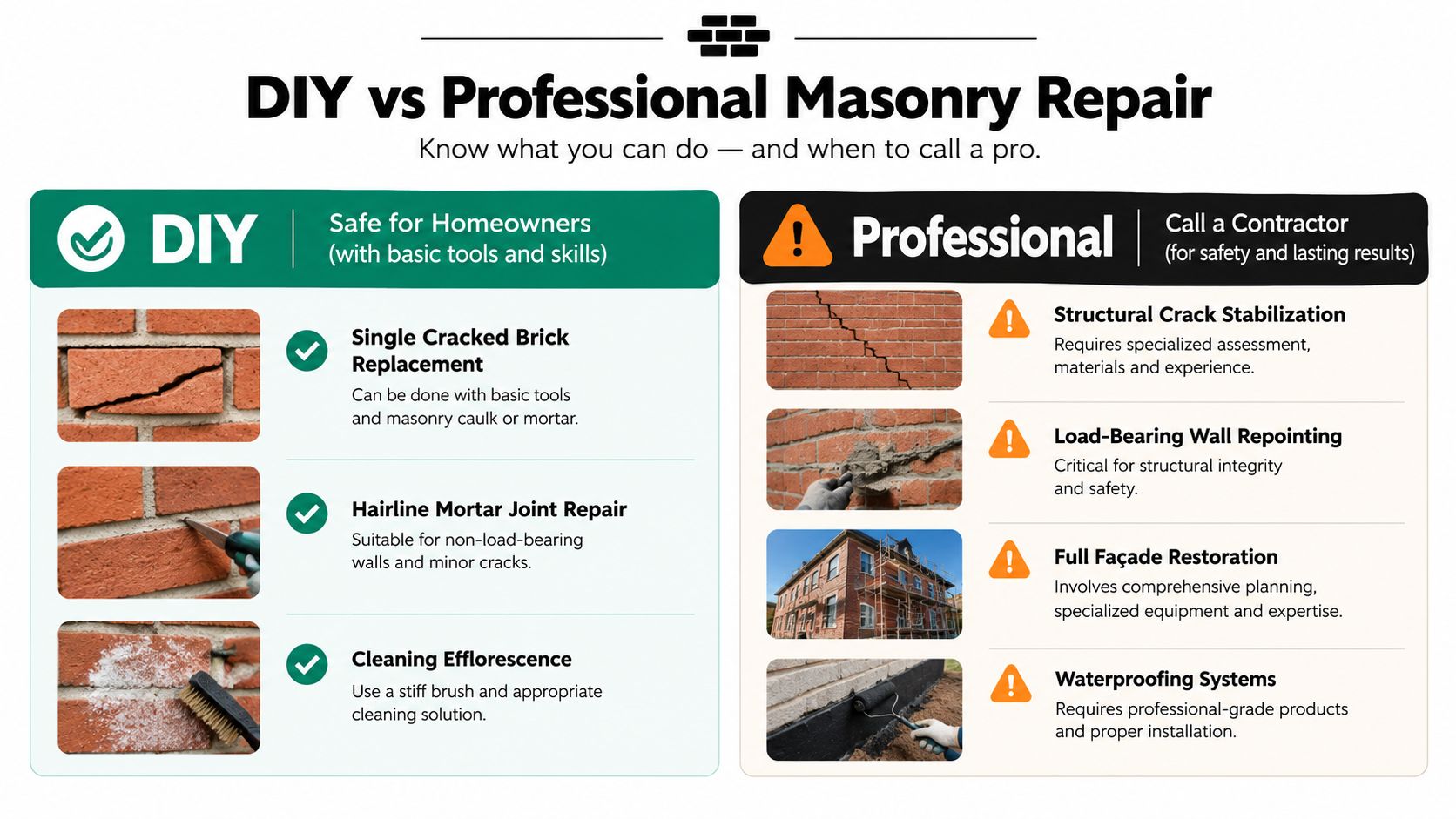
Most masonry repair belongs with a professional, particularly when the wall carries load, sits above a door or window, or shows movement. The risk isn't limited to making the patch look uneven. The wrong mortar can hold moisture against older brick, and the wrong chisel can damage sound units beside the repair.
DIY work that can make sense
A capable homeowner may handle a narrow job when the conditions are clear:
- One ground-level brick: Replace a single spalled unit only when surrounding masonry is stable and the new brick matches its dimensions and absorption.
- A small garden-pier patch: A pre-mixed mortar bag and grout bag can work for a limited non-load-bearing repair, provided the joint is clean and the material is compatible.
- Cleaning light efflorescence: Dry brushing and moisture-source observation are safer starting points than aggressive acid cleaning.
- A suitable breathable sealer: Apply one only to sound, dry masonry after confirming that joints, flashing, and drainage aren't failing.
Call a contractor for the risky work
Hire a professional for stair-step cracks, bulging walls, load-bearing repointing, full facade work, lintel corrosion, chimney rebuilding, waterproofing systems, or any repair requiring ladders and staging. A contractor should be able to identify historic mortar, map cracks, check moisture, inspect drainage, and explain why the proposed material won't damage the existing wall.
A neat patch can still be a failed repair if water keeps entering behind it.
Use this decision check before starting:
- Is the wall load-bearing or attached to a chimney, lintel, porch, or foundation?
- Does the defect repeat, widen, bulge, or return after cleaning?
- Can you identify the original mortar and match its behavior?
- Can you work without damaging adjacent brick or stone?
- Can you inspect and correct the water pathway first?
If any answer is uncertain, pay for diagnosis before buying materials. A missed structural sign can turn a limited repair into a much larger rebuild, while a bad mortar match can accelerate deterioration even when the finished joint looks clean.
Timelines, Permits, and Atlanta-Specific Considerations
A small chimney repointing job can take two to four days, while a full-facade repointing project may take one to two weeks. Structural brick or stone replacement can extend to three weeks or more, depending on access, demolition, curing, material availability, and the amount of concealed damage.
Permit requirements depend on the scope and jurisdiction. Cosmetic repointing and brick replacement involving less than 25% of a wall commonly don't require a permit inside the City of Atlanta or Fulton County, but structural changes, chimney rebuilding, and exterior alterations in historic districts such as Inman Park, Virginia-Highland, and parts of Buckhead may trigger Historic Preservation review. Confirm the requirement with the governing office before work begins, because project details can change the answer.
Atlanta weather affects scheduling. Summer thunderstorms can interrupt exposed-wall work, winter freeze-thaw cycles can stress fresh repairs, and Georgia red clay can direct water toward foundations. Your contractor should explain how the crew will protect open joints and manage rain during the project.
Before signing, verify the contractor's Georgia licensing, insurance, and workers' compensation coverage. Ask for three local references, request mortar and brick material match sheets, and require a written scope that identifies the moisture or movement source. A sound proposal tells you what will be repaired, what will be excluded, and how the crew will confirm the wall is ready for finish work.
Atlanta Concrete Solutions offers concrete and masonry repair for damaged structures, including brick replacement, tuckpointing, custom patching, high-pressure grouting, and masonry color blending. If your Atlanta wall is showing cracks, spalling, crumbling joints, or recurring moisture damage, visit Atlanta Concrete Solutions to request a project review and connect the visible defect to the repair it needs.