
Most pickleball surface advice starts with the wrong question. Owners compare asphalt, concrete, and court colors as if the visible coating carries the whole project. In Atlanta, expansive clay, summer heat, storm-driven rain, tree roots, and drainage restrictions usually decide whether a court earns its keep long before anyone chooses a paint color.
A pickleball court is a layered system. The structural base supports the playing finish, the finish controls traction and ball response, and the site grading determines whether water leaves the court or settles beneath it. For most permanent Atlanta installations, my recommendation is straightforward: build a properly prepared concrete base and apply a compatible acrylic sport-surface system after the slab has cured. Asphalt, cushioned acrylic, and modular tiles each have legitimate uses, but none should be selected just because the initial quote looks lower.
The same discipline applies to nearby flatwork. A court may connect to a driveway, sidewalk, parking pad, or apron, and poor grading at any of those edges can send water toward the playing area. If you're also planning Concrete Driveway Replacement Atlanta, design the court and driveway drainage together instead of asking two separate crews to solve one runoff problem.
Why the Surface You See Is Not the Surface You Choose
The most popular advice says to choose between concrete and asphalt, then add a coating. That's incomplete. Concrete and asphalt are structural bases. Acrylic is a playing finish. Treating them as interchangeable surface options hides the part that most often causes failure in Georgia, the ground beneath the court and the way water moves across the property.
Atlanta-area sites commonly include expansive clay. That soil can move as moisture conditions change, especially where grading directs stormwater toward the court or where trees draw moisture from one portion of the subgrade. A beautiful acrylic finish can't correct settlement below the slab. It can only reproduce the movement above it as cracks, depressions, peeling, or inconsistent bounce.
Georgia heat changes the calculation
Asphalt has a practical advantage at the start. It can reduce initial construction cost and suit light-use conversions or projects with a limited budget. The weakness appears later, when sustained summer heat, moisture, and thermal movement make the pavement more vulnerable to softening, cracking, and deformation.
Concrete provides a more rigid, dimensionally stable platform. That doesn't make it immune to movement or poor construction, but it gives an acrylic system a better base for consistent play when the subgrade, reinforcement strategy, joints, and drainage are properly planned.
My rule for Atlanta: Don't spend premium money on a court coating until the contractor explains how the clay, aggregate base, slope, and runoff destination will be handled.
Storms expose shortcuts quickly. A low spot holds water, shaded areas dry slowly, and standing moisture can accelerate deterioration while making traction unpredictable. Fulton County's building-permit checklist requires site plans to show existing and proposed topography with arrows indicating stormwater flow, and it states that runoff must move toward a drainage easement, drainage structure, or street, not another lot. That's a property-planning issue as much as a court issue, and the requirements are detailed in the Fulton County building permit and site-plan checklist.
A court that looks excellent on installation day can still become expensive if the base settles or the coating traps moisture. The cheapest-to-build surface isn't automatically the cheapest-to-own. For a permanent home court, HOA amenity, commercial facility, or public project, base preparation, drainage geometry, concrete curing, and resurfacing access matter more than the brand of acrylic or the color combination.
The Three Layers Every Outdoor Court Shares
Think of an outdoor court as a sandwich. The bottom layer carries water and distributes loads, the middle layer supplies structural strength, and the top layer creates the playing characteristics players feel.
The bottom layer is the sub-base
At the bottom sits a compacted aggregate sub-base. It provides a stable working platform and helps manage moisture beneath the structural pavement. On Atlanta clay, this stage deserves more attention than a surface brochure usually gives it. Excavation depth, unsuitable-soil removal, aggregate selection, and compaction determine whether the court stays level after wet and dry cycles.
A contractor should explain how the sub-base will be graded and compacted, not just name the material. If the bottom layer contains soft spots, the upper layers can settle unevenly. The result may be ponding, cracks, or a ball that takes a strange hop from one side of the court to the other.
A properly planned walkway uses the same principle. If you're building access from a driveway or parking area, a step-by-step stone path guide can help you think through route preparation, although a permanent accessible route needs a firm, stable, slip-resistant finish rather than loose decorative material.
The middle layer carries the court
The structural layer is usually concrete or asphalt. Concrete offers rigidity and dimensional stability, while asphalt offers a more flexible pavement with a potentially lower initial cost. Neither should be treated as the finished playing surface for a serious outdoor court.
Concrete must also be connected to the surrounding work intelligently. A contractor handling residential foundation concrete understands the same basic principle that applies here: a durable slab depends on what supports it, how moisture is controlled, and how the concrete is placed and allowed to cure.
The top layer controls play
The finish may be a standard acrylic system, cushioned acrylic, modular interlocking tiles, or, in niche settings, a synthetic turf or clay-like surface. Acrylic coatings are applied over concrete or asphalt in multiple layers, often including a silica-filled resurfacer and color coats. Those layers improve traction, control surface texture, limit abrasion, and protect the base from weather exposure.
The performance target is not visual smoothness alone. A commonly cited USA Pickleball benchmark is approximately 34 inches of rebound from a 78-inch ball drop, which makes surface flatness, coating uniformity, and substrate stability important design considerations. A spec sheet should tell you whether a requirement applies to the sub-base, structural pavement, or playing finish.
| Layer | Typical role | What can go wrong |
|---|---|---|
| Compacted aggregate sub-base | Supports the pavement and manages subgrade conditions | Settlement, soft spots, moisture movement |
| Concrete or asphalt | Supplies structural strength | Cracking, deformation, poor slope, unstable edges |
| Acrylic, cushion, tile, or niche finish | Controls traction, appearance, and ball response | Peeling, seams, irregular texture, inconsistent bounce |
The sandwich analogy matters because a premium top layer can't rescue a weak bottom layer. Ask about the entire assembly, not just the product name printed on the coating proposal.
Poured Concrete, Asphalt, Acrylic, Cushioned, Tile, and Turf
There isn't one universal winner among pickleball court surface options. There is, however, a clear default for a permanent Atlanta court: a properly prepared concrete base with a 100% acrylic sport-surface system. The other materials make sense when the project has a specific constraint, such as an existing slab, phased repairs, player comfort, relocation, or limited use.
Poured concrete
Poured concrete is my first choice for a new permanent court on Atlanta clay. It offers a rigid, dimensionally stable base and is often selected for long service life. Once the slab has been prepared correctly and the acrylic system is installed uniformly, players get predictable footing and ball response.
Concrete's weakness is not the material alone. A poor sub-base, inadequate drainage, uncontrolled joints, or premature coating can still produce failures. The slab also feels hard, so facilities serving older players or people who play for long sessions may prefer a cushioned system above it.
Atlanta verdict: Choose concrete for a permanent residential, HOA, municipal, or commercial court when the owner wants the strongest long-term platform and is willing to fund proper excavation, grading, curing, and drainage.
Asphalt
Asphalt can be a sensible choice for a lower-cost court, an existing pavement conversion, or a facility where resurfacing is already part of the maintenance plan. It's familiar, workable, and can reduce the initial construction cost.
The trade-off is movement. Atlanta's heat can soften asphalt, while temperature and moisture changes contribute to cracking and deformation. Asphalt also demands closer attention to recurring maintenance, particularly where tree roots, drainage failures, or heavy use affect the pavement.
Atlanta verdict: Use asphalt when the budget, existing site, or planned maintenance program clearly supports it. Don't sell it as a permanent, maintenance-free alternative to concrete.
Acrylic over concrete or asphalt
Acrylic is a finish system, not a structural base. Contractors generally apply multiple layers, including silica-filled resurfacer and color coats, to create controlled texture, traction, weather resistance, and consistent ball response.
Acrylic can work over either concrete or asphalt when the substrate is stable, accurately graded, and compatible with the coating system. The top finish can look identical over two very different bases, which is why owners need to inspect the structural specification rather than shop by color samples.
Atlanta verdict: Make acrylic the standard playing finish for a properly built outdoor court. Spend more attention on substrate preparation than on decorative color choices.
Cushioned acrylic
Cushioned acrylic adds an elastic layer beneath the playing finish. The purpose is comfort, not structural rescue. It can make extended play feel easier on joints, but it adds material, installation, maintenance, and drying-time considerations.
For an HOA, club, or commercial facility serving frequent players, cushioning may justify the additional investment. For an occasional backyard court, standard acrylic over a sound concrete base usually delivers better value.
Atlanta verdict: Choose cushioned acrylic when player comfort is a stated project requirement, not as a substitute for a stable slab.
Modular interlocking tiles
Modular tiles can be installed over suitable hard surfaces and replaced in sections. That repairability is valuable for conversions, temporary facilities, and projects where the owner may relocate or reconfigure the court. Many systems also drain through the tile assembly.
The seams and subfloor preparation deserve scrutiny. A tile system can't hide a badly uneven base, and its ball response may differ from a monolithic acrylic court. Heat exposure also makes product quality and installation details important.
Atlanta verdict: Use tiles when fast installation, localized replacement, relocation, or drainage access outweighs the desire for a traditional acrylic feel.
Turf and clay-like finishes
Synthetic turf and clay-like finishes belong in niche or multi-use projects. Turf can support casual play or an aesthetic concept, but it won't provide the same predictable response as a properly finished hard court. Clay-like systems may suit a tennis conversion or recreational setting, yet they demand a maintenance approach that most dedicated pickleball owners don't want.
Atlanta verdict: Choose these only when appearance or multi-use programming matters more than conventional pickleball performance.
| Surface | Typical cost per sq ft | Best Atlanta use case | Repairability | Climate fit |
|---|---|---|---|---|
| Concrete base with acrylic | Project-specific | Permanent residential, HOA, commercial, and public courts | Localized coating repairs, structural work is more involved | Strong fit when clay and drainage are addressed |
| Asphalt with acrylic | Project-specific | Budget-sensitive builds and existing pavement conversions | Cracks and resurfacing are accessible, but recurring work is more likely | Usable, with greater heat and movement exposure |
| Cushioned acrylic | Project-specific | Frequent play and comfort-focused facilities | Finish can be renewed, cushion requires specialized work | Good when moisture and drying are managed |
| Modular tiles | Project-specific | Conversions, phased repairs, and relocatable courts | Individual sections can be replaced | Good drainage potential, seams and heat movement require care |
| Turf or clay-like finish | Project-specific | Casual or multi-use settings | Depends on the system | Niche fit, not my default for dedicated play |
Owners also need to plan the game around the court they build. A new surface won't replace basic player organization, so facility managers may find a practical guide to pickleball formations useful when setting up clinics, open play, or league programming.
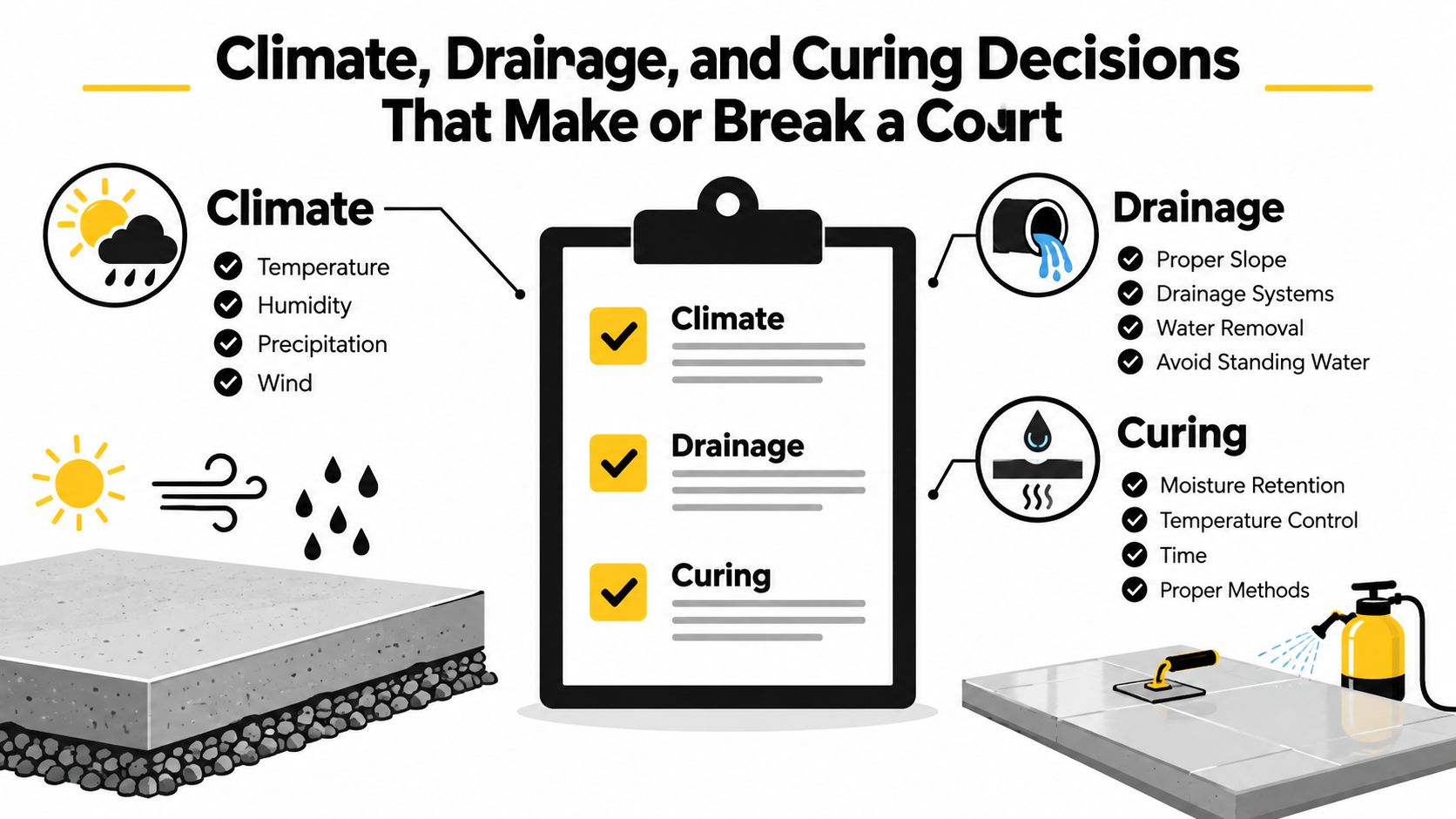
Climate, Drainage, and Curing Decisions That Make or Break a Court
The three numbers I want owners to remember are 34 inches, 28 days, and 1 to 2 percent. The first concerns rebound, the second concerns concrete curing, and the third concerns the court's drainage slope.
A commonly cited USA Pickleball benchmark calls for a rebound of approximately 34 inches from a 78-inch ball drop. That result depends on a uniform base and controlled coating texture. A contractor can't guarantee consistent play by checking color alone.
Newly poured concrete should cure for at least 28 days before acrylic is applied, according to the USA Pickleball court-building guidance. Coating too soon can trap slab moisture, causing adhesion failure, peeling, or uneven color. This is one of the easiest avoidable mistakes on a rushed project.
The playing area should slope approximately 1 to 2 percent in one direction so rain leaves the surface rather than forming puddles. Atlanta's humid, storm-prone weather makes that geometry more important, particularly beside retaining walls, landscaping, shaded areas, or properties with limited runoff destinations.
What the surface comparison means
| Surface system | Initial cost position | Climate fit | Repairability | Typical use |
|---|---|---|---|---|
| Concrete with acrylic | Higher than basic asphalt | Strong when clay, slope, and drainage are handled | Structural repair is demanding, coating renewal is manageable | Permanent courts |
| Asphalt with acrylic | Lower initial position | More exposed to heat, cracking, and movement | Crack repair and resurfacing are practical | Budget projects and conversions |
| Cushioned acrylic | Higher than standard acrylic | Good when cure and moisture controls are followed | Specialized repair and resurfacing | Comfort-focused facilities |
| Modular tile | Project-specific, often chosen for flexibility | Good drainage potential | Sectional replacement | Conversions and relocatable courts |
A Miami-Dade public-sector specification illustrates the precision owners should demand. It limits finished-base deviation to 3/8 inch when checked with a 10-foot straightedge, requires a defined drainage plane, and specifies compacted asphalt and base courses before acrylic resurfacing, as shown in the Miami-Dade court procurement specification. Atlanta owners don't need to copy every jurisdiction's document, but they should insist on the same level of measurable quality.
Commissioning checklist: Check the base with a straightedge, verify the slope, confirm cure time, inspect drainage after water exposure, and review acrylic texture and adhesion. A color review is not commissioning.
Asphalt's lower starting price doesn't erase its exposure to sustained summer heat and thermal movement. Concrete generally holds geometry better, but only when the slab and sub-base were built as a moisture-management system.
Here's a short explanation of why these steps matter on a real court.
For a concrete project that needs accurate placement and a durable slab, owners can review residential poured concrete services alongside the court-specific coating specification.
Accessibility, Codes, and the Atlanta Permit Reality
A court can meet a playing-surface benchmark and still provide a poor experience at the gate, route, seating area, or parking connection. Owners should treat accessibility as a complete path from arrival to play, not a paint or coating decision.
The 2010 ADA Standards don't establish a court-specific pickleball surface specification. They do require accessible routes to be stable, firm, and slip-resistant. Loose gravel, wood chips, and uncompacted decomposed granite create obvious problems for wheelchairs, walkers, and people with limited balance. Concrete, asphalt, and stabilized compacted stone are more practical route materials when designed and installed correctly.
The edges deserve as much attention as the court
A court route should be checked for uneven transitions, slippery wet areas, excessive cross-slope, drainage grates, narrow gates, and thresholds that catch mobility devices. Contrasting line colors can improve visual clarity, while shaded seating and rest areas make the facility more usable for older players and people who need breaks.
Cushioned acrylic may improve perceived comfort on the playing surface, but it doesn't solve a rough approach route. The route, gate, seating, and court finish need to work together.
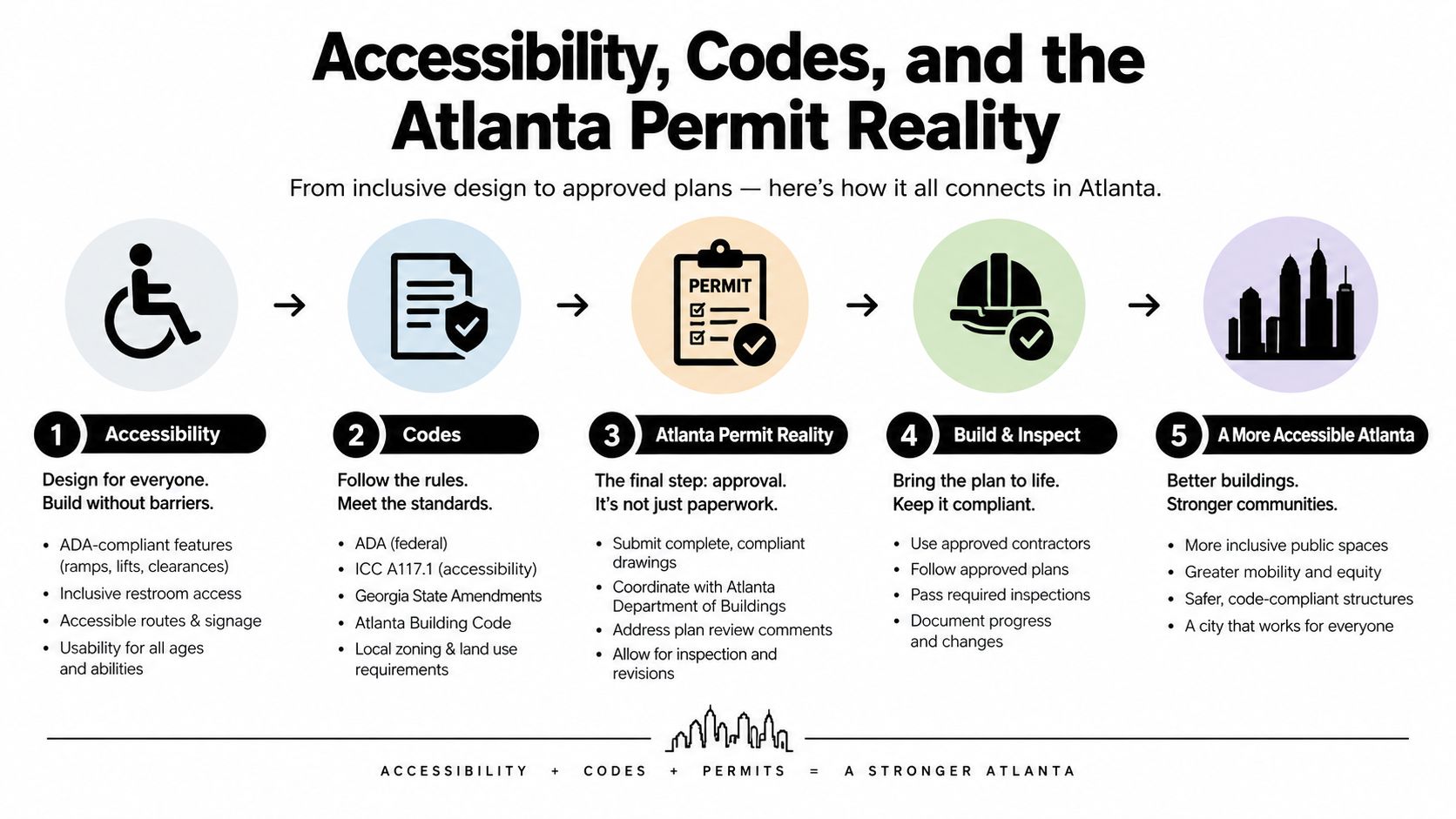
Atlanta permitting affects connected concrete work
Fulton County requires site plans to show topography and stormwater flow, and runoff can't be directed toward another lot. The checklist also requires the driveway apron's location and dimensions and specifies that the apron must be at least 5 feet from a lot line, according to the county document linked earlier.
That matters when a court access route crosses or approaches a driveway. A court contractor may need to coordinate the apron, sidewalk, parking connection, and drainage swale before placing concrete. If the project changes the way water leaves the site, the grading plan needs to show the intended destination clearly.
Atlanta's Department of Transportation states that any disturbance to the public right-of-way requires an issued permit. Its examples include installing or repairing a driveway apron, constructing a structure that requires an apron, and other work occupying or affecting the right-of-way, as explained on the Atlanta Department of Transportation right-of-way page.
Practical rule: If the court project touches a public street, driveway apron, sidewalk connection, or right-of-way, review the permit path before excavation begins.
Homeowners, HOAs, and facility managers should also document the route and drainage before construction. That record helps distinguish a coating issue from a site issue if water later appears at the court edge.
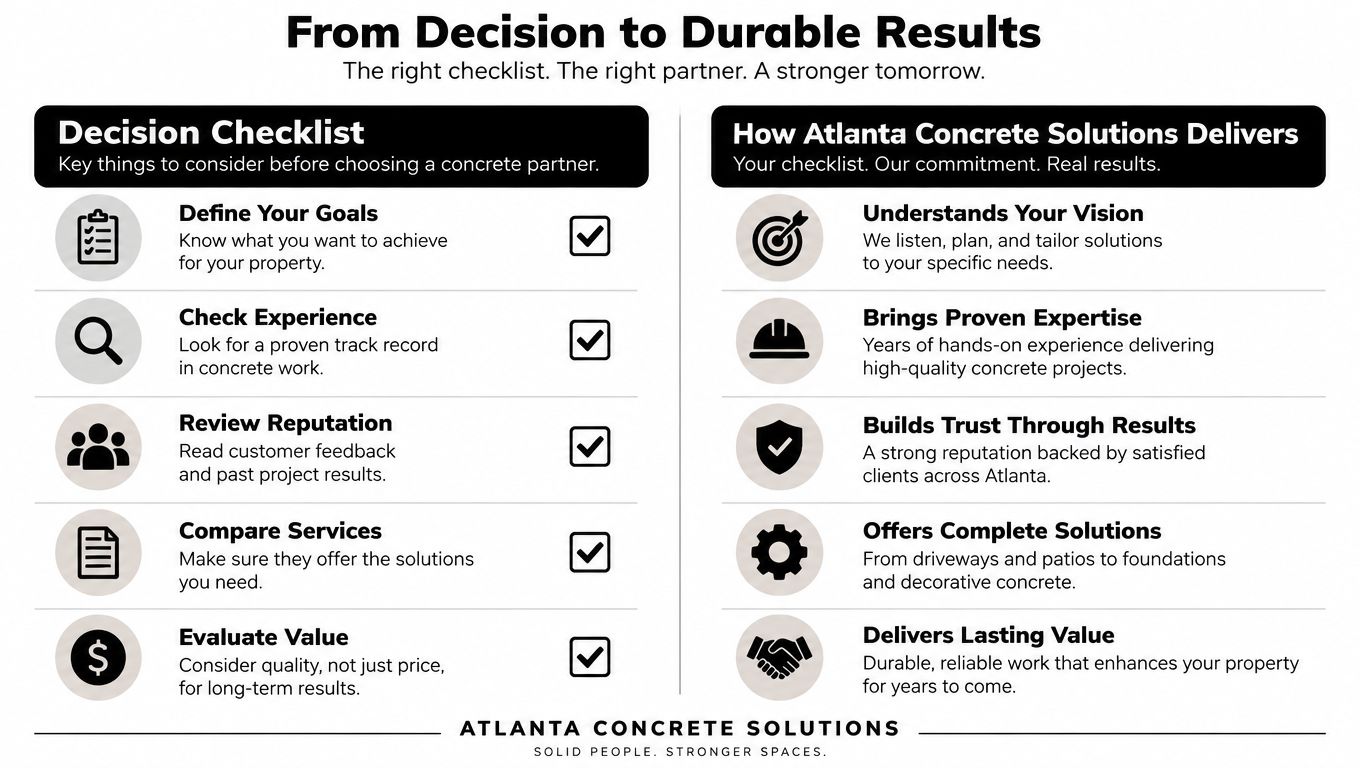
Decision Checklist and How Atlanta Concrete Solutions Delivers
Start with use, not color. A private court played occasionally has a different ownership equation from an HOA court used every day, and a public facility needs a different route, drainage, and maintenance plan from a backyard conversion.
Ask these questions before choosing the finish
How much use will the court receive? Heavy, regular play supports a stable concrete base and may justify cushioned acrylic. Light use can support asphalt or an existing-surface conversion if the pavement is sound.
What is below the court? Identify expansive clay, soft spots, tree roots, old pavement, and areas that collect water. A contractor who only discusses the top coating hasn't answered the structural question.
Where will stormwater go? Confirm the court slope, perimeter drainage, adjacent lots, street connection, easement, and driveway apron. Don't wait until the slab is poured to discover that the site has nowhere legal to send runoff.
How important is comfort? Standard acrylic over concrete is a strong default. Cushioned acrylic deserves consideration where frequent play, older users, or joint comfort drives the specification.
How will repairs happen? Concrete and acrylic offer a conventional long-term system. Tiles allow sectional replacement, but seams and subfloor tolerances need closer inspection.
What is the budget horizon? Compare excavation, base work, slab or pavement, finish, drainage, access routes, resurfacing, and repairs. An initial surface price doesn't represent the full ownership cost.
Coordinate the court with surrounding flatwork
A concrete contractor can contribute more than the playing slab. The same project may include excavation, aggregate compaction, concrete placement, driveway work, apron adjustments, sidewalk connections, parking pads, curbs, and drainage structures. Coordinating those scopes prevents one finished surface from draining directly toward another.
Atlanta Concrete Solutions handles concrete installation, driveway replacement, decorative and stamped concrete, poured slabs, sidewalks, and related masonry work. Its project portfolio gives owners examples of the broader flatwork that may connect to a court installation.
A court and driveway should be designed together when they share an approach, slope, drainage outlet, or public-street connection. Combining the planning can reduce duplicated excavation and mobilization, but it doesn't remove the need to verify permits or site-plan requirements.
For owners considering Concrete Driveway Replacement Cost Atlanta 2026, the same site-specific principle applies. A current homeowner comparison reports that a concrete driveway averages just under $6,500 nationally, with a typical range of approximately $1,600 to $32,000 and installed pricing of about $8 to $20 per square foot, including labor, according to NerdWallet's asphalt-versus-concrete driveway comparison. Those figures aren't an Atlanta court quote, but they show why square footage, access, excavation, and drainage can move a project budget sharply.
The One Sentence That Decides Which Surface to Pick
For most permanent Atlanta courts, choose a properly prepared concrete base with a compatible acrylic finish, and choose something else only when a clear site or user requirement justifies the trade-off.
That sentence captures the practical answer. Concrete earns its place where the owner wants a stable platform for long-term play, especially on a site with expansive clay and demanding stormwater conditions. Acrylic supplies the controlled texture, traction, weather resistance, and consistent playing response. The two materials perform different jobs, and the project succeeds when the contractor designs them as one system.
Asphalt can still be the right call. Choose it for an existing pavement conversion, a lighter-use facility, or a project where lower initial construction cost matters more than minimizing recurring maintenance. Require a plan for heat-related movement, cracking, drainage, and resurfacing rather than accepting a vague promise that the coating will solve everything.
Cushioned acrylic makes sense when comfort is central to the facility's purpose. It's a reasonable upgrade for HOAs, clubs, and commercial courts serving frequent players. Modular tiles suit owners who value sectional repair, fast installation over a suitable hard surface, relocation, or rapid drainage. Neither option should be used to hide poor grading or an unstable subfloor.
Carry this checklist to the job site
- Base: Ask whether the design uses concrete or asphalt and why that choice fits the site.
- Subgrade: Require an explanation of clay, soft spots, roots, excavation, aggregate, and compaction.
- Drainage: Confirm the slope and runoff destination before placement.
- Curing: Verify that new concrete will cure for at least 28 days before acrylic application.
- Flatness: Request straightedge checks and correction of low spots.
- Finish: Confirm the acrylic build, texture, adhesion, line layout, and maintenance plan.
- Access: Review the route from parking or driveway to gate, seating, and court.
- Connected work: Coordinate driveway replacement, widening, extension, apron repair, and sidewalk construction where they share drainage or right-of-way impacts.
That same logic guides How Long Does a Concrete Driveway Last in Atlanta? A current homeowner comparison reports an average concrete driveway life of about 27.5 years before repair, with potential to reach 30 to 40 years with proper maintenance, as stated in the NerdWallet comparison cited above. Construction quality and water management influence whether flatwork remains serviceable near the upper end of its expected life.
The court surface is only one part of the property improvement. If the project also involves Concrete Driveway vs Asphalt in Atlanta, Best Concrete Thickness for a Residential Driveway, Do You Need Rebar in a Concrete Driveway?, Concrete Driveway Cracks: When Should You Replace It?, Concrete Driveway Repair vs Replacement, How to Fix Drainage Problems on an Atlanta Driveway, Concrete Driveway Apron Atlanta, Driveway Widening Atlanta, Driveway Extension Atlanta, Stamped Concrete Driveway Atlanta, Concrete Driveway Sealing Atlanta, How Long Before You Can Drive on New Concrete?, or a Concrete Driveway Maintenance Guide, bring those questions into the same site review. The right answer depends on the existing slab, runoff, access, soil, and intended use, not a generic material ranking.
If you're planning a new court, driveway replacement, extension, or apron repair in metro Atlanta, Atlanta Concrete Solutions can review the subgrade, grading, drainage, concrete scope, and surrounding flatwork as one project. Request a site-specific quote through Atlanta Concrete Solutions before choosing a surface, so the court finish, access route, and runoff plan are settled before concrete is placed.