
You open the Atlanta garage door after a week of rain and find the same problem waiting: a dull concrete slab, fine dust on the shelves, dark tire marks near the parking area, and stains that cleaning never quite removes. The floor may be structurally sound, but it doesn't look finished, and every attempt to make the space more useful exposes another weakness.
A polished concrete garage can solve some of those problems by transforming the existing slab rather than covering it with a separate flooring layer. It can create an attractive, light-reflective surface for a clean show garage, home gym, or organized daily-driver space. It isn't automatically the right choice for a working garage exposed to frequent water, vehicle fluids, or aggressive maintenance.
The practical questions are straightforward. Is the slab sound enough to polish? Is moisture moving through it? Will the garage stay mostly dry, or will you wash vehicles inside? Which sheen and aggregate exposure fit the lighting and the way you use the room? This guide answers those questions in order, with the Atlanta climate and common residential garage conditions in mind.
Introduction to Polished Concrete Garages in Atlanta
A garage floor often starts as a utility surface, not a finished room. It supports vehicles, collects tracked-in water, and absorbs whatever spills beneath a car. In Atlanta homes, humidity, heavy rain, drainage problems, and ground moisture can make an ordinary slab look tired even when the concrete still has useful life.
Polishing changes the surface through grinding, densification, and diamond refinement. The result can feel more like a deliberate architectural finish than a dusty parking pad. That makes it appealing for homeowners creating an uncluttered garage with bright walls, storage cabinets, display lighting, or a workshop corner that stays relatively dry.
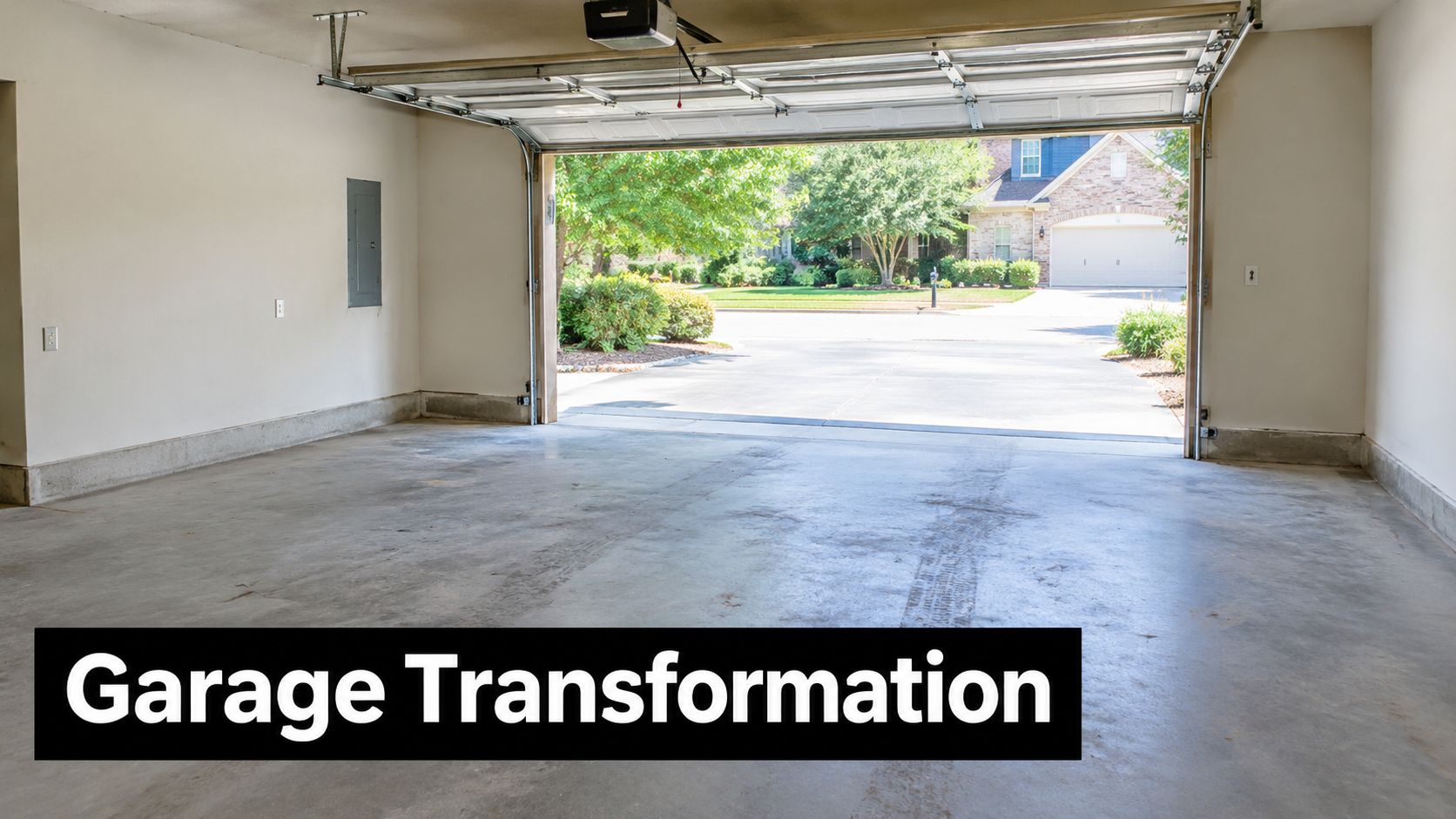
A finish, not a cure for every slab problem
Polishing exposes the existing concrete. Cracks, patches, aggregate variation, oil staining, uneven repairs, and construction joints may remain visible, even after the surface looks cleaner and brighter. A contractor can often repair selected defects before polishing, but those repairs won't make the slab behave like newly placed concrete.
Moisture also matters. A garage with persistent dampness, no effective vapor barrier, or water entering around the walls may need moisture correction before any finish is selected. Grinding and polishing won't stop water from moving through the slab.
Where the finish fits best
Polished concrete tends to make sense when the garage is used as a dry, controlled space. It can suit a display garage, a clean storage area, a hobby room, or a workshop where spills are occasional and cleaned promptly. A family that frequently washes cars indoors, tracks in snowmelt, or works with oily equipment may need a different system or a more protective specification.
The finish also carries a distinctive look. Some homeowners want visible slab character and an industrial, minimal appearance. Others want a uniform surface that hides repairs and everyday marks. Those preferences should guide the inspection and sample process, not follow it.
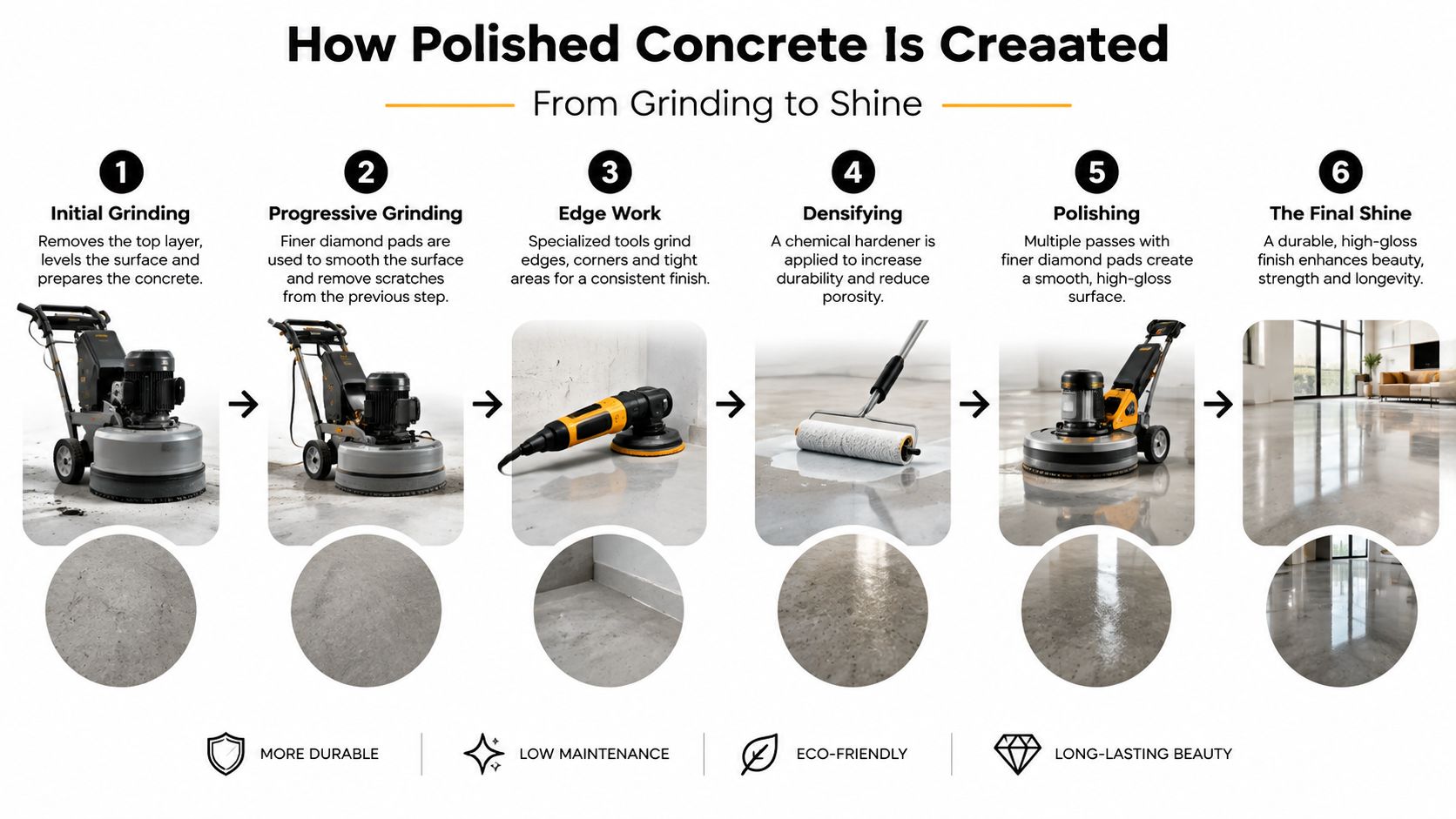
How Polished Concrete Is Created From Grinding to Shine
Polished concrete isn't paint and it isn't a thick plastic sheet laid over the floor. Crews reshape and refine the concrete surface with industrial equipment, then harden and polish the material that remains.
The process developed into a modern flooring system in the early 1990s. One widely cited milestone was Advanced Floor Products' Retro Plate system, which combined mechanical grinding, a chemical densifier or hardener, and diamond-impregnated pads. Industry histories also identify HTC's HTC 800 as the first concrete polishing machine, launched in 1992, while HTC introduced polished concrete to the United States through a 40,000-square-foot warehouse floor at the Bellagio in Las Vegas in 1999, according to this history of polished concrete.
Step one removes the weak surface
The crew begins with coarse diamond tooling. This stage removes laitance, surface dirt, old residue, minor irregularities, and selected coatings. The goal isn't only to make the floor smooth. It creates a stable surface that can accept the next treatment.
Some garages need more aggressive grinding because of paint, adhesive, oil contamination, or uneven patches. Others need less exposure because the homeowner wants a cream finish with minimal aggregate showing.
Step two hardens the concrete
After the surface is prepared, the contractor applies a chemical densifier. The material penetrates the concrete and reacts with available compounds to form harder calcium-silicate-hydrate, or CSH. That reaction helps reduce dusting and gives the surface a stronger foundation for later refinement.
Moisture affects this stage. Higher slab moisture can reduce densifier absorption, which can contribute to weaker hardening, haze, whitening, or uneven polish quality. The contractor must evaluate the slab and surrounding conditions rather than treating densifier as a magic sealer.
Core concept: Polishing transforms the slab itself. It doesn't simply add a decorative layer on top.
Step three refines the surface
The crew progresses through finer diamond abrasives, much like sanding a piece of wood with increasingly fine paper. Coarse tooling establishes the shape, intermediate grits remove scratches from the earlier stage, and fine polishing creates the chosen level of clarity and reflection.
A topical coating differs from this process. A coating sits on the concrete and may provide a separate chemical or decorative barrier. Polishing leaves the concrete as the visible wearing surface, although a contractor may specify a guard or stain-resistant treatment for a particular garage.
The exact sequence depends on the slab, desired aggregate exposure, sheen, repairs, and traction requirements. You can review the service approach for a residential polished concrete garage finish before discussing samples and site conditions.
Choosing Your Finish Sheen Levels and Aggregate Exposure
The appearance of a polished concrete garage comes from two separate choices. Sheen controls how much light reflects from the surface, while aggregate exposure controls how much of the stone and sand within the slab becomes visible.
A matte or low-sheen finish has a calmer, more understated appearance. It tends to suit a working garage where glare is undesirable and small marks shouldn't dominate the room. Satin and semi-gloss finishes offer more reflected light without creating the mirror-like effect some homeowners associate with showrooms. High gloss can brighten a dim garage, but it also makes surface variation, tire marks, repairs, and standing water more noticeable.
Match sheen to the room
Think about the garage's lighting before choosing the most reflective option. White walls, overhead LED fixtures, and a clean display area can benefit from semi-gloss or high gloss. A garage with strong daylight entering through the door may become visually harsh if every surface reflects light.
A daily-driver garage often benefits from satin or semi-gloss. These finishes still look intentional, but they may be more forgiving of dust, wet tire tracks, and small surface inconsistencies. A show garage can justify higher gloss when the slab is attractive and the owner accepts more frequent wipe-downs.
Aggregate exposure changes the character
Cream exposure removes little material and leaves a relatively fine, consistent appearance. It's a reasonable direction when the slab has an appealing surface and the homeowner wants a quieter floor.
Salt-and-pepper exposure reveals small particles and creates more visual texture. It can disguise mild variation better than a nearly uniform cream finish while retaining a refined appearance.
Large aggregate exposure cuts deeper into the slab to reveal larger stones. This produces a stronger terrazzo-like or industrial character, but it also exposes more of the slab's original composition and any differences between pours.
Slip resistance isn't determined by appearance alone. The final grit, surface refinement, and any traction-enhancing guard or aggregate strategy should be evaluated with the intended wet conditions in mind. Ask for a physical sample and view it under the actual garage lights, both dry and lightly damp. A sample outside a showroom can look completely different beneath your overhead fixtures.
Durability Maintenance and Real World Performance
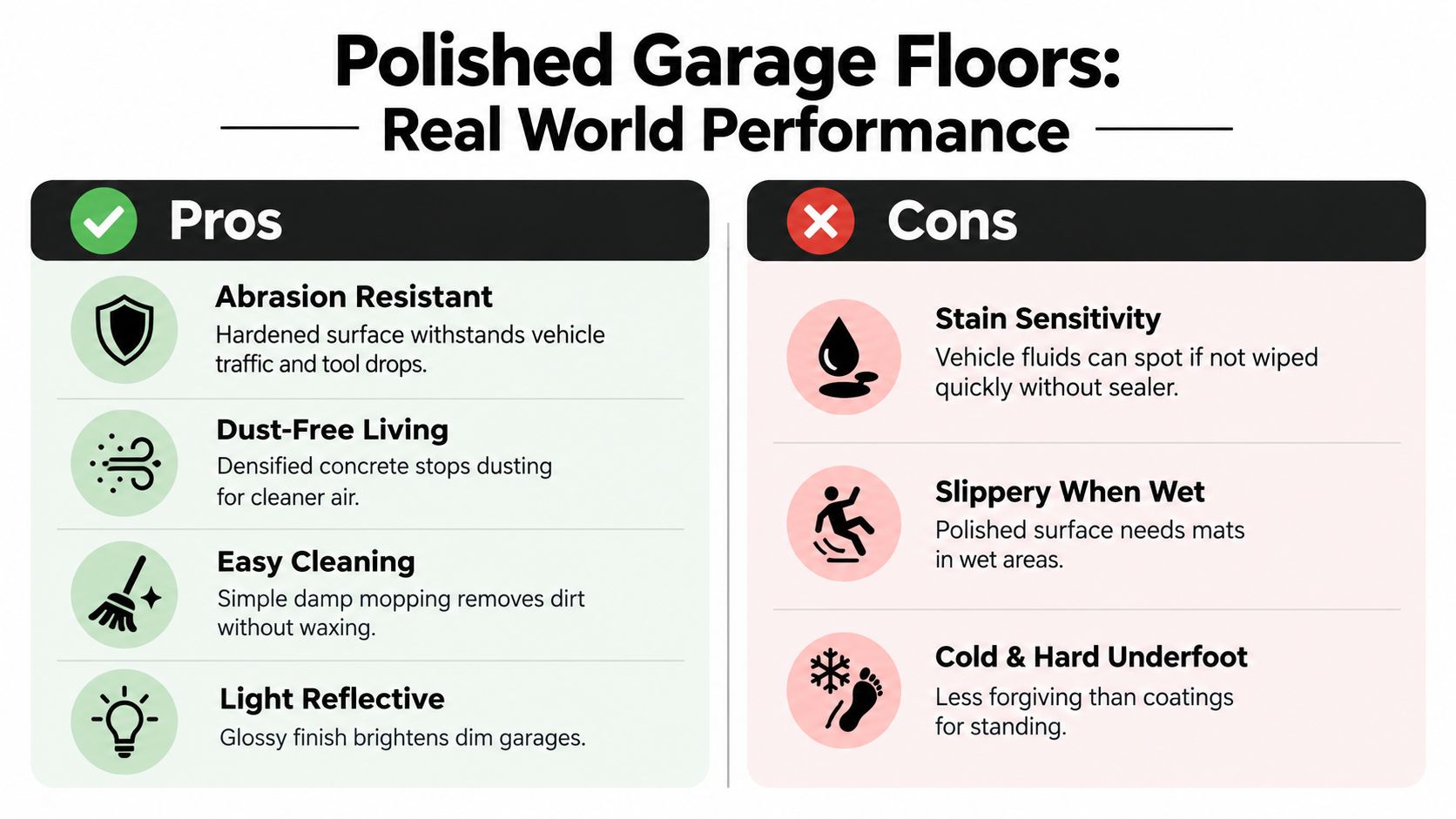
A polished concrete garage is easy to misunderstand because it looks tough before you learn how it behaves. The densified surface can reduce dusting and handle normal vehicle traffic well, but it isn't impervious to staining, impact, moisture, or poor cleaning habits.
Vehicle fluids deserve quick attention. Oil, coolant, brake fluid, and other materials can leave marks if they sit on the floor, especially when the specification doesn't include a suitable guard. A polished surface can be cleaned more easily than a dusty untreated slab, but easy cleaning doesn't mean you should ignore spills.
Daily maintenance is simple, but specific
Sweep or dust-mop loose grit before it gets dragged beneath tires or storage bins. Fine grit acts like an abrasive when it moves across a finished surface. Damp mopping with a cleaner appropriate for polished concrete can remove tracked-in dirt without creating wax buildup.
Avoid choosing a household product because it leaves a strong shine. A residue-forming cleaner can create a film that changes traction and dulls the intended finish. For general concrete floor cleaning tips, focus on removing grit, responding to spills promptly, and keeping water from sitting on the floor.
Gloss and traction are different questions
A high-gloss floor isn't automatically slippery. An ASCC technical document reported polished concrete test results that significantly exceeded the commonly cited wet dynamic coefficient of friction threshold of 0.42, even at very high gloss levels, as described in its slip resistance technical document.
That finding doesn't mean every polished garage is safe in every wet condition. Tires, rainwater, melted snow, and car-washing runoff change the situation. Traction depends on the final grit, surface refinement, guard selection, and aggregate exposure. Request wet-traction data rather than judging safety by shine.
Practical rule: Specify traction for the way you use the garage, not for the photograph you want to take.
Show garage versus working garage
A dry show garage can be an excellent match. The floor stays mostly free of standing water, spills are occasional, and the owner values reflection and cleanability. A working garage requires a harder decision. Frequent washing, wet tire ingress, or vehicle fluids may call for mats, drainage improvements, a traction-enhancing treatment, or an alternative coating system.
Independent safety guidance also warns that wet slip risk isn't reliably predicted by gloss level or sealer choice alone, and recommends pendulum testing for evaluation, as discussed in this polished concrete wet-slip guidance. The finish should serve the garage's real operating conditions. More project examples can help you compare how different concrete surfaces are used in practice through Atlanta Concrete Solutions projects.
Is Your Existing Slab Ready for Polishing
Polishing works best when the existing slab gives the contractor something sound to refine. Before discussing sheen, inspect the concrete itself. A floor with widespread movement, unstable repairs, severe settlement, or persistent water intrusion may need structural work or replacement rather than cosmetic finishing.
Start with a practical inspection:
- Soundness: Tap suspicious areas and look for hollow, loose, or flaking concrete.
- Cracks: Separate stable hairline cracking from cracks that show displacement, widening, or continuing movement.
- Flatness: Identify low spots where water collects and high areas that may require heavier grinding.
- Previous materials: Document paint, adhesive, sealer, epoxy, or other coatings that must be removed or tested.
- Contamination: Locate oil and chemical stains because deep contamination can affect the final appearance.
- Edges and joints: Check walls, control joints, door thresholds, and transitions where water may enter.
Moisture is the go or no-go variable
Two measurements deserve special attention: moisture vapor emission rate, or MVER, and in situ relative humidity, or RH. They directly affect densifier penetration, dye retention, shine clarity, and the risk of efflorescence or whitening.
Higher moisture can reduce densifier absorption because the treatment needs to penetrate the surface and react within the concrete. A garage built over a slab without a proper vapor barrier, or one exposed to persistent ground moisture, may polish unevenly or develop haze that becomes difficult to correct after grinding. Atlanta's humid conditions and heavy rain make drainage, wall edges, and slab moisture worth checking rather than assuming.
Use a decision tree
Repair first when the slab is generally sound but has localized cracks, holes, stains, or minor surface defects. Repairs may remain visible, so the sample should include repaired areas when possible.
Replace or reassess when the slab has widespread structural cracking, poor support, serious settlement, or moisture that can't be controlled. Grinding won't correct movement below the surface.
Choose an alternative finish when the garage stays wet, handles frequent fluid exposure, or needs a surface with a separate protective barrier. A neutral residential concrete and masonry repair service can help address defects before you commit to a finish.
The most useful estimate includes moisture testing, repair recommendations, expected aggregate exposure, and a discussion of how visible the slab's history will remain.
Cost Factors Longevity and Value for Atlanta Homeowners
A polished garage quote reflects more than square footage. Contractors must account for the slab's current condition, the amount of grinding required, coating or adhesive removal, repair work, access for equipment, desired aggregate exposure, sheen, densifier, and any guard intended to improve stain resistance or traction.
Two garages with similar dimensions can require very different preparation. One may have a clean, level slab ready for a straightforward polishing sequence. Another may contain old coatings, oil contamination, uneven patches, and moisture concerns that demand testing and additional preparation. Ask the estimator to separate those items instead of presenting one unexplained total.
Compare value across the property
A garage floor is only one part of the concrete system around an Atlanta home. Driveway performance depends heavily on the sub-base, drainage, and reinforcement. One source describes a properly engineered 4,000 PSI, rebar-reinforced driveway as capable of lasting 30 to 50 years, while another identifies 4 inches as standard for passenger cars and recommends 5 to 6 inches with reinforcement for heavier vehicles and higher traffic. Those figures come from concrete driveway sizing guidance and residential driveway thickness guidance.
Properly installed concrete driveways are commonly described as lasting 30 to 50 years, compared with roughly 15 to 20 years for asphalt, and sealing every 5 to 10 years is cited as a maintenance interval that helps protect concrete from water, stains, and freeze-thaw damage, according to this concrete versus asphalt driveway comparison. Those numbers describe driveways, not a guarantee for a polished garage, but they show why drainage, support, thickness, and maintenance matter across concrete projects.
Localized driveway damage may favor repair when the slab remains structurally sound. Heavy cracking, weak sub-base conditions, thin pours, freeze-thaw exposure, or aggressive deicing salts can shorten expected life to roughly 15 to 25 years and make replacement more sensible, as explained in this concrete driveway repair and replacement guide.
For a garage estimate, ask about preparation, moisture findings, repair limits, finish samples, maintenance products, warranty terms, and payment or financing options. Those details make competing proposals easier to compare than a single total.
Making the Right Choice for Your Garage and Next Steps
A polished concrete garage is a conditional choice, not a universal upgrade. Choose it when the slab is structurally sound, moisture is controlled, the garage is mostly dry, and you appreciate visible concrete character. Consider another system when the floor faces frequent standing water, regular vehicle washing, persistent fluid exposure, or movement that repairs can't stabilize.
Your next steps should follow the risk, not the color chart:
- Inspect the slab. Record cracks, patches, stains, coatings, low spots, and wall-edge moisture.
- Test moisture. Request MVER and in situ RH testing before selecting densifier, dye, guard, or coating.
- Define the use. Explain whether the garage stores vehicles, houses tools, receives wet tires, or functions as a show space.
- Review samples. Compare cream, salt-and-pepper, and larger aggregate exposure under your own lighting.
- Specify traction. Ask how the final grit and guard address wet conditions, and request measurable wet-traction information.
- Plan maintenance. Keep grit swept up, remove spills promptly, and avoid residue-forming cleaners.
Atlanta Concrete Solutions evaluates concrete surfaces for polishing, repair, decorative work, driveways, and related masonry needs across the metro area. A site-specific recommendation should connect the slab's condition to the finish you want, rather than promising the same polished concrete garage specification for every home.
If you're ready to decide, request an evaluation that covers slab condition, moisture, intended use, and finish samples before work begins. That process gives you a clearer answer about whether polishing will deliver the clean, durable garage you want.
Atlanta Concrete Solutions offers polished concrete garage evaluations, concrete repair, driveway replacement, and decorative concrete services for Atlanta-area homes. Visit Atlanta Concrete Solutions to discuss your slab, request a quote, and plan a finish that fits both your garage's appearance and everyday use.