
You're staring at a cracked driveway in Marietta, Johns Creek, or Duluth, and three bids are already contradicting each other on thickness, rebar, drainage, and price. That's exactly when hiring the lowest bidder turns expensive. Unclear specifications, skipped base preparation, missing permits, and vague warranty terms don't disappear after you sign. They show up later as change orders, ponding water, or a slab you're replacing twice.
Treat these Questions to Ask a Concrete Contractor as a pre contract due diligence process, not a casual chat. First confirm legal and technical qualifications. Then pin down the site design, schedule, written scope, payment structure, and warranty. It works the same whether you're replacing a driveway, pouring a slab, building a basketball court, or managing commercial paving.
A quick way to compare answers
Ask each contractor the same eight questions and keep their answers in writing. A contractor who can't explain base depth, joint layout, or who pulls permits probably hasn't thought through your project either. If you're also comparing outdoor surface options beyond Atlanta, you can find paver contractors in Austin to see how another market scopes similar work, but the due diligence questions stay the same.
1. Are You Licensed, Insured, and Bonded for Work in My City and County?
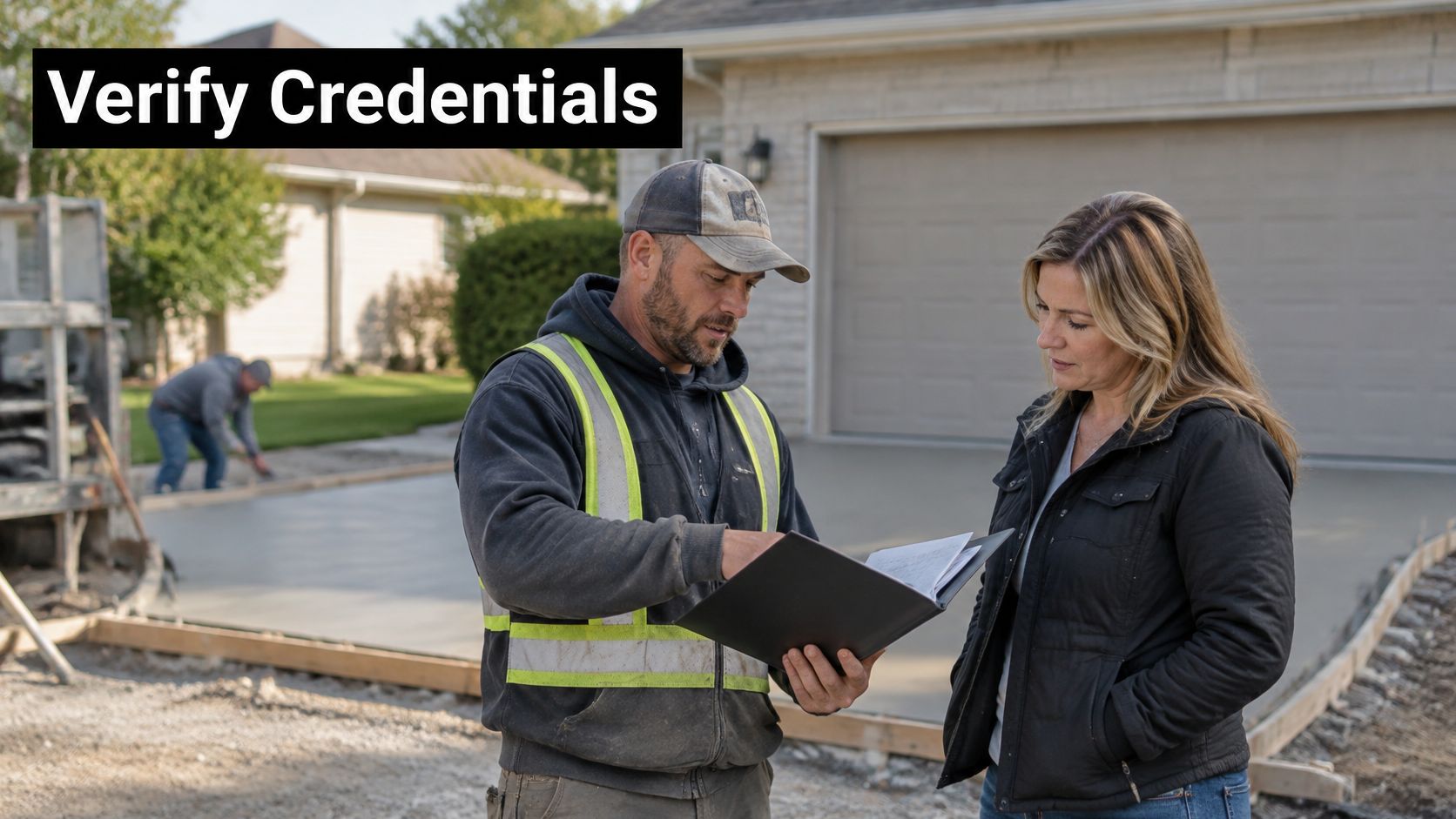
This comes first because it determines whether you're legally protected if something goes wrong. In Georgia, contractors performing work above the state threshold must hold a license through the State Construction Industry Licensing Board. Cities and counties around Atlanta, including Alpharetta, Marietta, Johns Creek, and Duluth, may add registration or permit requirements on top of that.
Ask for the license number and verify it yourself through the Georgia Secretary of State's professional licensing lookup. Then ask for a current certificate of insurance that names you as certificate holder, covering general liability and workers' compensation. The distinction matters, much like understanding bonded or insured cleaning teams before someone works in your home.
What verified paperwork prevents
A Marietta homeowner requested the certificate before work began. When equipment struck a buried irrigation line, the contractor's liability policy covered the repair instead of the homeowner's budget. On a Duluth job, a subcontractor without workers' compensation was injured, and because coverage hadn't been verified, the homeowner's property became part of the claim review.
- Request it from the insurer: Ask for the certificate directly from the insurer, not only a PDF from the contractor.
- Match the classification: Confirm it covers residential concrete, not only general home improvement.
- Check the history: Look for complaints or disciplinary action through the state licensing board before you sign.
2. What Thickness, Concrete Strength, and Reinforcement Will You Use?
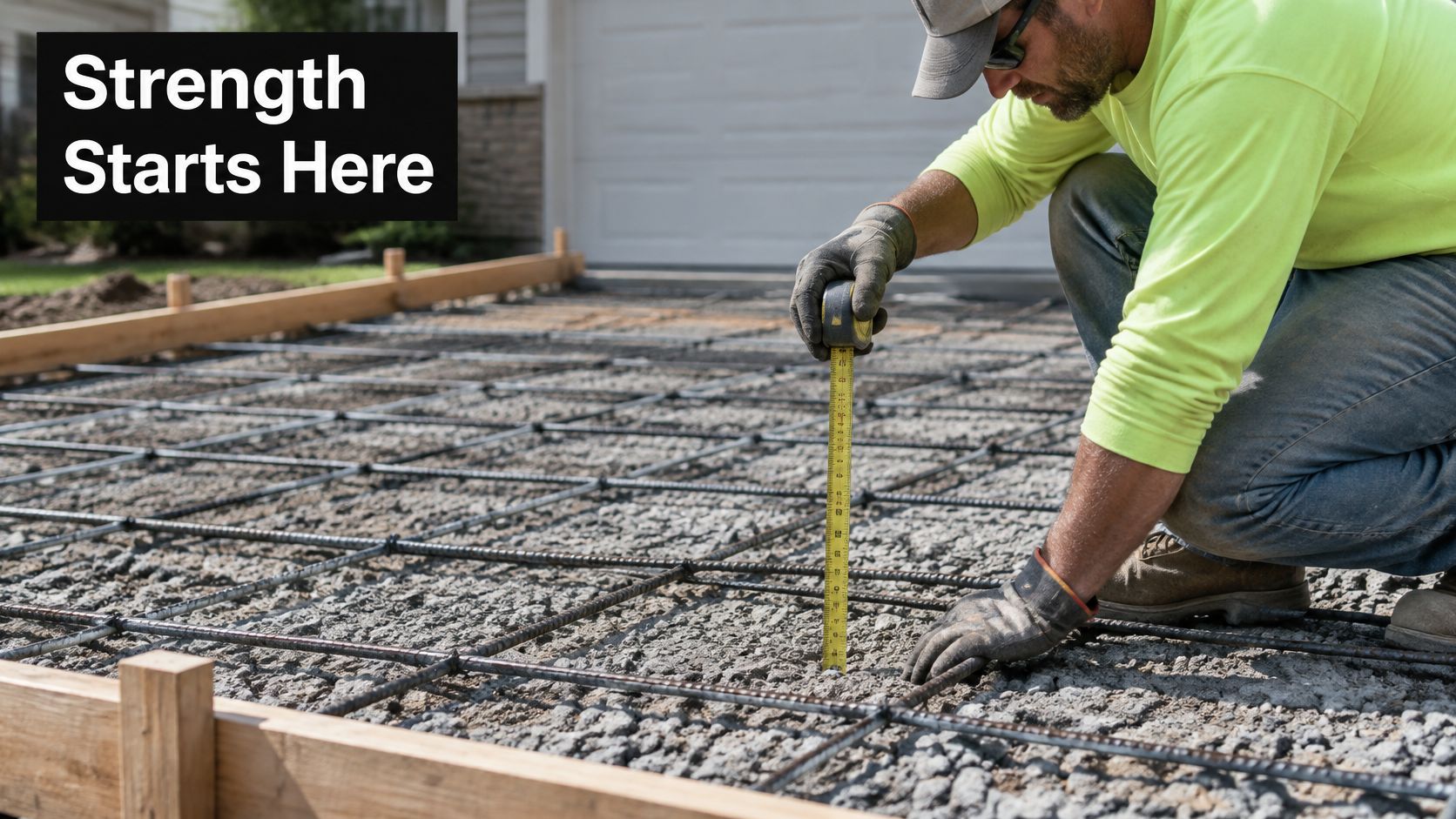
Specs decide how long the slab survives your vehicles. Most Atlanta residential driveways pour at 4 inches, while heavy trucks, RVs, and boats often need 5 to 6 inches. Ask for mix strength, 3,500 to 4,000 psi is a common residential target, whether air entrainment is included, and what reinforcement is planned.
Don't accept "high strength concrete" as a spec. Ask the contractor to state the specified compressive strength, testing method, and acceptance age in writing. American Concrete Institute guidance identifies 28 days as the conventional acceptance age, with cylinders sampled at delivery, standard cured under ASTM C31, and tested under ASTM C39.
Match the spec to the load
A typical 20 by 20 foot two car driveway uses 4 inches with welded wire mesh, which mainly controls shrinkage cracks. Park a 30 foot travel trailer on that same pad and you'll likely want 5 or 6 inches with steel rebar on chairs at mid depth, especially at edges and wheel paths. Residential work commonly follows ACI 332, and a pro should explain how the spec aligns with it. For background on related work, review residential poured concrete services before your consultation.
- Write it down: Put thickness, psi, and reinforcement type in the contract.
- Keep the ticket: Request the concrete delivery ticket to confirm what arrived.
- Ask why: Rebar generally performs better than mesh for vehicle loads, so make them justify either choice.
3. How Will You Prepare the Base and Handle Atlanta Clay Soil and Drainage?
Most failures start under the slab. Atlanta's red clay expands when wet and shrinks when dry, so a slab poured over a poorly compacted subgrade will heave, settle, and crack. Ask how the old driveway comes out, how it's hauled away, whether the subgrade gets compacted, and what base material goes in. A common approach is 4 to 6 inches of compacted crushed stone.
Then ask where the water goes. Federal Highway Administration preservation guidance explains that trapped water weakens unbound layers and subgrade, and traffic can pump fine material out from beneath the slab, causing loss of support, faulting, corner breaks, and cracking. Material choice alone doesn't fix that.
Practical rule: Make the contractor explain, on a sketch, exactly where runoff leaves the driveway, court, or parking area before you discuss finish color.
What a real drainage plan includes
A Duluth driveway poured over old gravel without compaction cracked along its center within two years. The replacement added full excavation, a compacted base, and a trench drain. In Alpharetta, a shallow French drain along the garage edge stopped runoff pooling against the slab. Resilience guidance for Georgia's built environment pushes the same point, assess flooding hazards and turn them into design criteria, using grading and drainage features rather than relying on mix alone.
Watch how base preparation and grading work in practice before your site visit:
- Base in writing: Confirm base depth and compaction method in the contract.
- Slope direction: Water should move toward the street or a drain, not the garage.
- Standing water history: If you've seen ponding, request finished elevations and a drainage plan first.
4. Who Handles Permits, Utility Locates, and HOA or City Approvals?
Paperwork surprises more homeowners than the pour does. Georgia requires utility locates through 811 before digging, called in at least three business days ahead. Some municipalities require a permit for new or expanded driveways, and work in the public right of way, the apron between street and sidewalk, may need separate city or county approval. Many HOAs also regulate materials, colors, widening, and setbacks.
Permit cost isn't one flat number either. Georgia Department of Transportation material lists a $200 permit review fee for a residential driveway serving up to four units, while the City of Atlanta charges $5 per $1,000 of construction cost with a $50 minimum, and Fulton County lists $350 plus $5 per acre of disturbed land. Your estimate should name the jurisdiction, valuation, and disturbed area.
Assign every approval to a name
A Marietta contractor scheduled the 811 locate early and found a shallow gas line missing from the original survey, so the crew adjusted before damage occurred. A Johns Creek homeowner widening a driveway learned the HOA required design review. Approval before the pour avoided a tear out.
- Permit number early: Ask for the permit number and inspection schedule before signing.
- HOA responsibility: Confirm in writing whether you or the contractor submits HOA paperwork.
- Timeline reality: Build permit review into move in dates, events, or commercial opening schedules.
- Your own digging: Call 811 yourself for any excavation outside the contractor's scope.
5. What Is Included in the Apron and How Will the Driveway Connect to the Street and Sidewalk?
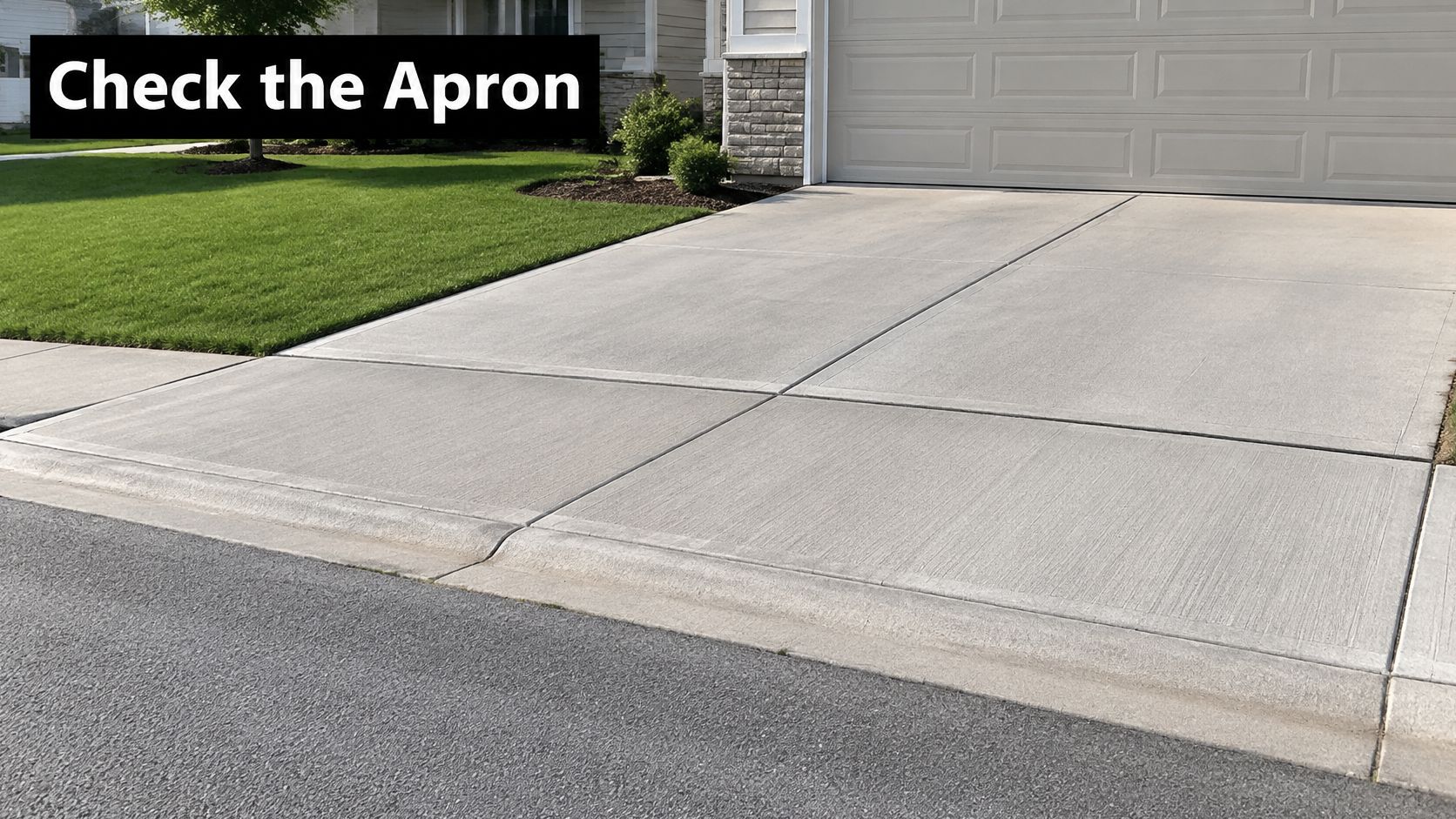
Homeowners often assume the apron is included. It may not be. This connecting section between your private drive and the street takes heavy abuse from turning vehicles, sits partly in public right of way in many cases, and may be priced separately or governed by city standards.
Ask whether the apron is in the base price, what thickness and width it'll be, and how the joint at the street or sidewalk will be finished. A clean transition prevents cracking, pooling, and trip hazards at the exact point every vehicle crosses twice a day. Reviewing residential driveway concrete work gives you a visual reference for how these connections should look.
Scope gaps show up at the street
A Cobb County quote excluded the apron entirely. When the city required replacement of a cracked apron section, it arrived as a change order that earlier scope confirmation would've made predictable. Another contractor poured the apron slightly thicker than the driveway and added an isolation joint at the sidewalk, and that connection stayed intact through years of heavy use.
- Separate line item: Ask if the apron is base price or an added line.
- City standards: Check required apron width, slope, and material before forming.
- Sketch it: Request a drawing showing apron, sidewalk, and driveway together.
- Extension projects: The same questions apply to driveway widening, extensions, and apron replacements.
6. What Joint Layout, Finish, and Sealing Plan Will You Use?
Concrete shrinks as it cures, and without planned weak points it'll crack where it wants. Control joints guide that cracking into straight lines. They're typically cut about one quarter of the slab depth, and a 4 inch driveway often uses joints every 8 to 12 feet with panels kept close to square.
Ask where joints go, when they'll be cut, and what finish you get. Broom finish is standard for slip resistance. Stamped and exposed aggregate finishes add decoration but change maintenance. If you're weighing decorative options, look at residential decorative concrete choices and ask how texture affects cleaning and sealing.
Minor cracks along control joint lines aren't failure. That's the joint doing its job, and it's far better than random cracks across a panel.
Finish choices have long term costs
A Milton homeowner chose broom finish with joints every 8 feet, and hairline cracking appeared only along those lines. A Roswell owner sealed about 30 days after the pour and reapplied every few years, resisting oil stains and keeping the surface fresh. That maintenance rhythm matters, since Federal Highway Administration guidance links long pavement life to design and construction quality, noting older concrete pavements were commonly designed for 20 to 25 years, while long life practices can reach 40 years or more.
- Joint drawing: Get joint locations on paper before the pour.
- Cut timing: Confirm joints will be cut within hours to a day, depending on conditions.
- Sealer specifics: Ask for the product name and whether it's penetrating or film forming.
7. What Is Your Schedule and When Can We Drive on the New Concrete?
Atlanta weather writes the schedule as much as the contractor does. Summer heat sets concrete fast, winter rain and cold snaps delay placement, and both affect finish quality. Ask for a start date, total duration, weather contingency, and a written cure plan with specific dates for foot traffic, parking, and normal use.
Here's where the strength conversation from earlier becomes practical. Ask what mix design, water to cementitious material ratio, target strength, and quality control tests will be documented. Federal Highway Administration concrete pavement guidance identifies slump, air content, and strength testing as core controls, and notes a maximum water to cementitious ratio of 0.45 or less is commonly specified for freeze thaw exposure with deicing chemicals. That documentation supports early opening decisions better than a guess.
Cure timing protects your investment
A Johns Creek homeowner waited seven days before parking. The slab handled foot traffic after a day and returned to full use after a week without surface marks. During a hot July job in Duluth, the crew misted and covered the slab with plastic sheeting to slow moisture loss and prevent surface cracking.
- Cure dates in writing: Mark walk, park, and heavy load dates on your calendar.
- Alternate parking: Plan at least a week away from the new slab.
- Weather protection: Ask how the crew handles rain, heat, and cold during curing.
- Early opening evidence: If they propose opening before full strength, ask what field testing supports it.
8. What Exactly Is in the Written Estimate, Payment Schedule, and Warranty?
A detailed written estimate is your best protection. Verbal promises about thickness, finish, or cleanup get forgotten, so the contract should itemize demolition and haul off, excavation, base material, reinforcement, concrete volume and psi, finish, joints, sealer, cleanup, and permits. Treat it like a project document. United States Census Bureau data puts total construction spending at $2.1544 trillion in 2024, up 6.5% from 2023, which is exactly why vague one line prices don't belong in a market this large.
Change orders deserve their own protocol before demolition starts. Hidden soil problems, utilities, or unexpected slab thickness are common. General Services Administration construction administration data show change order proposals can take months to finalize, including 123 taking 91 to 180 days in the reported data. Ask for unit prices for extra soil removal, base stone, or drainage work, plus written approval before changed work proceeds.

Compare line by line, not by total
Two Atlanta bids for a 400 square foot driveway differed by more than $1,500 until adding base compaction and haul off to the low bid closed the gap. An Alpharetta homeowner paid in stages tied to completed work, deposit, excavation and base, pour, then final cleanup. Sound estimate tips for service businesses point the same way, clarity up front prevents disputes later.
- Warranty limits: Ask what's covered, excluded, and how long you have to file a claim.
- Payment discipline: Don't pay in full before completion and cleanup.
- Repair versus replace: For existing slabs, ask whether isolated repair makes sense, noting Federal Highway Administration expected treatment lives for crack sealing and patching run from 4 to 7 years for crack sealing to 5 to 15 years for full depth patching.
8-Point Concrete Contractor Questions Comparison Guide
| Contractor Question | 🔄 Effort / Requirements | 📊 Expected Outcome | ⭐ Key Advantage | 💡 Ideal Use / Tip |
|---|---|---|---|---|
| 1. Are you licensed, insured, and bonded for this location? | Verify the Georgia license and classification; request current liability and workers' compensation certificates; check local requirements. | Confirms credentials and coverage before work begins. | Reduces legal and financial exposure from injuries or property damage. | Check requirements for your city and county; request insurance documents directly from the insurer. |
| 2. What thickness, concrete strength, and reinforcement will you use? | Specify slab thickness, concrete strength (commonly 3,500–4,000 psi), and mesh or rebar in the contract. | Matches driveway construction to vehicle loads and durability needs. | Makes bids easier to compare and helps prevent structural problems. | Ask about thicker, reinforced concrete for RVs, boats, or heavy vehicles. |
| 3. How will you prepare the base and manage soil and drainage? | Confirm excavation, subgrade compaction, base material and depth, and planned slope or drainage. | Reduces settling, heaving, standing water, and premature cracking. | Addresses common failure causes below the concrete surface. | Especially important on clay soils or where water has pooled before. |
| 4. Who handles permits, utility locates, and HOA or city approvals? | Assign responsibility for Georgia 811, permits, right-of-way approvals, and HOA submissions. | Helps prevent utility damage, compliance issues, and scheduling delays. | Clarifies obligations before excavation and can prevent costly rework. | Get responsibilities and permit details in writing; schedule utility locating at least three business days ahead. |
| 5. What is included in the apron and street or sidewalk connection? | Confirm apron dimensions, thickness, joints, tie-ins, and any right-of-way requirements. | Defines the scope and creates a safer, better-draining transition. | Prevents unexpected costs and unclear project boundaries. | Ask whether apron work is included in the quote or priced separately. |
| 6. What joint layout, finish, and sealing plan will you use? | Agree on joint locations and timing, surface finish, and sealer type and application schedule. | Helps control crack appearance and provides the desired traction and protection. | Aligns appearance, maintenance, and performance expectations. | Request a joint-layout sketch; choose a finish suited to traction and cleaning needs. |
| 7. What is the schedule, and when can we use the concrete? | Confirm project dates, weather contingencies, curing methods, and written access milestones. | Sets expectations for delays and safe return to foot and vehicle traffic. | Helps prevent damage from using the slab too soon. | Arrange alternate parking; light vehicles commonly wait about seven days. |
| 8. What is included in the estimate, payment schedule, and warranty? | Review itemized scope, milestone payments, change-order terms, and written warranty coverage and exclusions. | Makes costs, responsibilities, and claim terms clearer. | Supports fair bid comparisons and reduces payment disputes. | Compare line items, not just totals, and avoid paying the full amount before completion. |
Turn Eight Questions Into a Confident Decision
The strongest contractor answers each question clearly, documents the answer in the estimate, and explains limitations without pressure. Weak answers follow a pattern. You'll hear "we always do it that way" instead of a thickness, a psi rating, a base depth, or a drainage path you can point to on a sketch. That vagueness is information. Believe it.
Compare at least three proposals using the same scope. That means the same demolition, haul off, excavation, base, reinforcement, apron treatment, joints, finish, sealer, permits, and cleanup in every bid. If one proposal is dramatically cheaper, find what's missing before you celebrate. In my experience reviewing failed Atlanta driveways, the missing item is almost always underground, either inadequate compaction over clay or water with nowhere to go.
Verify credentials independently rather than trusting a logo on a truck. Check the license, get the insurance certificate from the insurer, confirm who calls 811, and ask for references from projects that are a few years old so you can see how the work aged. Fresh concrete almost always looks good. Concrete after several Atlanta summers, heavy rain events, and a few freeze thaw cycles tells the truth.
Think beyond replacement day too. Ask about sealing intervals, maintenance, crack monitoring, and when a future crack means cosmetic sealing versus structural concern. A contractor who discusses concrete driveway maintenance, sealing, apron care, and drainage upkeep during the first meeting is planning for service life. One who only discusses price per square foot is planning for the sale.
Also match the contractor to the job type. A crew that's excellent at broom finish driveways may not be the right fit for stamped decorative work, a sport court that must stay flat and drain perfectly, a structural foundation, or commercial paving with testing requirements. Ask for examples of your specific project type and ask who performs the pour, their own crew or a subcontractor you haven't met.
For a local benchmark or project consultation, Atlanta Concrete Solutions provides driveway, slab, foundation, decorative concrete, and masonry services throughout the greater Atlanta area. Use these questions with them or with any bidder. The goal isn't to interrogate anyone. It's to end up with a written, comparable, enforceable scope that gives your concrete a fair chance to last for decades.
Ready to put these questions to work on your driveway replacement, slab, foundation, or decorative concrete project in the Atlanta area? Request a detailed, itemized consultation from Atlanta Concrete Solutions and bring this checklist to the site visit so every spec, permit, and warranty term lands in writing.